

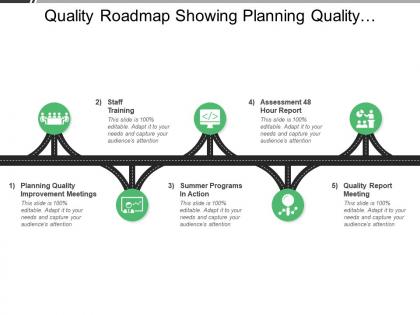
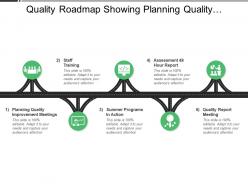
Quality roadmap showing planning quality improvement assessment




Try Before you Buy Download Free Sample Product
 Impress Your
 Audience
 100%
100% Editable
 Save Hours
 of Time


Jam efforts to intrude with our Quality Roadmap Showing Planning Quality Improvement Assessment. Eliminate any cause for distraction.
People who downloaded this PowerPoint presentation also viewed the following :
Quality roadmap showing planning quality improvement assessment with all 5 slides:
Draw folks into combining forces with our Quality Roadmap Showing Planning Quality Improvement Assessment. It will invite joint effort.



FAQs for Quality roadmap showing planning
A Quality Improvement Roadmap should include current state assessment, measurable quality objectives, stakeholder engagement strategies, process optimization initiatives, and performance monitoring systems. These elements work together by establishing clear baselines, defining improvement targets, and creating accountability frameworks, with many organizations finding that systematic roadmaps deliver enhanced operational efficiency and sustained competitive advantage.
Organizations effectively identify quality improvement areas through comprehensive data analysis, customer feedback collection, process mapping, employee insights, and performance benchmarking against industry standards. Through systematic audits and metric tracking, companies in manufacturing, healthcare, and financial services streamline operations, reduce defects, and enhance customer satisfaction, while employee feedback often reveals operational inefficiencies that management might overlook.
Effective Quality Improvement Roadmap frameworks include Lean Six Sigma, DMAIC (Define-Measure-Analyze-Improve-Control), Plan-Do-Study-Act cycles, and ISO 9001 standards. These methodologies streamline operations by standardizing processes, reducing waste, and enhancing customer satisfaction, with many manufacturing and healthcare organizations finding that structured approaches ultimately deliver measurable cost reductions and competitive advantage.
Measuring quality improvement success involves tracking key performance indicators like defect rates, customer satisfaction scores, process cycle times, cost reductions, and compliance metrics over defined periods. Organizations typically establish baseline measurements, set quarterly milestones, and conduct comprehensive annual reviews, with many finding that combining quantitative data with stakeholder feedback delivers the most accurate assessment of strategic progress.
Stakeholder engagement ensures quality improvement roadmaps address real operational challenges, align with strategic priorities, and secure necessary resources for implementation. Through collaborative input from leadership, frontline staff, customers, and partners, organizations develop comprehensive strategies that enhance buy-in, streamline execution processes, and ultimately deliver sustainable improvements with measurable business outcomes.
Data informs Quality Improvement Roadmaps by identifying performance gaps, tracking improvement metrics, and predicting future quality challenges through analytics and trend analysis. Through integrated data systems, organizations streamline decision-making, enhance resource allocation, and accelerate improvement cycles, with many healthcare institutions and manufacturers finding that data-driven roadmaps deliver measurable quality gains and competitive advantage.
Common challenges include resource constraints, resistance to change, inadequate stakeholder buy-in, unclear metrics, and insufficient training programs. Organizations often struggle with balancing short-term operational demands against long-term quality goals, while maintaining consistent communication across departments, ultimately requiring strategic leadership commitment and phased implementation approaches to ensure sustainable transformation.
Quality Improvement Roadmap alignment requires integrating strategic objectives through stakeholder consultation, performance metric mapping, regular review cycles, and cross-departmental coordination. Organizations achieve this by establishing clear KPIs that connect quality initiatives to business outcomes, conducting quarterly alignment assessments, and ensuring improvement projects directly support revenue growth, cost reduction, and customer satisfaction targets.
Tools supporting Quality Improvement Roadmap development include process mapping software, statistical analysis platforms, project management systems, quality management databases, and stakeholder feedback mechanisms. These resources streamline roadmap creation by identifying improvement opportunities, tracking performance metrics, and facilitating cross-functional collaboration, with many organizations finding that integrated digital platforms ultimately deliver faster implementation timelines and measurable quality outcomes.
A Quality Improvement Roadmap should be reviewed quarterly and updated annually, with additional reviews triggered by significant operational changes, regulatory updates, or strategic shifts. This systematic approach enables organizations to adapt to evolving quality standards, incorporate lessons learned from implementation phases, and maintain alignment with business objectives, ultimately delivering sustained operational excellence and competitive advantage.
Best practices for communicating a Quality Improvement Roadmap include clear milestone visualization, regular progress updates, role-specific training sessions, feedback collection mechanisms, and leadership endorsement. These approaches enhance employee engagement by creating transparency, fostering ownership, and demonstrating tangible benefits, with many organizations finding that consistent communication and celebrating quick wins ultimately drives successful adoption and sustainable quality improvements.
Leadership fosters continuous quality improvement by establishing clear quality standards, empowering employees to identify improvement opportunities, and implementing regular feedback systems. Through transparent communication and resource allocation, organizations across manufacturing, healthcare, and financial services enhance operational efficiency, reduce errors, and maintain competitive advantage, with many finding that employee engagement significantly increases when quality becomes everyone's responsibility.
**INPUT**: What strategies can be employed to train staff on the Quality Improvement Roadmap? **OUTPUT**: Effective training strategies include interactive workshops, role-based simulations, mentorship programs, digital learning modules, and cross-departmental collaboration sessions. These approaches enhance understanding by combining theoretical knowledge with practical application, real-world scenarios, and peer learning, with many organizations finding that blended training methods ultimately deliver higher engagement, faster adoption, and sustained quality improvements across teams. [Word count: 58 words]
Technology significantly enhances Quality Improvement Roadmaps by automating data collection, enabling real-time performance monitoring, and facilitating predictive analytics for proactive issue identification. Through advanced systems like IoT sensors and AI-driven platforms, organizations streamline quality processes, reduce manual errors, and accelerate improvement cycles, ultimately delivering faster response times and measurable operational efficiency gains.
Patient feedback serves as a critical foundation for quality improvement initiatives by identifying care gaps, highlighting patient priorities, and revealing real-world experiences that clinical metrics might miss. Healthcare organizations increasingly integrate patient surveys, focus groups, and digital feedback platforms into their improvement strategies, with many hospitals finding that patient insights drive more targeted interventions, enhance care protocols, and ultimately deliver better health outcomes while improving patient satisfaction scores.
-
Very unique, user-friendly presentation interface.
-
Designs have enough space to add content.