

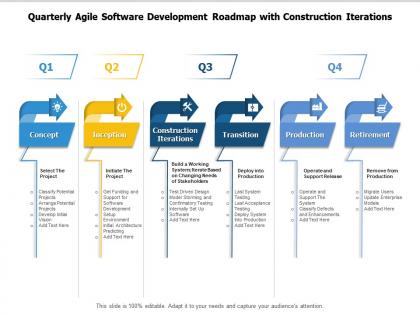
Quarterly agile software development roadmap with construction iterations




Try Before you Buy Download Free Sample Product
 Impress Your
 Audience
 100%
100% Editable
 Save Hours
 of Time


Utilize our pre build Quarterly Agile Software Development Roadmap With Construction Iterations to present your plan of action in the most effective way. Reduce the paperwork and showcase how different activities are linked to each other by incorporating this attention grabbing PowerPoint theme. This completely editable roadmap PPT layout is suitable to fit all your needs and to have a structured outline of the entire process flow using color coding. Provide guidelines to your teammates about the progression process by employing our PPT theme. Team members can easily be designated into teams by accessing the work milestones to be accomplished within the timeframe. You can easily modify the PowerPoint slide according to real time situations. Download our stunning Quarterly Agile Software Development Roadmap With Construction Iterations, and you are good to go to prove your expertise in strategic planning.
People who downloaded this PowerPoint presentation also viewed the following :
Quarterly agile software development roadmap with construction iterations with all 2 slides:
Use our Quarterly Agile Software Development Roadmap With Construction Iterations to effectively help you save your valuable time. They are readymade to fit into any presentation structure.
FAQs for Quarterly agile software development roadmap
You'll want to nail down your vision and main goals first. Break things into themes or big initiatives, then add rough timeframes - but don't get crazy detailed since that's what backlogs are for. Dependencies between major projects are super important to map out. I always include success metrics too, otherwise how do you know if you're winning? Honestly, the biggest thing is giving people visibility into what's happening next while keeping room to change course. Nobody wants to be locked into something that doesn't make sense anymore. I'd update it quarterly or whenever priorities get shuffled around. Oh, and definitely call out any assumptions that could totally derail your timeline.
So the main thing? Flexibility. Traditional roadmaps are basically set-in-stone project plans - you decide what you're building and when, then stick to it no matter what. Pretty rigid if you ask me. Agile roadmaps work totally differently. They focus on bigger themes and outcomes instead of super specific features. You're constantly updating based on user feedback and what you actually learn along the way. It's more like having a compass than following a strict GPS route, you know? Treat it as something that grows with your product rather than a contract you can't break.
Your team size totally changes how detailed your roadmap should be. Small teams? Keep it super simple - maybe just plan 2-3 sprints ahead with basic swim lanes. Bigger teams need way more structure, like having feature teams own different sections and planning further out. If you've got cross-functional teams, organize by customer journey or product areas. Component teams work better around technical layers. But honestly - and this might sound obvious - the format doesn't matter if people can't actually use the thing. Just map out who owns what first, then dial the detail up or down so it's helpful without being a total headache.
For dedicated stuff, check out ProductPlan, Roadmunk, or Aha! - they're made for this. But honestly? Some killer roadmaps I've seen were just thrown together in Miro or even PowerPoint (I know, I know). Jira's got a decent roadmap thing if you're already using it, keeps everything linked up. The real trick is finding something your team won't ignore after week one. Don't get stuck choosing forever - just grab whatever makes priorities and timelines super obvious. Oh, and dependencies too, those always bite you later.
Honestly, it's all about staying in regular contact with your stakeholders - quarterly reviews work great for the big picture stuff. I'd set up sprint demos too since people get way more excited seeing actual progress than just hearing about plans. Between meetings, give them easy ways to reach out like surveys or office hours when ideas hit them. The trick that actually matters? Show them how their feedback changed things. People get frustrated when they feel like they're talking into a void. Oh, and don't just collect input - be upfront about what you can and can't act on. Start with scheduling your next review session and build from there.
Skip the vanity metrics and go straight for what actually moves the needle. Customer satisfaction scores, feature adoption rates, business value - that's your bread and butter. Time-to-market improvements always blow people's minds when you present them. Team velocity matters too, plus how often you're course-correcting based on feedback (which you should be doing constantly in agile). Honestly, don't fall into the trap of measuring everything - pick 3-4 things that genuinely matter to your business. I'd start with defining what success looks like first, then figure out how to measure it. Way easier than drowning in data you'll never use.
Your roadmap is basically just your priorities in order - what gets built first, second, etc. I'm always using frameworks like MoSCoW or those value vs effort grids to figure it out. High-priority stuff goes in early sprints. Nice-to-haves get pushed way out (sometimes forever, let's be real). The tricky part? Everything changes constantly. Stakeholders will flip priorities on you, so you've got to revisit the roadmap pretty regularly. Otherwise you'll be building features nobody actually wants anymore. Keep it flexible - that's honestly the most important thing.
Honestly, your roadmap should evolve constantly - that's what makes Agile actually work. Pull feedback from stakeholders and retros, then adjust priorities based on what you're learning. I always tell teams to treat it like a living doc, not some set-in-stone plan (learned that the hard way). Build regular review checkpoints into your sprints so pivoting feels natural. Market shifts happen, requirements change - your roadmap needs to roll with it. The teams that resist updates usually end up building stuff nobody wants anymore.
So basically, roadmaps let everyone see how their piece fits into the whole project. Teams can actually spot dependencies and figure out when they need to coordinate - or when someone's blocking them. Honestly saves you from those awkward "oh wait, we needed that done already?" conversations. Plus it becomes the go-to place for checking timing across teams instead of hunting down random Slack threads. One thing though - don't make it super detailed or it'll be outdated immediately. Keep it simple and actually update the damn thing regularly with input from everyone, not just the PMs.
Don't treat your roadmap like gospel - things change constantly in agile. Skip the crazy details for stuff months away, it's pointless. Stakeholders love turning roadmaps into rigid project plans with deadlines, but push back on that. Your dev team needs to be involved from the start or you'll end up with totally unrealistic timelines. Oh, and every meeting someone will pitch their "brilliant" new feature idea. Just say no most of the time. Focus on what actually matters for your goals, not building a feature factory. Review it monthly or you'll drift off course fast.
Quarterly reviews are the bare minimum, but monthly works way better. After big sprints too. Look, if you're waiting 6 months between updates, you're just doing waterfall pretending to be agile - which is honestly worse than admitting you're doing waterfall. Things change fast. User feedback shifts priorities. New stuff comes up that breaks your assumptions. Get your product owner and key people in a room for like 30 minutes regularly. Short check-ins beat letting everything drift for months then scrambling to fix it.
Honestly, just rip the bandaid off early and often. Don't wait around hoping things will magically fix themselves - I've watched that blow up in people's faces way too many times. Hit them with the news right when priorities shift, but always explain why it's happening. Connect it back to what customers actually need or whatever the business is trying to accomplish. Multiple touchpoints work best - standups, those dedicated roadmap meetings, maybe a dashboard they can't ignore. Oh, and here's something people forget: tell them what's NOT changing too. Makes the whole thing feel less chaotic. Create some kind of template so these updates don't feel random every time.
Your Agile roadmap is basically the thing that connects your company's big goals to what your dev teams actually build day-to-day. It breaks down those huge organizational objectives into features people can work on. Without it, you'll have endless meetings where everyone's like "wait, why are we doing this again?" - trust me on that one. Plus it shows stakeholders how your product work ties to business results, which makes getting budget way easier. I always think of it as keeping everyone pointed in the same direction without being too rigid about the path. Just don't forget to update it every quarter or so when things inevitably change.
Honestly, swimlanes are your best friend here - organize by team or theme and color-code everything by priority. Skip exact dates, just use quarters since those always shift anyway. Show the "what" and "why" with clear outcome metrics and dependencies. One thing that's been a game-changer for me? Adding confidence levels (high/medium/low) to each item. Stakeholders eat that up because it sets realistic expectations. Interactive filtering is clutch too - people love drilling down to their stuff. Oh, and when you present updates, always lead with the biggest changes or blockers first.
Honestly, agile roadmaps are game-changers for transparency. Everyone can actually see what's prioritized and when stuff might ship - no more wild guessing. Dependencies become obvious, you'll spot trade-offs happening, and progress updates are real-time. The best part? They're actually updated regularly (unlike those ancient project plans gathering dust). Marketing finally gets engineering's constraints. Sales understands realistic timelines. People stop working in their own bubbles. Just start sharing yours in weekly standups - I swear the cross-team conversations improve almost immediately. It's weird how much drama disappears when everyone's looking at the same picture.
No Reviews