

Quarterly enterprise cyber security roadmap through identification




Try Before you Buy Download Free Sample Product
 Impress Your
 Audience
 100%
100% Editable
 Save Hours
 of Time


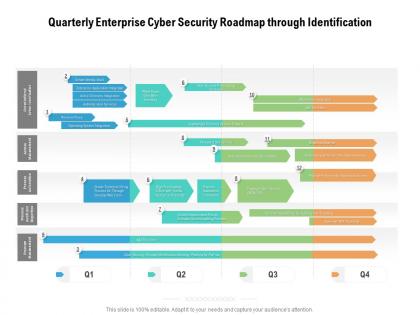
A well thought out action plan makes execution easier and increases the possibility of success significantly. Ensure hitting all the milestones within the deadlines by introducing our fully customizable Quarterly Enterprise Cyber Security Roadmap Through Identification. Streamline the work related information, budget, timeframe, key deliverable, landmarks, and major steps involved, all in one place to give an organized overview of the project by utilizing our PowerPoint theme. Minimize time lag and increase work efficiency by providing insight into the process with our comprehensively researched roadmap PowerPoint layout. Color coding helps in highlighting the process and grabs the attention of the audience. Download our handy Quarterly Enterprise Cyber Security Roadmap Through Identification to identify the possible problem areas in a much shorter time and propose solutions. Have a productive brainstorming session with your workforce by utilizing our action plan visualization tool.
People who downloaded this PowerPoint presentation also viewed the following :
Quarterly enterprise cyber security roadmap through identification with all 2 slides:
Use our Quarterly Enterprise Cyber Security Roadmap Through Identification to effectively help you save your valuable time. They are readymade to fit into any presentation structure.

FAQs for Quarterly enterprise cyber security
Effective quarterly cybersecurity roadmaps include threat assessment and vulnerability analysis, security infrastructure updates, employee training programs, incident response planning, and compliance auditing. These components work together by identifying emerging risks, strengthening defensive capabilities, and ensuring organizational readiness, with many enterprises finding that this structured approach delivers enhanced security posture and regulatory compliance.
Organizations align cybersecurity roadmaps with business objectives by conducting comprehensive risk assessments, mapping security initiatives to strategic goals, establishing measurable KPIs, and integrating security planning into quarterly business reviews. This strategic combination enables companies to prioritize investments that protect revenue-generating assets, ensure regulatory compliance, and maintain customer trust, with many financial institutions and healthcare organizations finding that aligned roadmaps deliver both enhanced protection and operational efficiency.
**INPUT**: What metrics should be used to measure the success of a quarterly cybersecurity strategy? **OUTPUT**: Quarterly cybersecurity success metrics include incident response times, threat detection rates, vulnerability remediation speed, compliance audit scores, and security awareness training completion. These measurements enable organizations to track operational efficiency, risk reduction, and strategic improvements across their security infrastructure, with many enterprises finding that comprehensive metric tracking ultimately delivers enhanced threat resilience and regulatory compliance. *[Word count: 57 words]*
Organizations should conduct comprehensive risk assessments quarterly to align with roadmap cycles, supplemented by monthly mini-assessments and immediate evaluations after significant incidents or infrastructure changes. This strategic combination enables businesses to maintain current threat visibility, adjust security priorities dynamically, and ensure resource allocation matches evolving risks, with many enterprises finding that regular assessment cycles ultimately deliver stronger security postures and faster incident response capabilities.
Emerging cybersecurity threats for quarterly roadmaps include AI-powered attacks, supply chain vulnerabilities, ransomware-as-a-service, cloud misconfigurations, and IoT device exploits. These evolving threats require strategic responses through enhanced monitoring, zero-trust implementations, and employee training, with many organizations finding that proactive threat intelligence and adaptive security frameworks ultimately deliver stronger resilience and competitive advantage.
Compliance requirements significantly influence quarterly cybersecurity roadmaps by mandating specific security controls, audit schedules, and reporting timelines that must be integrated into planning cycles. These regulations, including GDPR, HIPAA, and SOX, drive organizations to prioritize vulnerability assessments, employee training, and system updates quarterly, ultimately ensuring regulatory adherence while strengthening overall security posture.
Employee training and awareness serve as foundational pillars in quarterly cybersecurity roadmaps, addressing human vulnerabilities through regular phishing simulations, security protocols education, and incident response preparation. These initiatives significantly reduce breach risks by 70%, with many organizations finding that consistent quarterly training cycles enhance overall security posture, minimize costly human errors, and ultimately deliver stronger organizational resilience.
Organizations integrate threat intelligence into quarterly cybersecurity planning by incorporating real-time threat data into risk assessments, aligning security investments with emerging attack vectors, and updating incident response protocols based on current threat landscapes. This strategic approach enables financial institutions, healthcare systems, and retail organizations to proactively address sector-specific vulnerabilities, ultimately delivering enhanced protection and optimized resource allocation.
Essential tools include SIEM platforms, vulnerability scanners, endpoint detection systems, identity management solutions, and threat intelligence feeds. These technologies streamline quarterly assessments by automating threat monitoring, identifying security gaps, and tracking compliance metrics, with many organizations finding that integrated security platforms deliver faster incident response and enhanced operational visibility.
Incident response plans should be updated quarterly by incorporating emerging threat intelligence, refining communication protocols, integrating new security tools, and updating contact information and escalation procedures. These updates align with roadmap priorities by addressing identified vulnerabilities, enhancing detection capabilities, and streamlining response times, with many organizations finding that regular plan revisions significantly improve their ability to contain breaches and minimize operational disruption.
Cybersecurity budgeting strategies include risk-based prioritization, phased implementation planning, cross-departmental cost sharing, vendor consolidation, and performance-based allocation models. These approaches streamline resource distribution by aligning investments with threat landscapes, leveraging economies of scale, and measuring ROI through incident reduction metrics, with many organizations finding that strategic budget allocation delivers enhanced security posture while optimizing operational costs.
Organizations effectively communicate quarterly cybersecurity plans through executive dashboards with risk metrics, regular board presentations highlighting strategic priorities, and department-specific briefings tailored to operational needs. These communication strategies enhance transparency and accountability by translating technical security measures into business outcomes, with many financial institutions and healthcare organizations finding that structured quarterly reviews ultimately strengthen stakeholder confidence and ensure aligned cybersecurity investments.
Revisiting and updating cybersecurity roadmaps based on previous quarter outcomes enables organizations to adapt to evolving threats, address identified vulnerabilities, and optimize resource allocation based on actual performance data. This iterative approach helps companies refine their security strategies, improve incident response capabilities, and maintain competitive advantage in an increasingly complex threat landscape, with many enterprises finding that quarterly assessments significantly enhance their overall security posture.
Third-party vendors can be assessed through comprehensive security questionnaires, penetration testing requirements, compliance certifications, and continuous monitoring protocols that evaluate their cybersecurity posture quarterly. Organizations increasingly integrate vendor risk assessments into their roadmaps by establishing security baselines, requiring regular audits, and implementing tiered access controls, with many companies finding that strategic vendor partnerships enhanced through rigorous security standards ultimately deliver stronger overall cybersecurity resilience.
Best practices for prioritizing cybersecurity initiatives include risk-based assessment, compliance alignment, business impact analysis, threat landscape evaluation, and resource availability consideration. Organizations typically prioritize critical infrastructure protection first, followed by data governance enhancements and user training programs, with many finding that this systematic approach delivers improved security posture while optimizing budget allocation.
-
Great quality product.
-
Content of slide is easy to understand and edit.
-
Excellent work done on template design and graphics.
-
Visually stunning presentation, love the content.