

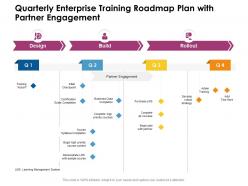
Quarterly enterprise training roadmap plan with partner engagement





Try Before you Buy Download Free Sample Product
 Impress Your
 Audience
 100%
100% Editable
 Save Hours
 of Time


Utilize our pre build Quarterly Enterprise Training Roadmap Plan With Partner Engagement to present your plan of action in the most effective way. Reduce the paperwork and showcase how different activities are linked to each other by incorporating this attention grabbing PowerPoint theme. This completely editable roadmap PPT layout is suitable to fit all your needs and to have a structured outline of the entire process flow using color coding. Provide guidelines to your teammates about the progression process by employing our PPT theme. Team members can easily be designated into teams by accessing the work milestones to be accomplished within the timeframe. You can easily modify the PowerPoint slide according to real time situations. Download our stunning Quarterly Enterprise Training Roadmap Plan With Partner Engagement, and you are good to go to prove your expertise in strategic planning.
People who downloaded this PowerPoint presentation also viewed the following :
Quarterly enterprise training roadmap plan with partner engagement with all 2 slides:
Give your audience a fulfilling experience. They will find our Quarterly Enterprise Training Roadmap Plan With Partner Engagement elevating.
FAQs for Quarterly enterprise training roadmap plan
Key objectives in a quarterly training roadmap include skill development aligned with business goals, compliance training updates, leadership development programs, technical competency building, and performance improvement initiatives. These objectives should address immediate operational needs while building long-term capabilities, with many organizations finding that strategic alignment between training outcomes and business priorities ultimately delivers enhanced productivity, employee engagement, and competitive advantage.
Organizations assess training needs effectively through skills gap analyses, performance reviews, employee surveys, departmental consultation, and industry benchmarking. These methods enable companies to identify specific competency deficiencies across teams, align learning objectives with business goals, and prioritize resource allocation, with many finding that systematic needs assessment ultimately delivers more targeted training programs and measurable performance improvements.
Designing flexible training schedules involves offering multiple session times, implementing self-paced online modules, creating hybrid learning paths, utilizing microlearning formats, and establishing make-up session protocols. These approaches enable organizations to accommodate shift workers, remote teams, and busy professionals while maintaining consistent skill development, with many companies finding that flexible scheduling increases completion rates by 40% and enhances employee engagement across departments.
Technology enhances quarterly training roadmaps by streamlining content delivery, tracking progress analytics, and personalizing learning paths based on individual performance data. Through AI-powered platforms and mobile learning systems, organizations can automate scheduling, deliver interactive modules, and provide real-time feedback, with many companies finding significantly improved completion rates and skills retention.
Performance metrics serve as critical evaluation tools for training initiatives, measuring knowledge retention, skill application, behavioral changes, employee engagement, and business impact outcomes. These metrics enable organizations to assess training effectiveness through pre-and-post assessments, productivity improvements, and performance indicators, with many companies finding that comprehensive measurement frameworks ultimately deliver better resource allocation and enhanced competitive advantage.
**INPUT**: What strategies can be employed to ensure employee engagement during training sessions? **OUTPUT**: Employee engagement strategies include interactive workshops, gamified learning modules, peer-to-peer mentoring, real-world case studies, and personalized development paths tailored to individual career goals. These approaches streamline knowledge retention by encouraging active participation, fostering collaborative problem-solving, and connecting training content to daily responsibilities, with many organizations finding that engaged employees demonstrate significantly higher skill application and overall performance improvements. **Word count: 60 words**
Feedback from previous training sessions informs future roadmaps by identifying skill gaps, assessing content effectiveness, and revealing employee engagement patterns through surveys, performance metrics, and completion rates. This data enables organizations to refine curriculum design, adjust delivery methods, and prioritize high-impact topics, ultimately delivering more targeted learning experiences and improved training ROI.
The most effective methods for delivering remote training include interactive webinars, microlearning modules, virtual simulations, collaborative online workshops, and gamified learning platforms. These approaches enhance engagement by combining real-time interaction, bite-sized content delivery, and hands-on practice, with many organizations finding that blended remote training reduces costs while improving knowledge retention and employee flexibility.
Organizations can address diverse learning styles by incorporating visual presentations, hands-on workshops, interactive discussions, digital modules, and peer-to-peer learning opportunities. Through strategic combination of these approaches, companies streamline knowledge retention, enhance employee engagement, and accelerate skill development, with many finding that multi-modal training programs ultimately deliver higher completion rates and improved performance outcomes.
Incorporating soft skills into quarterly training roadmaps enhances communication, leadership, teamwork, and emotional intelligence capabilities that directly impact productivity and workplace culture. These competencies complement technical training by improving employee collaboration, customer interactions, and adaptability to change, with many organizations finding that balanced skill development ultimately delivers higher employee engagement, reduced turnover, and stronger competitive advantage.
Collaboration among teams during training activities can be fostered through cross-functional workshops, shared project simulations, mentorship exchanges, and collaborative problem-solving sessions. These approaches streamline knowledge transfer while building interpersonal connections, with many organizations finding that mixed-team exercises ultimately enhance communication, break down silos, and deliver stronger operational efficiency across departments.
Essential tools include learning management systems (LMS), progress tracking dashboards, competency assessment platforms, feedback collection tools, and performance analytics software. These technologies streamline monitoring by automating data collection, providing real-time visibility into completion rates, and generating comprehensive reports, with many organizations finding that integrated tracking systems ultimately deliver enhanced accountability and measurable skill development outcomes.
Organizations should align training goals with business objectives by conducting thorough skills gap analyses, mapping training outcomes to specific performance metrics, establishing clear ROI measurements, and creating cross-functional collaboration between HR and business leaders. This strategic alignment enables companies to prioritize high-impact learning initiatives, optimize resource allocation, and ensure training investments directly support revenue growth, operational efficiency, and competitive advantage, with many finding that quarterly reviews maintain momentum.
Budget considerations for quarterly training include program development costs, trainer fees, employee time allocation, technology platform expenses, and materials procurement. Organizations increasingly find that strategic investment in comprehensive training delivers enhanced productivity, improved retention rates, and competitive advantage, with many companies discovering that upfront training expenditures ultimately reduce operational costs while accelerating skill development across teams.
Organizations measure training ROI by tracking performance metrics, productivity improvements, employee retention rates, skill assessments, and revenue growth before and after programs. Through comprehensive analytics, companies can quantify cost savings, enhanced efficiency, and competitive advantages, with many finding that strategic training investments deliver measurable business outcomes and long-term organizational growth.
No Reviews