

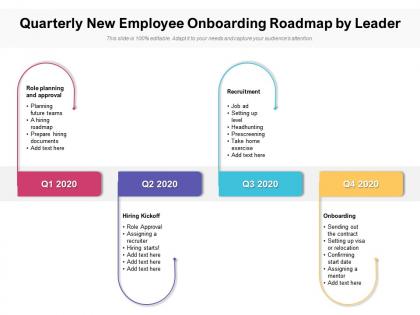
Quarterly new employee onboarding roadmap by leader




Try Before you Buy Download Free Sample Product
 Impress Your
Audience
 100%
Editable
 Save Hours
of Time


Utilize our pre build Quarterly New Employee Onboarding Roadmap By Leader to present your plan of action in the most effective way. Reduce the paperwork and showcase how different activities are linked to each other by incorporating this attention grabbing PowerPoint theme. This completely editable roadmap PPT layout is suitable to fit all your needs and to have a structured outline of the entire process flow using color coding. Provide guidelines to your teammates about the progression process by employing our PPT theme. Team members can easily be designated into teams by accessing the work milestones to be accomplished within the timeframe. You can easily modify the PowerPoint slide according to real time situations. Download our stunning Quarterly New Employee Onboarding Roadmap By Leader, and you are good to go to prove your expertise in strategic planning.
People who downloaded this PowerPoint presentation also viewed the following :
Quarterly new employee onboarding roadmap by leader with all 2 slides:
Use our Quarterly New Employee Onboarding Roadmap By Leader to effectively help you save your valuable time. They are readymade to fit into any presentation structure.


FAQs for Quarterly new employee onboarding
A quarterly onboarding roadmap outlines key objectives such as aligning new hires with company culture, ensuring they understand their roles and responsibilities, and facilitating skill development. These objectives streamline the onboarding process, minimize ramp-up time, and ultimately boost employee retention and productivity, with many organizations finding that a structured roadmap leads to faster time-to-contribution and increased engagement.
Organizations can tailor onboarding processes by segmenting roles into categories based on responsibilities and required training. This allows for customized content, timelines, and mentorship programs, with sales teams receiving product knowledge training while engineers focus on technical infrastructure, ultimately ensuring each new hire feels supported and quickly contributes to their specific department's goals.
A comprehensive onboarding program should track metrics like time-to-productivity, employee satisfaction surveys, knowledge retention scores, and goal achievement rates. These metrics, when analyzed, provide insights into how effectively new hires are integrating into the company culture, acquiring necessary skills, and contributing to overall objectives, ultimately leading to increased retention and improved performance.
Cultural elements significantly influence the onboarding experience by shaping expectations, communication styles, and team dynamics. For instance, in collaborative cultures, onboarding might involve team-building activities and peer mentoring, while in more hierarchical cultures, it might emphasize structured training and clear reporting lines. Ultimately, understanding and aligning with an organization's culture enhances employee engagement and accelerates their integration into the team, leading to improved retention and productivity.
A quarterly onboarding roadmap can be enhanced by tools and technologies that streamline communication, track progress, and personalize the experience. These include learning management systems (LMS) for delivering engaging content, project management software for task allocation and collaboration, and CRM platforms for personalized communication and data analysis. By leveraging these technologies, organizations can create a more efficient, engaging, and data-driven onboarding process, ultimately leading to improved employee retention and productivity.
Organizations can ensure compliance and policy training is integrated into onboarding by implementing a structured quarterly roadmap. This roadmap outlines key training modules delivered at specific intervals, such as initial onboarding, 30 days, 90 days, and quarterly thereafter. These modules can cover topics like data security, harassment prevention, and ethical conduct, ensuring employees stay up-to-date on policies and regulations, ultimately minimizing risk and fostering a culture of compliance.
Mentorship plays a crucial role in a successful onboarding strategy by fostering knowledge transfer, building relationships, and accelerating employee integration. It provides new hires with personalized guidance, helping them navigate company culture, processes, and expectations, while also offering a sounding board for questions and challenges. With many organizations finding that mentorship significantly improves retention and productivity, it becomes a strategic investment in employee success and long-term organizational growth.
Integrating feedback mechanisms within a quarterly onboarding roadmap enhances the effectiveness of the process by providing continuous improvement opportunities. For example, at the end of each month, new hires can provide feedback on specific modules or training sessions, while managers can offer insights into performance and areas for development. These insights can then be used to refine future onboarding content and delivery, ultimately leading to a more engaged and productive workforce.
A quarterly onboarding roadmap for remote employees encompasses pre-boarding communication, a structured week one, ongoing check-ins, and skill-based training modules. These best practices enable a seamless transition by fostering early connection, providing clear expectations, and promoting continuous learning, ultimately leading to higher engagement and faster productivity.
A quarterly onboarding roadmap provides a flexible framework by outlining key milestones and touchpoints, allowing for adjustments as business strategy or workforce dynamics shift. This structured approach enables organizations to seamlessly integrate new initiatives, accommodate changes in team structure, or address evolving employee needs, ultimately ensuring a consistent and relevant onboarding experience for all new hires.
An effective onboarding presentation template requires resources like engaging visuals, clear communication guidelines, company culture insights, and role-specific information. These resources, when combined, enable a streamlined onboarding experience, ultimately enhancing new hires' understanding of the company's mission, values, and expectations, leading to faster integration and increased productivity.
Employee engagement during onboarding directly correlates with higher retention rates. A well-structured onboarding program, encompassing clear goals, meaningful interactions, and opportunities for growth, demonstrates a commitment to employee success, increasing satisfaction and loyalty. For instance, financial services companies with robust onboarding initiatives report a 20% decrease in employee turnover within the first year, while retail organizations see a 15% increase in employee tenure. This investment in early engagement ultimately delivers a more stable and productive workforce.
Innovative onboarding approaches can include gamification, personalized learning paths, interactive simulations, and virtual reality experiences. These methods enhance engagement by making learning fun, relevant, and memorable, ultimately boosting new hire retention and productivity, especially in competitive industries like tech and finance.
A quarterly onboarding roadmap review is ideal, allowing for adjustments based on new hires' needs and evolving business priorities. These reviews ensure the roadmap remains relevant and effective by incorporating feedback from new hires, managers, and HR, while also aligning with any shifts in company goals or departmental strategies, ultimately optimizing the onboarding experience and driving employee engagement.
Organizations can seamlessly integrate diversity and inclusion training into their onboarding processes by weaving it into the initial orientation, facilitating interactive workshops led by diversity experts, and incorporating inclusive language guidelines throughout onboarding materials. These practices foster a welcoming and equitable environment, ultimately leading to increased employee engagement and a more diverse talent pool.
No Reviews