

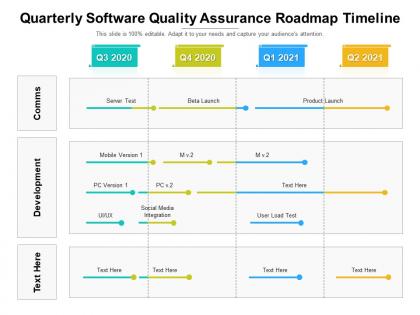
Quarterly software quality assurance roadmap timeline




Try Before you Buy Download Free Sample Product
 Impress Your
 Audience
 100%
100% Editable
 Save Hours
 of Time


The success rate of business plans is hugely dependent on the plan of action, and this editable Quarterly Software Quality Assurance Roadmap Timeline rightly serves the purpose. Encapsulate all the information related to the project in a well structured manner to obtain maximum efficiency by incorporating our stunning PowerPoint theme. State the critical deliverable, steps involved, time frame, workforce allocation, and lots more in an easy to understand manner by utilizing this pre designed roadmap PowerPoint layout. You can also prioritize your tasks and discuss the problem areas with your colleagues by incorporating this tailor made PPT layout. Empower your work plan by employing this professionally designed PPT theme. Entrepreneurs can download Quarterly Software Quality Assurance Roadmap Timeline as a beneficial communication tool that facilitates in collaborating with different tasks and achieve targets.
People who downloaded this PowerPoint presentation also viewed the following :
Quarterly software quality assurance roadmap timeline with all 2 slides:
Give your audience a fulfilling experience. They will find our Quarterly Software Quality Assurance Roadmap Timeline elevating.
FAQs for Quarterly software quality
Key objectives of a quarterly software QA roadmap include establishing comprehensive testing strategies, defining quality metrics and benchmarks, allocating resources efficiently, scheduling critical testing phases, and ensuring seamless integration across development cycles. These strategic frameworks enable organizations to minimize defects, accelerate release timelines, and enhance user experiences, with many software companies finding that structured quarterly planning ultimately delivers stronger product reliability and competitive market positioning.
Teams should prioritize software testing initiatives by focusing on high-risk areas, critical user journeys, recent code changes, regulatory compliance requirements, and performance bottlenecks. This strategic approach enables organizations to allocate resources efficiently, minimize production issues, and deliver reliable software experiences, with many development teams finding that risk-based prioritization ultimately reduces costs while accelerating release cycles.
Essential QA metrics include defect density, test coverage percentage, defect escape rate, mean time to resolution, and test execution efficiency. These metrics enable organizations to streamline quality assurance by identifying bottlenecks, enhancing release reliability, and minimizing post-production issues, with many software teams finding that comprehensive tracking ultimately delivers faster deployment cycles and improved customer satisfaction.
QA professionals can align their roadmap with product development by synchronizing testing phases with development sprints, establishing shared milestones, integrating continuous testing practices, and maintaining regular cross-functional communication. Through strategic coordination, teams streamline release cycles, reduce bottlenecks, and enhance product quality, with many organizations finding that this alignment accelerates time-to-market while minimizing post-release defects.
Automation serves as the foundation for quarterly QA roadmaps by enabling continuous testing, accelerating release cycles, and optimizing resource allocation across development phases. Through automated regression suites and CI/CD integration, organizations streamline testing workflows, reduce manual effort by up to 70%, and enhance product quality, with many software teams finding that strategic automation delivers faster time-to-market and improved competitive positioning.
Organizations can incorporate user feedback into quarterly QA planning by establishing systematic feedback collection channels, analyzing user-reported issues for priority testing areas, integrating customer support data into test case development, and creating feedback-driven testing scenarios that mirror real-world usage patterns. This approach enables QA teams to focus resources on user-critical functionality, enhance product reliability, and deliver improved user experiences, with many software companies finding that feedback-integrated planning reduces post-release defects significantly.
Effective QA roadmap execution requires establishing clear testing milestones, maintaining comprehensive documentation, implementing automated testing frameworks where feasible, and conducting regular stakeholder reviews throughout each quarter. These practices streamline quality assurance by reducing manual testing overhead, enhancing defect detection rates, and ensuring alignment with development cycles, with many software teams finding that structured roadmap adherence ultimately delivers faster release cycles and improved product reliability.
Risk assessment integrates into quarterly QA planning through threat modeling, priority matrix development, historical defect analysis, and impact evaluation across critical system components. This strategic combination enables QA teams to allocate testing resources more effectively, focus on high-risk modules first, and establish mitigation protocols, ultimately delivering more robust software releases while minimizing potential production issues.
Testing emphasis should rotate quarterly: Q1 focuses on performance and load testing after holiday traffic analysis, Q2 emphasizes security testing before summer releases, Q3 prioritizes usability and accessibility testing, and Q4 concentrates on integration testing. This strategic rotation enables organizations to systematically address critical quality areas while maintaining development velocity, ultimately delivering more reliable software and enhanced user experiences.
Teams should adjust QA strategies by analyzing defect patterns, testing coverage gaps, and performance bottlenecks from previous quarters, then reallocating resources accordingly. This data-driven approach enables organizations to prioritize high-risk areas, streamline testing processes, and enhance automation frameworks, with many software teams finding that quarterly retrospectives ultimately deliver faster release cycles and improved product quality.
Essential tools for executing a quarterly QA roadmap include automated testing frameworks like Selenium and Cypress, test management platforms such as TestRail or Jira, performance testing tools like JMeter, and continuous integration systems including Jenkins or GitLab CI. These technologies streamline testing cycles, enhance defect tracking, and enable faster release schedules, with many organizations finding that strategic tool integration ultimately delivers improved software quality and competitive advantage.
Cross-departmental collaboration enhances QA roadmap success by aligning testing priorities with business objectives, streamlining communication workflows, and integrating diverse expertise from development, operations, and product teams. Through strategic coordination, organizations accelerate defect resolution, reduce deployment risks, and deliver higher-quality releases, with many finding that collaborative frameworks ultimately improve customer satisfaction and competitive advantage.
Industry trends and emerging technologies significantly influence quarterly QA strategies by driving adoption of AI-powered testing tools, cloud-based testing environments, shift-left methodologies, and automated security testing frameworks. These advancements enable organizations to streamline test cycles, enhance coverage accuracy, and reduce time-to-market, with many software companies finding that strategic integration of emerging technologies delivers competitive advantage and operational efficiency.
Teams typically face challenges including resource allocation constraints, shifting project priorities, integration complexities with development cycles, evolving technology requirements, and balancing manual versus automated testing approaches. These obstacles often stem from inadequate cross-team communication, unrealistic timeline expectations, and insufficient buffer planning, with many organizations finding that proactive stakeholder alignment and flexible milestone frameworks ultimately deliver more predictable outcomes and sustainable quality processes.
A quarterly QA roadmap adapts to agile methodologies by incorporating iterative testing cycles, continuous integration practices, sprint-aligned quality gates, and flexible milestone adjustments that accommodate changing requirements. This strategic approach enables development teams to maintain quality standards while embracing agile's rapid iteration cycles, with many software organizations finding that integrated QA planning ultimately delivers faster releases and enhanced product reliability.
No Reviews