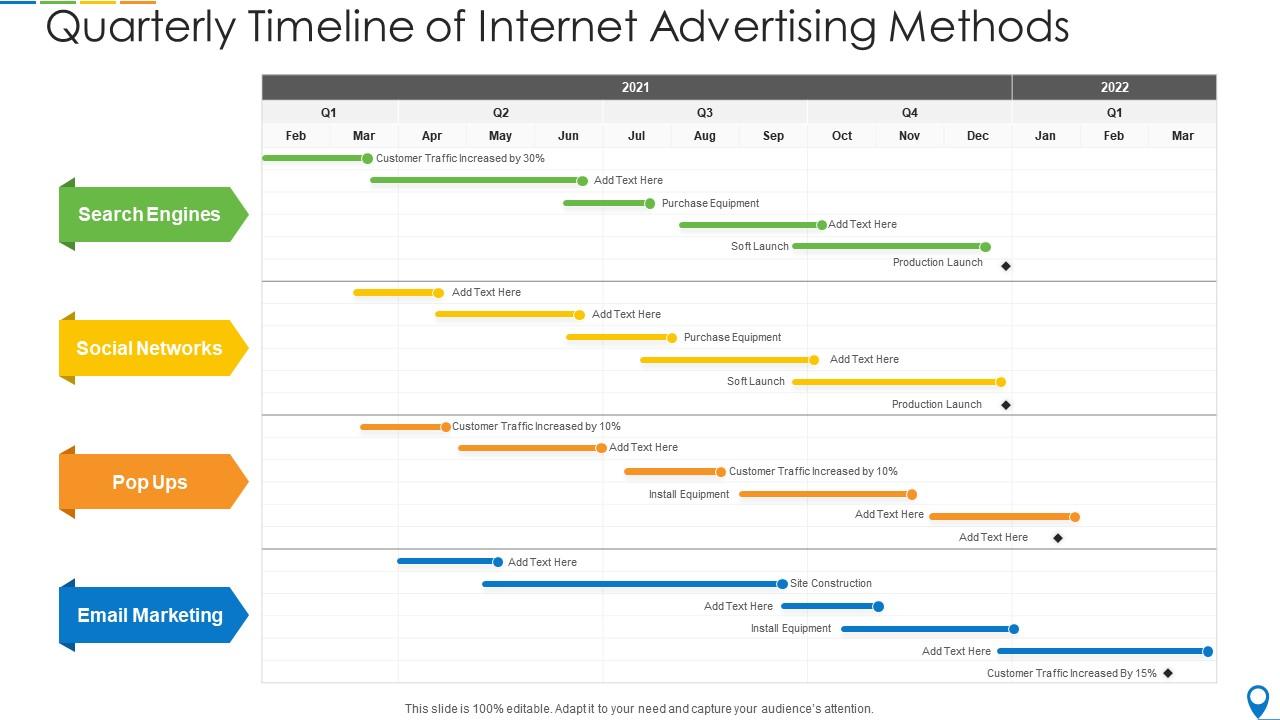
Quarterly timeline of internet advertising methods
Try Before you Buy Download Free Sample Product
Audience
Editable
of Time
Our Quarterly Timeline Of Internet Advertising Methods are topically designed to provide an attractive backdrop to any subject. Use them to look like a presentation pro.
People who downloaded this PowerPoint presentation also viewed the following :
Quarterly timeline of internet advertising methods with all 6 slides:
Use our Quarterly Timeline Of Internet Advertising Methods to effectively help you save your valuable time. They are readymade to fit into any presentation structure.
FAQs for Quarterly timeline of
Early internet advertising methods included banner ads, pop-up windows, email marketing campaigns, search engine submissions, and simple text-based directory listings. These foundational approaches established digital marketing principles by introducing targeted messaging, clickable engagement, and measurable response rates, with many companies finding that these methods delivered cost-effective customer acquisition compared to traditional media channels.
Banner ads revolutionized online advertising by introducing visual, clickable marketing directly into web pages, establishing the foundation for digital advertising revenue models and measurable click-through rates. They enabled businesses to target specific websites and audiences while providing publishers with monetization opportunities, ultimately creating the advertising-supported internet ecosystem that drives today's digital economy and e-commerce growth.
PPC advertising revolutionized internet marketing by introducing performance-based, measurable advertising that allowed businesses to pay only for actual clicks, dramatically reducing waste and enabling precise budget control. This model democratized online advertising by making it accessible to small businesses while providing instant feedback and optimization capabilities, ultimately transforming digital marketing into a data-driven, ROI-focused discipline that scaled globally.
SEO has fundamentally transformed internet advertising by shifting focus from purely paid placements to organic visibility strategies, integrating content marketing with search algorithms, and emphasizing long-term brand authority building. This evolution enables businesses to reduce advertising costs while improving targeting precision, with many companies finding that strategic SEO delivers sustained traffic growth and enhanced competitive positioning.
Social media platforms revolutionized advertising strategies by enabling targeted demographic marketing, real-time customer engagement, and cost-effective campaign management compared to traditional media. These platforms streamlined brand-consumer interactions through direct messaging, community building, and viral content distribution, with companies across retail, entertainment, and financial services finding that social advertising delivered measurably higher engagement rates and conversion tracking capabilities.
Mobile advertising evolved from basic SMS campaigns and simple banner ads to sophisticated location-based targeting, in-app advertising, and personalized experiences through app data. With smartphones enabling GPS tracking, push notifications, and seamless app integration, advertisers can now deliver contextually relevant ads while users browse, shop, or navigate, ultimately creating more engaging customer touchpoints and measurable conversion opportunities.
Display ads are clearly identifiable promotional content with distinct visual boundaries, while native advertising seamlessly blends with surrounding editorial content, matching the platform's format and style. Display ads offer transparent branding and immediate recognition, whereas native ads enhance user engagement through contextual relevance, with many publishers finding that strategic combinations deliver both brand visibility and improved customer experiences.
Programmatic advertising has revolutionized ad space transactions by automating buying and selling through real-time bidding, data-driven targeting, and algorithmic optimization. This technology enables companies to streamline media purchasing, reduce costs, and enhance campaign precision across multiple channels simultaneously, with retail and financial services sectors finding significantly improved ROI and audience engagement.
Ethical considerations include data privacy consent, transparency in collection practices, algorithmic bias prevention, user control over personal information, and protecting vulnerable populations from manipulation. While targeted advertising enables personalized experiences and business efficiency, companies must balance commercial interests with consumer rights, with many organizations finding that ethical data practices ultimately build stronger customer trust and competitive advantage.
Video advertising revolutionized online engagement by enabling storytelling, emotional connection, and interactive experiences that static banner ads couldn't deliver. Through platforms like YouTube and social media, brands could demonstrate products, share testimonials, and create immersive content, ultimately driving higher click-through rates, longer engagement times, and more effective conversion funnels than traditional display advertising methods.
Influencer marketing trends include the rise of micro-influencers, authentic storytelling over promotional content, long-term brand partnerships, video-first platforms, and performance-based compensation models. These approaches streamline audience targeting, enhance engagement rates, and deliver measurable ROI, with many brands finding that authentic collaborations ultimately drive stronger customer loyalty and conversion rates.
AI has revolutionized customer targeting through predictive analytics, behavioral pattern recognition, real-time personalization, dynamic segmentation, and automated campaign optimization. These technologies enable advertisers to deliver highly relevant content by analyzing vast datasets, predicting consumer preferences, and adjusting strategies instantly, with many retailers and financial services finding significantly improved conversion rates and customer engagement.
Ad blockers present significant challenges for internet marketers, including reduced reach, decreased revenue from display advertising, difficulty tracking user behavior, and limited retargeting capabilities. These technologies force marketers to pivot toward native advertising, content marketing, and influencer partnerships, with many organizations finding that diversified strategies focusing on value-driven content ultimately enhance customer relationships and brand trust.
User-generated content has revolutionized online advertising by enabling authentic brand advocacy, peer-to-peer recommendations, and cost-effective content creation through customer testimonials, social media posts, and review platforms. This strategic shift allows companies to leverage genuine customer experiences for increased trust and engagement, with brands like Nike and Starbucks finding that user-created content delivers higher conversion rates and deeper audience connections.
Privacy regulations like GDPR significantly reshape internet advertising by restricting data collection, requiring explicit user consent, and mandating transparent privacy policies. These changes drive advertisers toward contextual targeting, first-party data strategies, and privacy-compliant technologies, with many companies finding that building consumer trust through transparency ultimately delivers stronger customer relationships and sustainable competitive advantage.
-
Excellent template with unique design.
-
Unique research projects to present in meeting.
-
Innovative and attractive designs.
-
Best Representation of topics, really appreciable.