


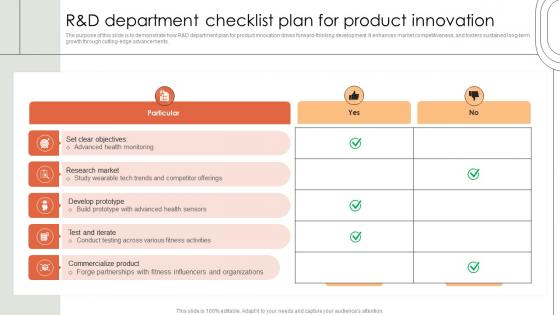
R And D Department Checklist Plan For Product Innovation




Try Before you Buy Download Free Sample Product
 Impress Your
Audience
 100%
Editable
 Save Hours
of Time


The purpose of this slide is to demonstrate how R and D department plan for product innovation drives forward-thinking development. It enhances market competitiveness, and fosters sustained long-term growth through cutting-edge advancements.
People who downloaded this PowerPoint presentation also viewed the following :
R And D Department Checklist Plan For Product Innovation with all 9 slides:
Use our R And D Department Checklist Plan For Product Innovation to effectively help you save your valuable time. They are readymade to fit into any presentation structure.








FAQs for R And D Department Checklist Plan
R&D departments should prioritize market research and customer needs analysis, feasibility studies and technical validation, competitive landscape assessment, resource allocation planning, and timeline management for product development cycles. These strategic objectives enable organizations to streamline innovation processes, minimize development risks, and accelerate time-to-market, with many companies finding that structured R&D frameworks ultimately deliver stronger competitive advantages and higher success rates.
R&D teams can effectively assess market needs through customer surveys, competitor analysis, industry reports, focus groups, and trend monitoring platforms. These methodologies enable teams to identify emerging opportunities, validate product concepts, and align development priorities with market demands, with many organizations finding that systematic market research significantly reduces development risks while accelerating time-to-market for innovative solutions.
Cross-functional collaboration enhances R&D outcomes by integrating diverse expertise from marketing, engineering, manufacturing, and customer service teams, ensuring products align with market needs and operational capabilities. This strategic approach streamlines development cycles, reduces costly redesigns, and accelerates time-to-market, with many organizations finding that collaborative R&D delivers more commercially viable innovations and stronger competitive advantage.
R&D departments can foster innovation culture through collaborative brainstorming sessions, cross-functional team rotations, dedicated innovation time, mentorship programs, and failure-tolerant environments that encourage experimentation. These approaches streamline creative processes by reducing hierarchical barriers, enhancing knowledge sharing, and promoting calculated risk-taking, with many technology and pharmaceutical companies finding that such cultures ultimately deliver breakthrough products and sustained competitive advantage.
Best practices for conducting feasibility studies in R&D projects include comprehensive market analysis, technical capability assessment, resource requirement evaluation, risk identification, and timeline development. These practices enable organizations to streamline project selection, minimize resource waste, and accelerate innovation cycles, with many technology companies and pharmaceutical firms finding that structured feasibility frameworks ultimately deliver higher success rates and competitive advantage.
R&D teams can measure innovation impact through key performance indicators like revenue from new products, time-to-market metrics, cost reduction achievements, and customer satisfaction scores. These measurements enable organizations to track return on investment, assess competitive positioning, and demonstrate strategic value, with many companies finding that systematic impact measurement ultimately enhances resource allocation and accelerates future innovation cycles.
R&D departments can leverage project management platforms, CAD software, simulation tools, PLM systems, and collaborative digital workspaces to streamline product development lifecycles. These technologies enhance efficiency by automating workflows, enabling real-time collaboration, and accelerating prototyping processes, with many organizations finding that integrated digital ecosystems ultimately deliver faster time-to-market and stronger competitive advantage.
R&D teams should approach prototyping through rapid, low-cost iterations that test core assumptions, gather user feedback early, and validate technical feasibility before significant resource investment. This methodology enables organizations to minimize development risks, accelerate time-to-market, and refine products based on real-world data, with many innovation-driven companies finding that iterative testing ultimately delivers higher success rates and stronger market alignment.
Key metrics for evaluating R&D product innovation success include time-to-market reduction, patent applications filed, revenue from new products, development cost efficiency, and customer adoption rates. These indicators enable organizations to track both immediate outcomes and long-term strategic value, with many technology companies finding that balanced scorecards combining financial performance with innovation pipeline strength deliver the most comprehensive assessment of R&D effectiveness.
R&D departments ensure regulatory compliance through early regulatory consultation, comprehensive documentation protocols, staged testing procedures, cross-functional compliance teams, and continuous monitoring systems. These frameworks streamline approval processes by integrating regulatory considerations into each development phase, enabling pharmaceutical companies, medical device manufacturers, and food producers to accelerate time-to-market while maintaining safety standards, ultimately delivering competitive advantage through faster, compliant product launches.
Risk management strategies for product innovations include comprehensive market research, prototype testing, phased rollout approaches, cross-functional team collaboration, and establishing clear go/no-go decision points throughout development cycles. These methodologies streamline uncertainty by validating customer demand early, minimizing financial exposure, and enabling rapid pivots, with many organizations finding that structured risk assessment frameworks ultimately deliver faster time-to-market and higher success rates.
Market feedback integration involves establishing structured collection channels, cross-functional review processes, feedback categorization systems, regular stakeholder meetings, and iterative testing protocols. Through customer surveys, user analytics, and sales team insights, R&D teams can prioritize feature development, refine product specifications, and accelerate time-to-market, with many organizations finding that systematic feedback loops ultimately deliver more market-aligned innovations and stronger competitive positioning.
Intellectual property management protects R&D innovations through patent applications, trademark registrations, trade secret protocols, copyright protections, and licensing strategies. These safeguarding mechanisms enable organizations to secure competitive advantages, prevent unauthorized use, and monetize their research investments, with many technology companies and pharmaceutical firms finding that robust IP portfolios ultimately deliver significant market differentiation and revenue generation opportunities.
R&D departments can effectively balance short-term and long-term goals by implementing portfolio management approaches, establishing dual-track development processes, and creating cross-functional innovation committees that prioritize projects based on strategic value and market timing. Through structured resource allocation frameworks, organizations streamline immediate product improvements while investing in breakthrough technologies, with many tech companies and pharmaceutical firms finding that this balanced approach ultimately delivers sustained competitive advantage and accelerated market responsiveness.
Government grants, tax credits, innovation vouchers, research partnerships, and venture capital programs support R&D efforts for product innovation. These funding mechanisms enable companies to accelerate development timelines, reduce financial risk, and access specialized expertise, with many organizations finding that strategic funding combinations significantly enhance their competitive advantage while minimizing upfront investment costs.
-
It makes easy work of my work presentations. I’ve never had to be nervous about my presentations for meetings.
-
One word for SlideTeam–Versatile!