Real Time Marketing Data Analysis
Try Before you Buy Download Free Sample Product
Audience
Editable
of Time
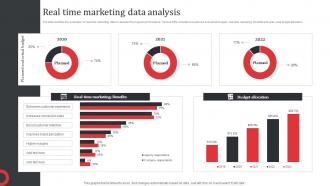
The slide exhibits the evaluation of real time marketing data to assess the program performance. Various KPIs included are planned and actual budget, real time marketing benefits and year wise budget allocation
People who downloaded this PowerPoint presentation also viewed the following :
Real Time Marketing Data Analysis with all 7 slides:
Use our Real Time Marketing Data Analysis to effectively help you save your valuable time. They are readymade to fit into any presentation structure.
FAQs for Real Time
Key components include data integration platforms, predictive analytics tools, customer behavior tracking systems, automated response mechanisms, and performance monitoring dashboards. These technologies streamline decision-making by processing live data streams, identifying emerging trends, and triggering immediate campaign adjustments, with many organizations finding that real-time insights deliver faster customer engagement and significantly improved marketing ROI.
Real-time analytics enhance marketing decision-making by providing instant campaign performance data, enabling immediate strategy adjustments, identifying audience engagement patterns, and revealing optimal timing for content delivery. Through continuous monitoring dashboards, marketing teams can pivot underperforming ads, capitalize on trending topics, and allocate budgets dynamically, ultimately delivering higher ROI and more targeted customer experiences.
Essential tools for real-time marketing analysis include social media monitoring platforms, web analytics software, customer data platforms, marketing automation systems, and AI-powered sentiment analysis tools. These technologies streamline campaign optimization by tracking engagement metrics, analyzing customer behavior patterns, and identifying trending opportunities instantly, with many organizations finding that integrated dashboards ultimately deliver faster decision-making and improved ROI.
Businesses leverage social media for immediate marketing insights by monitoring engagement metrics, tracking trending hashtags, analyzing competitor activity, and collecting real-time customer feedback through comments and direct messages. These social listening approaches enable companies to adjust campaigns instantly, identify emerging market opportunities, and respond to customer concerns quickly, ultimately delivering more responsive marketing strategies and enhanced customer relationships.
Key metrics include engagement rates, conversion rates, click-through rates, social media mentions, website traffic, and cost per acquisition. These metrics enable marketers to optimize campaigns instantly, adjust messaging based on audience response, and allocate resources strategically, with many organizations finding that real-time tracking delivers improved ROI and enhanced customer experiences.
Consumer behaviors influenced by real-time marketing data become more responsive, personalized, and immediate, with customers expecting tailored offers, dynamic pricing, and contextual messaging based on their current activities and preferences. Through real-time analysis, retailers and service providers deliver targeted promotions during peak engagement moments, ultimately increasing conversion rates and customer satisfaction while reducing decision-making time spans.
Predictive analytics enables marketers to anticipate customer behavior, identify emerging trends, and optimize campaign timing through historical data analysis and machine learning algorithms. This strategic combination allows retailers and financial services companies to personalize offers instantly, allocate resources more effectively, and respond to market shifts proactively, ultimately delivering higher conversion rates and competitive advantage.
Brands can measure real-time marketing impact through conversion tracking, attribution modeling, social listening analytics, A/B testing, and customer journey mapping. These technologies streamline performance measurement by connecting engagement metrics to sales data, monitoring brand sentiment shifts, and analyzing purchase patterns, with many retail and e-commerce companies finding that integrated analytics platforms deliver clearer ROI visibility and faster campaign optimization.
Marketers implementing real-time analysis face challenges including data integration complexity, skill gaps in analytics interpretation, technology infrastructure limitations, and balancing speed with accuracy in decision-making. While these obstacles require strategic investment in training and systems, organizations increasingly find that overcoming them delivers significant competitive advantages through faster campaign optimization, improved customer responsiveness, and enhanced ROI.
Segmentation enhances real-time marketing by enabling personalized messaging, targeted content delivery, and precise audience targeting based on demographics, behavior, and preferences. Through advanced analytics and customer data platforms, businesses can deliver relevant offers to specific segments instantly, significantly improving engagement rates, conversion performance, and campaign ROI while reducing marketing waste across channels.
Successful real-time marketing analysis case studies include Starbucks' location-based promotions, Netflix's personalized content recommendations, Amazon's dynamic pricing strategies, Spotify's real-time playlist curation, and McDonald's weather-responsive menu advertising. These initiatives demonstrate how brands leverage live data streams to deliver personalized experiences, optimize pricing models, and increase customer engagement, with many companies finding that real-time insights drive significantly higher conversion rates and customer satisfaction.
Small businesses can utilize real-time marketing analysis through affordable social media analytics tools, Google Analytics, email marketing platforms with built-in tracking, and free customer feedback systems. These budget-friendly solutions enable monitoring campaign performance, customer engagement patterns, and website behavior instantly, helping small retailers, restaurants, and service providers optimize their marketing spend, adjust messaging quickly, and compete more effectively with larger competitors.
Marketers using real-time data must prioritize consumer privacy, data transparency, consent management, and responsible targeting practices. These ethical frameworks help organizations build trust while avoiding discriminatory practices, with many companies finding that transparent data policies and opt-in consent ultimately enhance customer relationships and brand reputation.
Real-time marketing analysis enhances customer relationship management by enabling immediate response to customer behaviors, personalizing interactions based on current data, and identifying engagement opportunities as they occur. Through continuous monitoring of customer touchpoints, businesses can adjust messaging, resolve issues proactively, and deliver timely offers, ultimately strengthening relationships and increasing customer lifetime value across all channels.
Future trends in real-time marketing analysis include AI-powered predictive insights, edge computing for instant data processing, advanced customer journey mapping, cross-channel attribution modeling, and automated campaign optimization. These technologies will revolutionize marketing by delivering hyper-personalized experiences, reducing response times, and enabling dynamic content adaptation, with many organizations finding that real-time capabilities provide significant competitive advantages in increasingly fast-paced markets.
-
Stunning collection! With a wide variety of options available, I was able to find a perfect slide for my presentation. Thank you, SlideTeam!
-
The quality of PowerPoint templates I found here is unique and unbeatable. Keep up the good work and continue providing us with the best slides!