


Rehabilitation IT Robotic Exoskeleton And Levels Of Spinal Cord Injury Ppt Summary Graphics




Try Before you Buy Download Free Sample Product
 Impress Your
 Audience
 100%
100% Editable
 Save Hours
 of Time


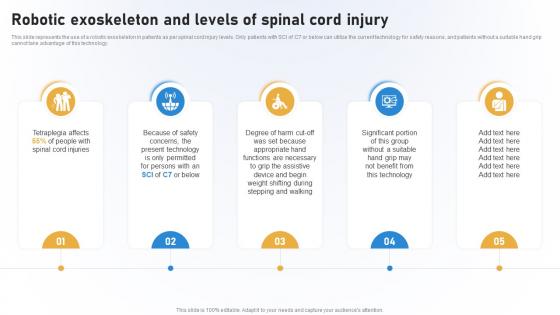
This slide represents the use of a robotic exoskeleton in patients as per spinal cord injury levels. Only patients with SCI of C7 or below can utilize the current technology for safety reasons, and patients without a suitable hand grip cannot take advantage of this technology.
People who downloaded this PowerPoint presentation also viewed the following :
Rehabilitation IT Robotic Exoskeleton And Levels Of Spinal Cord Injury Ppt Summary Graphics with all 6 slides:
Use our Rehabilitation IT Robotic Exoskeleton And Levels Of Spinal Cord Injury Ppt Summary Graphics to effectively help you save your valuable time. They are readymade to fit into any presentation structure.





FAQs for Rehabilitation IT Robotic Exoskeleton And Levels Of Spinal Cord Injury
Recent advancements in rehabilitation robotics include AI-powered adaptive therapy systems, haptic feedback exoskeletons, virtual reality integration, brain-computer interfaces, and soft robotic devices. These technologies enhance patient outcomes by personalizing treatment protocols, accelerating recovery timelines, and enabling remote monitoring, with hospitals and rehabilitation centers finding that automated therapy delivery significantly improves both therapeutic precision and operational efficiency.
Rehabilitation robots enhance patient engagement by providing interactive feedback, gamified exercises, and personalized therapy programs that adapt to individual progress levels. Through virtual reality integration and real-time performance tracking, patients in hospitals and rehabilitation centers experience more motivating sessions while achieving measurable improvements, with many facilities finding that robotic assistance increases therapy compliance and accelerates recovery outcomes.
Exoskeletons provide full-body or limb support for mobility and gait training, while robotic arms focus on upper extremity strength, coordination, and fine motor skills development. These technologies complement rehabilitation by targeting different recovery phases, with exoskeletons enabling mobility restoration in spinal injury patients and robotic arms enhancing precision therapy for stroke survivors, ultimately delivering comprehensive treatment approaches.
Personalized rehabilitation robots improve patient outcomes by adapting therapy intensity to individual capabilities, providing real-time feedback for motivation, and delivering consistent treatment protocols. These systems enable precise movement tracking, customized exercise progression, and data-driven recovery insights, with many hospitals and rehabilitation centers finding that patients achieve faster functional recovery, enhanced mobility restoration, and significantly improved treatment adherence rates.
Artificial intelligence enables rehabilitation robotics to personalize therapy programs, adapt to patient progress in real-time, and analyze movement patterns for optimal recovery outcomes. Through machine learning algorithms, these systems adjust resistance levels, track improvements, and provide data-driven insights to therapists, ultimately delivering more effective rehabilitation experiences and accelerated patient recovery across healthcare facilities.
Rehabilitation robotics integrates into healthcare systems through strategic partnerships with physical therapy departments, staff training programs, and gradual implementation protocols that complement traditional therapies. Hospitals and rehabilitation centers increasingly adopt these technologies by establishing dedicated robotics units, training existing therapists on robotic systems, and creating hybrid treatment protocols, ultimately delivering more consistent therapy sessions, improved patient outcomes, and enhanced operational efficiency.
Developers face challenges including ensuring patient safety protocols, creating adaptive interfaces for diverse disabilities, achieving precise motion control, managing high development costs, and securing regulatory approvals. While technical complexity presents obstacles, many healthcare institutions find that strategic partnerships between engineers and therapists streamline development processes, ultimately delivering more effective patient outcomes and faster recovery times.
Rehabilitation robots cater to different injuries through specialized designs including exoskeletons for mobility impairments, robotic arms for upper limb therapy, gait trainers for walking rehabilitation, and cognitive training systems for neurological conditions. These adaptive technologies deliver personalized therapy protocols, adjustable resistance levels, and real-time progress monitoring, with hospitals and rehabilitation centers finding enhanced patient outcomes and accelerated recovery timelines.
Rehabilitation robots significantly reduce patient recovery times by providing consistent, intensive therapy sessions, precise movement tracking, and personalized treatment protocols tailored to individual progress rates. Through automated assistance and real-time feedback, hospitals and rehabilitation centers deliver more frequent interventions, enhanced motor skill development, and measurable progress monitoring, ultimately enabling faster functional recovery and earlier discharge planning.
Virtual reality enhances rehabilitation robotics by creating immersive, interactive environments that motivate patients and provide real-time feedback during therapy sessions. This strategic combination enables precise movement tracking, gamified exercises, and personalized treatment protocols, with hospitals and rehabilitation centers finding that patients demonstrate improved engagement, faster recovery times, and better motor skill development outcomes.
Rehabilitation robotics presents ethical considerations including patient autonomy, data privacy, equitable access, safety protocols, and the balance between human care and technological intervention. While these technologies enhance recovery outcomes and therapeutic precision, healthcare institutions must address informed consent, algorithmic bias, and maintaining meaningful patient-therapist relationships, ultimately ensuring technology complements rather than replaces compassionate care.
Rehabilitation robots adapt to individual patients through AI-powered assessment systems, adjustable force feedback mechanisms, personalized therapy protocols, and real-time performance monitoring. These technologies enable customized treatment plans by analyzing patient progress, modifying resistance levels, and adjusting movement patterns, with hospitals and rehabilitation centers finding that personalized robotic therapy significantly accelerates recovery outcomes.
Rehabilitation robotics presents significant upfront capital costs ranging from $100,000 to $500,000 per system, alongside ongoing maintenance, training, and software expenses. However, these investments deliver substantial long-term value through reduced staffing requirements, increased patient throughput, and improved treatment outcomes, with many healthcare facilities finding enhanced operational efficiency and competitive positioning ultimately offset initial expenditures.
Industry partnerships advance rehabilitation robotics R&D by combining clinical expertise, engineering innovation, and manufacturing capabilities to accelerate product development, share research costs, and ensure regulatory compliance. Through strategic collaborations between medical device companies, healthcare institutions, and technology firms, partnerships enable faster prototype testing, comprehensive clinical trials, and scalable manufacturing solutions, ultimately delivering more effective therapeutic robots and enhanced patient outcomes across rehabilitation centers worldwide.
Future trends in rehabilitation robotics include AI-driven personalized therapy protocols, brain-computer interfaces for neural rehabilitation, exoskeletons with haptic feedback, virtual reality integration, and cloud-based progress monitoring systems. These advancing technologies streamline recovery processes by adapting to individual patient needs, accelerating treatment timelines, and enhancing therapeutic outcomes, with healthcare institutions increasingly finding that automated rehabilitation delivers more consistent results while reducing long-term care costs.
-
I want to thank SlideTeam for the work that they do, especially their customer service.
-
Top Quality presentations that are easily editable.