


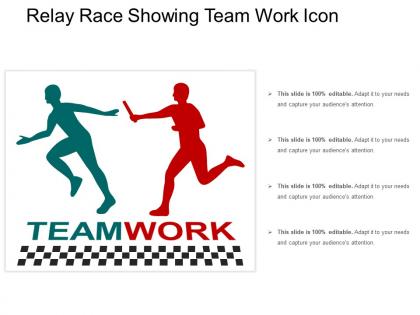
Relay race showing team work icon




Try Before you Buy Download Free Sample Product
 Impress Your
 Audience
 100%
100% Editable
 Save Hours
 of Time


Your claim to fame will continue to increase due to our Relay Race Showing Team Work Icon. It generates ascending graphs.
People who downloaded this PowerPoint presentation also viewed the following :
Relay race showing team work icon with all 5 slides:
Create the exact composite image you imagined with our Relay Race Showing Team Work Icon. Discover an attractive interplay of colors.



FAQs for Relay race showing
Each runner in a relay race has distinct responsibilities: the first runner establishes pace and positioning, the second maintains momentum through the first exchange, the third navigates the critical turn, and the anchor delivers the final sprint. These specialized roles require seamless coordination, with each athlete mastering handoff techniques, zone positioning, and strategic pacing, ultimately delivering competitive advantage through optimized team performance and efficient baton transitions.
Effective communication among relay team members significantly impacts race performance by enabling precise baton exchanges, coordinating timing strategies, and minimizing costly handoff errors. Through clear verbal cues and synchronized movements, teams reduce transition delays, maintain optimal speed consistency, and eliminate disqualifications, with many championship teams finding that seamless communication ultimately delivers faster overall times and competitive advantages.
Teams can enhance baton passing through consistent practice of the upcall method, establishing designated exchange zones, maintaining steady running speeds, and developing clear verbal communication cues. These techniques streamline coordination by reducing fumbles, minimizing time loss, and building runner confidence, with many competitive relay teams finding that synchronized timing ultimately delivers faster race times and improved performance outcomes.
Trust and mutual support in relay races enhance performance by ensuring seamless baton exchanges, reducing handoff errors, and enabling teammates to push their limits confidently. These psychological factors streamline coordination, minimize dropped batons, and maximize speed transitions, with many championship teams finding that strong interpersonal bonds ultimately deliver faster overall times and competitive advantage.
Relay coaching emphasizes synchronized handoff techniques, communication protocols, and zone positioning strategies, while individual training focuses on personal performance optimization and technique refinement. Through specialized practice sessions, coaches develop timing drills, baton exchange sequences, and strategic runner positioning, with many successful programs finding that relay-specific training ultimately delivers enhanced team coordination and competitive performance advantages.
Psychological factors in relay racing include performance anxiety, trust dynamics, communication clarity, focus maintenance, and collective responsibility management. These mental elements significantly impact team coordination, with elite relay teams finding that shared visualization techniques, pre-established communication protocols, and distributed leadership roles help minimize individual pressure while maximizing collective performance under competitive conditions.
Team cohesion significantly influences relay race outcomes by enhancing communication, synchronizing handoffs, and building trust between runners. Through seamless coordination and shared accountability, cohesive teams minimize dropped batons, optimize transition zones, and maintain consistent pacing, ultimately delivering faster overall times and competitive advantages over less unified competitors.
Common baton exchange mistakes include improper timing, inadequate communication, wrong hand positioning, insufficient practice together, and panic under pressure. Teams can avoid these through consistent practice sessions focusing on timing and communication, establishing clear verbal cues, positioning the receiving hand correctly, and building trust between runners, ultimately delivering smoother transitions and competitive advantage in races.
Visualization techniques improve relay teamwork by enhancing mental rehearsal of handoffs, synchronizing timing between teammates, and reducing performance anxiety through repeated mental practice. Through guided imagery sessions, relay teams can perfect their baton exchanges, anticipate potential challenges, and build collective confidence, ultimately delivering smoother transitions and faster race times in competitive events.
Runner order significantly impacts relay performance through strategic positioning, speed optimization, and psychological momentum building. Teams typically place their fastest runner as anchor, strongest starter first, and most reliable exchangers in middle positions, with successful relay teams finding that proper sequencing can reduce overall times by several seconds while minimizing handoff errors.
Teams can effectively analyze post-race performance through video review, split-time analysis, handoff evaluation, individual runner assessment, and strategic debriefing sessions. These methods enable organizations to identify timing inefficiencies, communication breakdowns, and coordination gaps, while many sports teams and corporate groups find that systematic performance analysis ultimately delivers improved collaboration, faster execution, and enhanced competitive advantage.
Physical conditioning enhances relay race teamwork by improving endurance, speed consistency, and precise baton handoffs, while reducing fatigue-related errors and miscommunication. Well-conditioned teams maintain synchronized timing throughout races, execute smoother transitions under pressure, and deliver competitive advantages through sustained performance levels, with many athletic programs finding that comprehensive fitness training ultimately strengthens both individual capabilities and collective coordination.
Technology enhances relay race dynamics through automated timing systems, high-speed video analysis, motion sensors, GPS tracking, and performance analytics platforms. These tools streamline coaching decisions by identifying optimal handoff zones, analyzing runner transitions, and measuring split times with precision, ultimately delivering faster team coordination and competitive advantage in increasingly data-driven athletic environments.
Relay teams foster accountability through clear role definitions, regular performance reviews, and shared goal-setting where each member understands their impact on collective success. These approaches enhance team cohesion by establishing transparent communication channels, implementing peer feedback systems, and creating mutual support structures, with many athletic organizations finding that consistent accountability practices ultimately deliver improved performance outcomes and stronger team dynamics.
Diversity within relay teams enhances performance by combining complementary strengths, specialized techniques, and varied training backgrounds to optimize each leg of the race. Teams with diverse skill sets, from explosive starters to endurance specialists and technical baton-handlers, create strategic advantages through role specialization, ultimately delivering faster times and more consistent performances across competitive environments.
-
Amazing product with appealing content and design.
-
Innovative and attractive designs.