


Relocating Business Processes By Offshoring Powerpoint Presentation Slides




Try Before you Buy Download Free Sample Product
 Impress Your
 Audience
 100%
100% Editable
 Save Hours
 of Time


Offshoring is the process of relocating business processes from one country to another for reasons such as lower labor costs, better economic conditions, etc. It can be of different services such as manufacturing, accounting and finance, human resource, sales services, and software development. This template will be useful for middle level management with an objective to maximize the efficiency of operations and boosts business productivity. We have covered current situation analysis wherein we have discussed services offered by the company, emerging markets for offshoring and operating cost comparison analysis. Furthermore, the need for offshoring in the company such as high operating costs, shortage of skilled professionals, rising government intervention, lack of availability of resources, etc. Gap analysis has been performed wherein the focus is on the challenges faced by the company during offshoring and action plan to overcome such challenges. There are different types of offshoring models such as freelancing, functional, dedicated, own office and one of these models will be chosen for the company based on its features. This template covers the steps required for the offshoring process. Various costs incurred by all the offshoring model has been shared. We have covered the offshoring impact in the business which enhances service quality and business functions, reduces costs, etc. The business performance dashboard has been shared here which includes revenue, gross profit, profit margin, etc.
People who downloaded this PowerPoint presentation also viewed the following :
Content of this Powerpoint Presentation
Slide 1: This slide introduces Relocating Business Processes by Offshoring. State your Company name and begin.
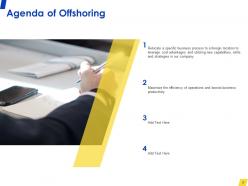
Slide 2: This slide displays Agenda of Offshoring.
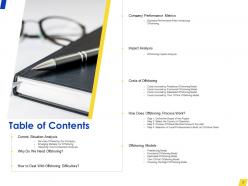
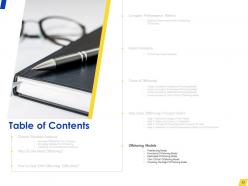
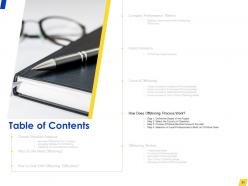
Slide 3: This slide displays Table of Contents of the presentation.
Slide 4: This slide displays Table of Contents.
Slide 5: This slide consists of the services offered by our company such as customer interaction, manufacturing services, app development & maintenance, data operations & administration, security & support services, etc.
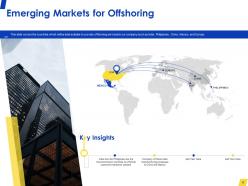
Slide 6: This slide covers the countries which will be best suitable to provide offshoring services to our company such as India, Philippines, China, Mexico, and Europe.
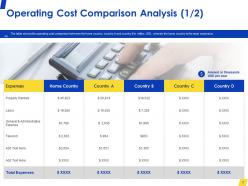
Slide 7: The table in this slide shows the operating cost comparison between the home country, country A and country B in million USD, wherein the home country is the most expensive.
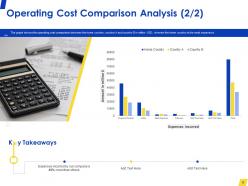
Slide 8: The graph in this slide shows the operating cost comparison between the home country, country A and country B in million USD, wherein the home country is the most expensive.
Slide 9: This slide displays Table of Contents.
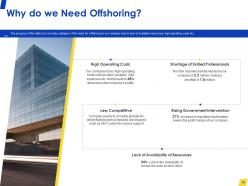
Slide 10: This slide explains Why do we Need Offshoring? The purpose of this slide is to provide a glimpse of the need for offshoring in our company due to lack of available resources, high operating costs etc.
Slide 11: This slide shows Table of Contents.
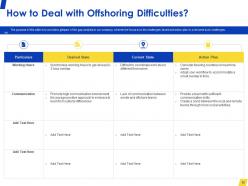
Slide 12: This slide shows How to Deal with Offshoring Difficulties? The purpose of this slide is to provide a glimpse of the gap analysis in our company wherein the focus is on the challenges faced and action plan to overcome such challenges.
Slide 13: This slide showcases Table of Contents.
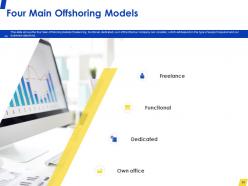
Slide 14: This slide presents Four Main Offshoring Models
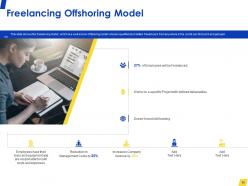
Slide 15: This slide shows the freelancing model, which is a well-known offshoring model wherein qualified and skilled freelancers from anywhere in the world can find work and get paid.
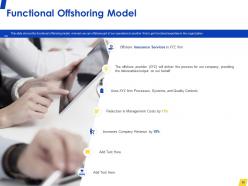
Slide 16: This slide shows the functional offshoring model, wherein we can offshore part of our operations to another firm to get functional expertise in the organization.
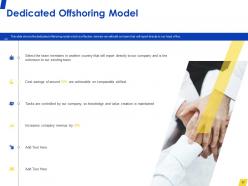
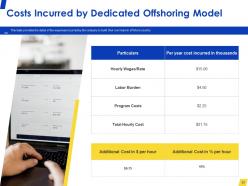
Slide 17: This slide shows the dedicated offshoring model which is effective, wherein we will build our team that will report directly to our head office.
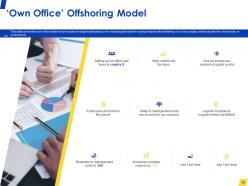
Slide 18: This slide shows the own office model which is used for larger businesses or for extending the team for various reasons like embarking on a new project, enhancing the line of services, or products etc.
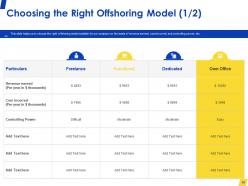
Slide 19: This slide helps us to choose the right offshoring model suitable for our company on the basis of revenue earned, cost incurred, and controlling power, etc.
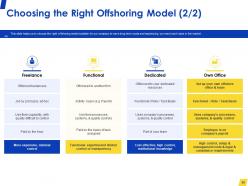
Slide 20: This slide helps us to choose the right offshoring model suitable for our company to save long-term costs and maximizing our reach and value in the market.
Slide 21: This slide displays Table of Contents.
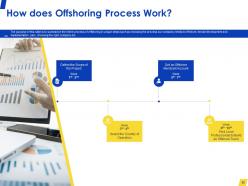
Slide 22: This slide shows How does Offshoring Process Work? The purpose of this slide is to summarize the entire process of offshoring in unique steps such as choosing the process our company needs to offshore, devise development and implementation plan, choosing the right company etc.
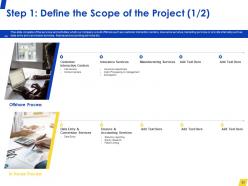
Slide 23: This slide consists of the services and activities which our company would offshore such as customer interaction centers, insurance services, marketing services or provide internally such as data entry and conversion services, finance and accounting services etc.
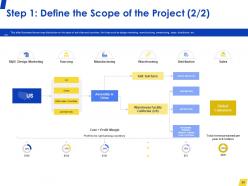
Slide 24: This slide illustrates the services distribution on the basis of activities and countries. Activities such as design marketing, manufacturing, warehousing, sales, distribution, etc.
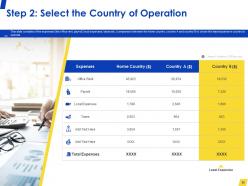
Slide 25: This slide consists of the expenses (like office rent, payroll, local expenses, taxes etc.) comparison between the home country, country A and country B to chose the least expensive country to operate.
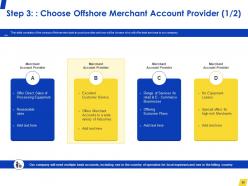
Slide 26: This slide consists of the various offshore merchant account provider and one will be chosen who will offer best services to our company.
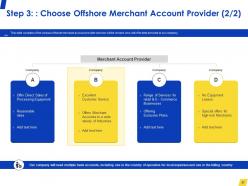
Slide 27: This slide consists of the various offshore merchant account provider and one will be chosen who will offer best services to our company.
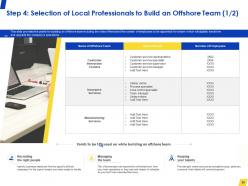
Slide 28: This slide provides the points for building an offshore team including the roles offered and the number of employees to be appointed for a team which will digitally transform and upgrade the company’s operations.
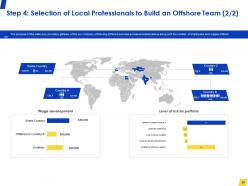
Slide 29: This slide provides a glimpse of the our company offshoring different services across several locations along with the number of employees and wages offered.
Slide 30: This slide showcases Table of Contents.
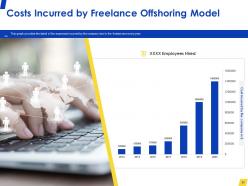
Slide 31: This slide showcases Costs Incurred by Freelance Offshoring Model. This graph provides the detail of the expenses incurred by the company due to the freelancers every year.
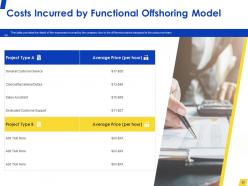
Slide 32: This slide depicts Costs Incurred by Functional Offshoring Model. This table provides the detail of the expenses incurred by the company due to the different projects assigned to the outsource team.
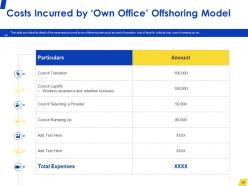
Slide 33: This slide provides the detail of the expenses incurred by the company to build their own team in offshore country
Slide 34: This slide provides the detail of the expenses incurred by an offshoring team such as cost of transition, cost of layoffs, cultural cost, cost of ramping up etc.
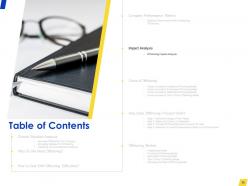
Slide 35: This slide shows Table of Contents.
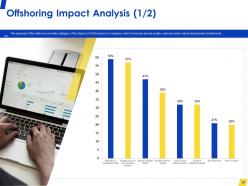
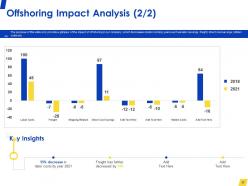
Slide 36: This slide shows Offshoring Impact Analysis. The purpose of this slide is to provide a glimpse of the impact of offshoring in our company which enhances service quality, reduces costs, enhances business functions etc.
Slide 37: This slide depicts Offshoring Impact Analysis.
Slide 38: This slide shows Table of Contents
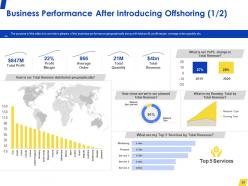
Slide 39: This slide represents Business Performance After Introducing Offshoring.
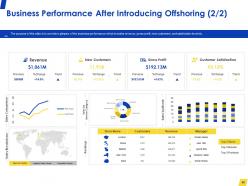
Slide 40: This slide shows Business Performance After Introducing Offshoring
Slide 41: This is Relocating Business Processes by Offshoring Icons Slide.
Slide 42: This slide is titled as Additional Slides for moving forward.
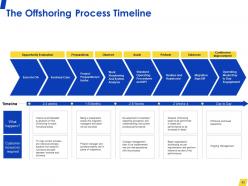
Slide 43: This slide presents The Offshoring Process Timeline.
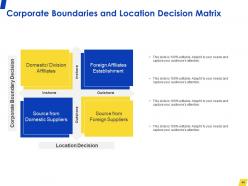
Slide 44: This slide displays Corporate Boundaries and Location Decision Matrix
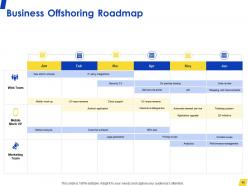
Slide 45: This slide displays Business Offshoring Roadmap.
Slide 46: This is 30 60 90 Plan of Action slide.
Slide 47: This slide shows Monthly Timeline with Task Name
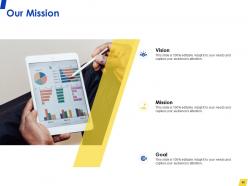
Slide 48: This slide displays Our Mission, Vision and Goal.
Slide 49: This is Our Team slide with Names and Designations.
Slide 50: This is About Us slide to showcase Company specifications.
Slide 51: This slide is titled as Post it Notes. Post your important notes here.
Slide 52: This is Thank You slide with Email address, Address and Contact number.
Relocating Business Processes By Offshoring Powerpoint Presentation Slides with all 52 slides:
Use our Relocating Business Processes By Offshoring Powerpoint Presentation Slides to effectively help you save your valuable time. They are readymade to fit into any presentation structure.





FAQs for Relocating Business Processes By Offshoring
Honestly, the money you save is insane - we're talking 40-60% off your operational costs. Access to talent worldwide is huge too, especially for specialized stuff that's hard to find locally. Time zones become your friend when you set it up right - having work happen while you sleep is pretty amazing. Scaling teams becomes way easier since you're not dealing with local hiring drama. Oh, and don't go all-in right away - start with something that won't kill your business if it goes sideways, then move the important stuff later.
Honestly, it's all about how you handle it. Rush in without doing your homework and yeah, quality will tank at first. But here's what people don't realize - a lot of offshore teams are actually crazy talented once they get what you need. I'd spend serious time upfront writing everything down, training them properly, and setting up good communication. Also get solid QA processes going and check in regularly. Oh and definitely - and I can't stress this enough - try a small pilot project first to see how their quality stacks up before you go all in.
Tech and manufacturing are the biggest ones - plus all that customer service stuff you deal with daily. Companies are shipping tons of coding work to India and Eastern Europe these days. China still gets most manufacturing, though Vietnam's picking up steam. Call centers are everywhere now, and honestly the healthcare industry's gotten pretty aggressive with it too - they're even having radiologists overseas read your scans. Oh, and all the boring back-office work like accounting and data entry. If you're thinking about it for your business, maybe try something small first that won't totally screw you if it goes sideways.
Honestly, get your communication sorted first - it'll save you so much headache later. Find some overlapping hours where everyone's online together, and pick good tools like Slack or Asana. Document everything because people forget stuff. Video calls are clutch here, way better than endless email chains that go nowhere. Oh, and heads up - different cultures communicate totally differently, so don't assume everyone's on the same page. I'd start with weekly team syncs to catch problems early. Trust me, small misunderstandings turn into massive issues if you're not careful.
Offshoring gets messy fast with all the legal stuff. GDPR is a nightmare if you have EU customers - data protection laws are no joke. Labor standards are completely different country to country, so employment law will trip you up. IP protection varies too, and honestly some places just don't enforce it well (we got burned on this before). Tax rules and transfer pricing add another layer of complexity. Oh, and get local lawyers early in whatever country you're targeting. Sounds expensive but trust me, it's nothing compared to cleaning up mistakes later. Way better to spend upfront than deal with legal headaches down the road.
Honestly, cultural stuff is huge when you're offshoring. Different communication styles will mess you up - like some cultures are super direct while others beat around the bush forever. Hierarchy matters way more in some places too. You really need cultural training on both sides from day one, not just wing it and hope for the best. Set up those regular check-ins because misunderstandings about deadlines and meeting styles happen constantly. Oh, and get someone who can bridge the cultural gaps when things get weird. Trust me, they will. Be patient with the whole learning curve - it's worth it long-term.
Honestly, tech is what makes or breaks offshoring. You'll need decent communication stuff - Slack, Teams, whatever works for your crew. Project management tools are a must so you can actually track what's happening. Oh, and cloud storage so everyone's working from the same files (learned that one the hard way). Video calls help too, though we're all pretty burned out on those by now. Bad tech setup means constant confusion and pissed off people everywhere. Spend the money upfront on good tools and teach people how to use them properly. Trust me, it's worth it.
Look, don't just think about saving money on wages. Factor in quality control issues, communication headaches, time zone weirdness, legal stuff, and honestly the pain of managing people remotely. Most companies totally underestimate how much coordination sucks at first. Also check if the country's politically stable and if their work culture meshes with yours - that matters more than you'd think. Do a small test project first instead of diving in headfirst. Way less risky that way.
Honestly, the worst myth is that offshoring equals terrible quality and zero communication. People assume you'll completely lose control and hit constant cultural roadblocks. I used to buy into this too. Cost-cutting isn't the only reason either - tons of companies do it for specialized talent or market expansion. Time zones? Yeah, they're manageable if you're not lazy about planning. Look, the whole thing comes down to researching your partners properly and nailing down solid processes upfront. Skip that homework and you're asking for trouble.
Honestly, get local legal experts on your team ASAP - they'll save your butt. I saw a client get wrecked by labor law changes they had no clue were coming. Do a legal audit before setting up anything. Train your offshore team on local rules and join those industry associations (boring but super useful for updates). Regular compliance check-ins are clutch too. Oh, and actually talk to local authorities - don't just avoid them. It costs money upfront but trust me, it's way cheaper than fixing a mess later.
Track your usual stuff first - code quality, sprint velocity, bug rates. The soft skills are huge though, honestly more important than people think. How fast do they respond? Are they actually participating in meetings or just sitting there? Time zones can totally kill productivity if there's no overlap. I'd also watch how quickly they pick up your company's weird quirks and processes. Get feedback from your internal teams too - they'll tell you if someone's being difficult to work with. Monthly check-ins mixing the hard numbers with real talk usually work best.
Yeah, morale's gonna take a hit initially - people get paranoid about their own jobs and hate training their replacements. Productivity drops while everyone's updating resumes. Your remaining staff ends up working harder managing teams across different time zones, which honestly sucks. But you can bounce back if you're straight with people about who's safe and what the actual plan is. Don't let them guess if they're next on the chopping block. Maybe throw in some training opportunities or new roles to sweeten the deal. The whole thing's messy at first, but transparency helps rebuild trust over time.
Honestly, most companies mess this up by skipping the basics. Start by actually auditing your offshore partner's security certs and compliance history - don't just trust what they tell you. Map out exactly what data you're sending first, then work backwards from there. Use encryption for everything and set up proper VPNs. Only share what's absolutely necessary through data classification. Regular security assessments are huge too, way more critical than people realize. Make sure your contracts have specific security requirements with real penalties. Oh, and nail down incident response protocols upfront - you'll thank me later when something inevitably goes sideways.
Honestly, COVID totally flipped the script on offshoring. Supply chains got absolutely destroyed, so companies started freaking out about being so dependent on far-away suppliers. Nearshoring became the hot thing - moving stuff closer to home for better control. Remote work made digital offshoring smoother (go figure), but manufacturing? That was a nightmare with all the shutdowns and shipping chaos. My cousin's company is still dealing with delays from 2020, it's wild. If you're planning anything now, build in way more backup plans and buffer time than you think you'll need.
Yeah, offshoring totally wrecks your carbon footprint. All that shipping adds massive emissions - like, the transport alone can kill most sustainability efforts. Moving to countries with weaker environmental rules doesn't help either. Sea freight's way better than air though, if you can swing the timing. Some companies are picking suppliers with solid green certs or buying carbon offsets to balance things out. Honestly, I've seen more businesses just moving production closer to home instead. Way simpler than trying to offset everything after the fact.
-
Thanks for all your great templates they have saved me lots of time and accelerate my presentations. Great product, keep them up!
-
Great product with effective design. Helped a lot in our corporate presentations. Easy to edit and stunning visuals.
-
Great experience, I would definitely use your services further.
-
Presentation Design is very nice, good work with the content as well.