

Requirements gathering identifying risks and business needs




Try Before you Buy Download Free Sample Product
 Impress Your
 Audience
 100%
100% Editable
 Save Hours
 of Time


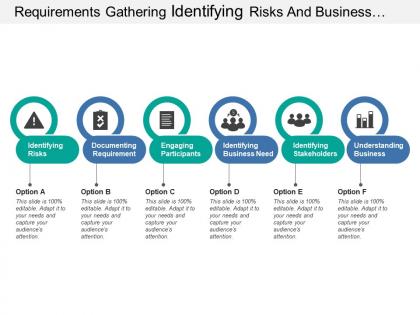
Appease insatiable desires with our Requirements Gathering Identifying Risks And Business Needs. Generate a high degree of contentment.
People who downloaded this PowerPoint presentation also viewed the following :
Requirements gathering identifying risks and business needs with all 5 slides:
Leave the feverish effort to our Requirements Gathering Identifying Risks And Business Needs. You can appear almost casual.
FAQs for Requirements gathering identifying risks
Interviews and workshops are your best bet - seriously, one-on-ones get people to actually tell you what's going on. Do structured interviews with key stakeholders first. Then run workshops to align everyone (and yeah, let them fight it out). Watch users work too - that's where you catch stuff they'd never mention. Surveys are fine as backup, but people lie on those things or just tell you what sounds good. Oh, and write everything down right after each session! You think you'll remember but trust me, you won't. Start with main users then branch out.
Honestly, the explicit stuff is pretty straightforward - just ask direct questions and write down what they tell you. But those implicit requirements? Total pain. People assume you know things they've never actually said out loud. I've learned to throw "what if" scenarios at them constantly. Also, watch how they actually work instead of just talking about it - there's always a gap there. User personas are clutch for this too. Oh, and definitely do multiple rounds of interviews plus some quick prototypes. That combo usually catches the stuff they forget to mention initially.
Personas are like your secret weapon for requirements gathering. They keep you grounded in what users actually want versus whatever random stuff stakeholders dream up. I literally ask "would Sarah the marketing manager use this?" for every single feature - sounds silly but it works. Plus they're perfect for prioritizing requirements around real user goals. Oh and definitely print them out or whatever and keep them visible during meetings. Nothing beats calling out persona names when people start going off track with feature requests. Trust me, it cuts through so much BS.
First, figure out who actually has pull in the organization - not everyone's opinion weighs the same (harsh but true). Get the conflicting people in a room together to hash it out. Yeah, it'll be awkward, but that's where you'll find the real issues. Use frameworks like MoSCoW or impact/effort grids to take emotion out of it. Still can't decide? Go back to your business goals and what users actually need. The biggest thing is being upfront about why you made each call. People won't always be happy with the outcome, but they'll respect the process if you're transparent about it.
Honestly, prototyping is your best bet - people get it when they can actually click around and see stuff. Story mapping sessions are super effective too, like you're literally building the user journey together. Don't overlook basic review meetings where you just walk through docs with them (boring but necessary). User acceptance testing is the real deal, but that's way down the line. Walkthroughs work well if your users are into detailed scenarios. Some people are visual learners, others want to talk everything through. Really depends on your crowd. Oh, and mockups are clutch for getting quick feedback early on.
Set boundaries from the start - figure out what "good enough" looks like and don't budge. I go for like 80% clarity on requirements then just move forward. You'll never hit 100% anyway, plus things always change. Hit the risky, important stuff first and put time limits on those analysis meetings. Week three of debating edge cases that barely anyone will use? That's when you know you've gone too far. Just build a tiny MVP with the basics, then improve it based on what people actually tell you. Way better than overthinking everything upfront.
Honestly, just use whatever your team already knows - don't overcomplicate it. Jira and Azure DevOps are decent if you're already doing project management there. Confluence is everywhere but kind of annoying to navigate sometimes (maybe that's just me?). There are fancier tools like Aha! or ProductPlan designed specifically for this stuff. But here's the thing - even Google Docs works fine for smaller projects. Notion's pretty solid too. The main issue isn't which tool is "best," it's getting everyone to actually stick with whatever you pick. Start simple.
Look, changing requirements happen constantly - don't beat yourself up about it. What saved my sanity was forcing people to actually write down their "quick requests" so I could show them how it'd mess with the timeline. Honestly, stakeholders have no clue how much their "tiny changes" can derail everything. Set up a proper change process where you assess impact before agreeing to anything. I got burned once when a simple addition ate three weeks of my life! Regular check-ins help too - catches this stuff early instead of last-minute panic mode. Stay flexible but don't let scope creep kill your main goals.
So with Agile, you basically flip the whole requirements thing on its head. Instead of trying to map out every tiny detail upfront (which never works anyway), you work in these short sprints. Build a little, get feedback, adjust, repeat. Honestly, it's so much better because - let's be real - most clients have no clue what they actually want until they see something. You start with the absolute must-haves and keep your stakeholders in the loop the whole time. When requirements change (and trust me, they always do), you can pivot without wanting to pull your hair out. Way less stressful than the old waterfall approach.
Honestly, getting everyone in the same room is a game-changer. Workshops and focus groups catch those conflicts you'd totally miss doing interviews one-on-one. People bounce ideas off each other and you'll spot gaps in real-time. I've seen departments realize they're talking about completely different things - those moments are gold. Plus you can hash out priorities together instead of trying to untangle conflicting opinions later. Fair warning though: you need someone decent running the show or it turns into chaos fast. Had one session last year that went completely sideways because we didn't prep the agenda properly.
Don't just assume what users want - actually talk to them first. Getting requirements from only one person is a recipe for disaster, trust me. Write everything clearly so your developers don't want to strangle you later. I've watched projects completely fall apart because teams skip validating stuff with users afterward. Also, prioritize your features or you'll just have a giant wishlist that goes nowhere. Document it all and get the important people to sign off before you start building anything. Sounds boring but it'll save your butt.
Honestly, visual stuff like wireframes and prototypes are total lifesavers for gathering requirements. People can actually see what you're building instead of trying to picture it from boring written specs. I can't tell you how many "wait, that's not what I wanted" conversations get avoided this way. Plus when stakeholders see a prototype, they'll suddenly remember all these edge cases they forgot to mention earlier - it's like magic or something. Start simple with rough sketches first. You can add more detail later once everyone's on the same page about what you're actually making.
So I always watch a few things to see if requirements gathering is actually working. Requirements volatility is huge - basically how much stuff changes after you think you're done. Defect rates help too, especially when you can trace them back to crappy requirements. Honestly? Incomplete requirements will screw you over every single time, so I measure completeness percentages. Also track how many times devs come back asking "wait, what did you mean by this?" - that's your red flag right there. Don't overcomplicate it though. Pick 2-3 metrics that actually matter for your project and just be consistent about measuring them each sprint.
Dude, this can make or break everything. Technical people are all about systems and what's actually possible, while business teams focus on outcomes and what users want. When they don't communicate well, you get something that works perfectly but solves the wrong problem - I've watched this disaster unfold way too many times. Regular check-ins help a ton. Keep the language simple, and honestly? Always repeat back what you think you heard. Sounds weird but it catches so many misunderstandings before they turn into expensive mistakes later.
Honestly, customer feedback is like your sanity check throughout the whole project. You think you know what users want at the start, but their real reactions show you what you actually got wrong. Short feedback loops are your best friend - don't make the mistake I see teams make all the time where they wait months to validate anything. Users will catch gaps you missed and help clarify those vague requirements that seemed clear in meetings but weren't. Business needs shift too, so you're basically course-correcting as you go. Get feedback early and often.
-
Presentation Design is very nice, good work with the content as well.
-
Great designs, really helpful.