

Requirements traceability matrix business stakeholder project manager priority source





Try Before you Buy Download Free Sample Product
 Impress Your
Audience
 100%
Editable
 Save Hours
of Time


Our Requirements Traceability Matrix Business Stakeholder Project Manager Priority Source are topically designed to provide an attractive backdrop to any subject. Use them to look like a presentation pro.
People who downloaded this PowerPoint presentation also viewed the following :
Requirements traceability matrix business stakeholder project manager priority source with all 12 slides:
Use our Requirements Traceability Matrix Business Stakeholder Project Manager Priority Source to effectively help you save your valuable time. They are readymade to fit into any presentation structure.




FAQs for Requirements traceability matrix business stakeholder project
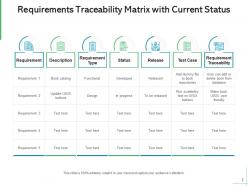
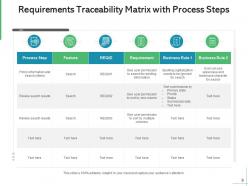
A Requirements Traceability Matrix (RTM) is a strategic documentation tool that maps and tracks relationships between business requirements, design specifications, test cases, and deliverables throughout the project lifecycle. This matrix enables project managers to ensure complete requirement coverage, minimize scope creep, and maintain stakeholder alignment, while facilitating faster change management and ultimately delivering enhanced project transparency and reduced risk of costly rework.
An RTM systematically tracks each requirement through every project phase by documenting its origin, linking it to design specifications, test cases, and deliverables, while monitoring status changes throughout development. This comprehensive tracking enables project managers to ensure complete requirement coverage, identify gaps or scope creep early, and maintain stakeholder alignment, ultimately delivering projects that meet all specified criteria while reducing rework and enhancing quality assurance.
A Requirements Traceability Matrix typically includes requirement IDs, descriptions, source documents, priority levels, status tracking, test cases, and verification methods. These components enable project teams to maintain comprehensive oversight by linking business needs to design specifications, implementation phases, and testing outcomes, with many organizations finding that this systematic approach significantly reduces project risks, enhances quality assurance, and streamlines compliance reporting.
A well-structured RTM benefits stakeholders by providing clear visibility into requirement status, facilitating change impact analysis, ensuring comprehensive test coverage, and maintaining alignment between business needs and deliverables. Throughout the project lifecycle, teams leverage RTMs to streamline communication, accelerate decision-making, and minimize rework, while project managers find enhanced control over scope and quality, ultimately delivering reduced costs and faster time-to-market.
Methods for maintaining and updating an RTM include automated traceability tools, regular review cycles, change impact analysis, stakeholder collaboration sessions, and version control integration. These approaches streamline requirements management by enabling real-time updates, ensuring cross-functional alignment, and maintaining comprehensive audit trails, with many project teams finding that systematic RTM maintenance ultimately delivers enhanced project visibility and reduced risk exposure.
Teams commonly face challenges including incomplete requirement documentation, complex tool integration, resource-intensive maintenance, and resistance to systematic tracking processes. While these obstacles can initially slow implementation, organizations in sectors like healthcare and financial services find that establishing clear traceability protocols, training team members thoroughly, and selecting appropriate tools ultimately streamlines project management and enhances delivery quality.
RTM facilitates compliance by creating comprehensive documentation trails that link regulatory requirements directly to design specifications, test cases, and validation results. In pharmaceuticals, medical devices, and aerospace industries, this systematic tracking enables auditors to verify complete requirement coverage, demonstrates adherence to standards like FDA 21 CFR Part 11 or DO-178C, and streamlines regulatory submissions while reducing compliance risks.
RTM enhances cross-functional communication by providing a centralized repository for requirement status, dependencies, and change impacts, ensuring all stakeholders access consistent information. Through shared visibility into requirement lifecycles, teams in development, testing, and business analysis can coordinate more effectively, reduce miscommunication, and align on project priorities, ultimately delivering faster resolution of issues and improved project outcomes.
Software tools enhance RTM creation and management by automating traceability links, providing real-time updates, and enabling collaborative editing across distributed teams. These platforms streamline requirement tracking through automated impact analysis, version control, and integration with testing frameworks, with many development organizations finding that dedicated RTM tools reduce manual overhead while improving compliance visibility and project delivery timelines.
RTM serves as a critical risk management tool by identifying potential gaps, dependencies, and coverage issues throughout the project lifecycle, enabling proactive mitigation strategies. Through systematic requirement tracking, organizations can assess impact scenarios, prioritize testing efforts, and ensure comprehensive validation coverage, with many software development teams finding that robust traceability significantly reduces deployment risks and enhances project predictability.
An RTM supports change management by providing complete visibility into requirement dependencies, impact analysis capabilities, and change tracking mechanisms throughout project lifecycles. Through systematic documentation and linking, project teams can quickly assess how proposed changes affect downstream elements like design specifications, test cases, and deliverables, ultimately enabling informed decision-making and minimizing project risks.
RTM usage differs significantly between methodologies, with Waterfall employing comprehensive upfront documentation and formal change control, while Agile uses lightweight, iterative traceability focused on current sprint requirements. While traditional development teams create detailed matrices linking business requirements to test cases, Agile organizations streamline traceability through user stories and acceptance criteria, ultimately delivering faster adaptability and continuous alignment with evolving business needs.
A traceability matrix improves test case design by ensuring comprehensive requirement coverage, identifying testing gaps, and eliminating redundant test scenarios while prioritizing critical functionalities based on business impact. Through systematic mapping between requirements and test cases, development teams streamline test execution cycles, enhance defect tracking accuracy, and deliver faster regression testing, with many software organizations finding that structured traceability ultimately reduces testing costs while improving product quality.
Best practices for developing an effective Requirements Traceability Matrix include establishing clear naming conventions, maintaining bidirectional traceability links, regularly updating status indicators, defining comprehensive coverage criteria, and implementing automated tracking tools. These practices streamline project management by enhancing visibility, reducing scope creep, and ensuring comprehensive testing coverage, with many software development teams finding that systematic traceability ultimately delivers faster delivery cycles and improved quality assurance.
Organizations can measure RTM implementation success through metrics like requirements coverage percentage, defect traceability rates, audit compliance scores, and change impact analysis efficiency. Many software development companies and regulated industries find that successful RTM implementation reduces post-release defects by 40-60%, accelerates compliance audits, and enables faster change management, ultimately delivering improved product quality and reduced development costs.
-
Presentation Design is very nice, good work with the content as well.
-
Nice and innovative design.
-
Innovative and attractive designs.
-
Wonderful templates design to use in business meetings.