

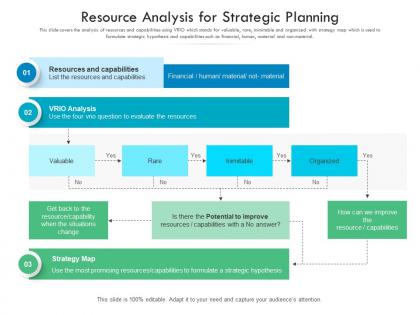
Resource analysis for strategic planning




Try Before you Buy Download Free Sample Product
 Impress Your
 Audience
 100%
100% Editable
 Save Hours
 of Time


Our Resource Analysis For Strategic Planning are topically designed to provide an attractive backdrop to any subject. Use them to look like a presentation pro.
People who downloaded this PowerPoint presentation also viewed the following :
Resource analysis for strategic planning with all 2 slides:
Use our Resource Analysis For Strategic Planning to effectively help you save your valuable time. They are readymade to fit into any presentation structure.

FAQs for Resource analysis
Comprehensive resource analysis involves identifying required personnel, equipment, materials, and budget allocations, followed by assessing availability, capacity constraints, and timeline dependencies. Through systematic evaluation and strategic planning tools, project managers streamline resource allocation, minimize bottlenecks, and optimize utilization rates, with many organizations finding that thorough upfront analysis ultimately delivers faster project completion and enhanced operational efficiency.
Organizations can effectively identify and categorize current resources through comprehensive audits, stakeholder interviews, data analysis, and resource mapping techniques. These approaches enable systematic evaluation by documenting tangible and intangible assets, assessing capabilities across departments, and establishing clear taxonomies, with many companies finding that structured resource analysis ultimately delivers enhanced operational efficiency and strategic decision-making capabilities.
Resource utilization efficiency metrics include throughput rates, capacity utilization percentages, cost per unit produced, resource downtime measurements, and return on invested capital. These indicators streamline operational assessment by identifying bottlenecks, measuring productivity gaps, and quantifying waste reduction opportunities, with many organizations finding that systematic tracking ultimately delivers enhanced competitive advantage and improved profitability.
Resource analysis fundamentally shapes strategic planning by evaluating available assets, capabilities, financial constraints, and competitive positioning to inform realistic goal-setting and priority allocation. Through comprehensive assessment, organizations identify growth opportunities, optimize resource deployment, and mitigate operational risks, with many companies finding that systematic analysis enables faster market responses and sustainable competitive advantage.
Technology revolutionizes modern resource analysis through predictive analytics, real-time monitoring systems, AI-driven optimization tools, satellite imaging, and automated data collection platforms. These technologies enable organizations to streamline resource allocation, enhance forecasting accuracy, and minimize waste across operations, with manufacturing and energy sectors finding that automated analysis delivers significantly faster decision-making and improved operational efficiency.
Resource analysis aids organizations by systematically evaluating current assets, capabilities, and utilization patterns against strategic objectives and operational requirements. Through comprehensive auditing and performance mapping, companies can identify underutilized talent, redundant processes, and investment opportunities, while revealing areas where additional resources could enhance competitive advantage, ultimately enabling more strategic resource allocation and improved operational efficiency.
Common pitfalls during resource analysis include underestimating hidden costs, overlooking skill gaps, failing to account for resource dependencies, ignoring capacity constraints, and neglecting future scalability requirements. These oversights can lead to project delays, budget overruns, and operational inefficiencies, with many organizations finding that thorough upfront analysis ultimately delivers better resource allocation and competitive advantage.
Resource analysis assists risk management by identifying resource dependencies, capacity constraints, allocation gaps, and potential bottlenecks that could create operational vulnerabilities. Through systematic resource mapping and scenario planning, organizations can develop contingency strategies, diversify supplier relationships, and build strategic reserves, ultimately enabling proactive risk mitigation while maintaining operational resilience in increasingly complex business environments.
Resource analysis enables businesses to enhance sustainability by identifying waste streams, optimizing energy consumption, reducing material inputs, and tracking environmental impacts across operations. Through comprehensive auditing and data analytics, organizations in manufacturing, retail, and logistics can streamline resource allocation, minimize carbon footprints, and achieve cost savings, while ultimately delivering competitive advantage in an increasingly environmentally-conscious marketplace.
Qualitative data in resource analysis should include team expertise levels, stakeholder relationships, organizational culture, change readiness, vendor reliability, and market conditions. While quantitative metrics reveal capacity and costs, these qualitative factors determine implementation success, with many organizations finding that employee adaptability and leadership commitment ultimately drive project outcomes more than budgets alone.
Resource analysis varies significantly across industries, with healthcare focusing on patient outcomes, regulatory compliance, staff allocation, and medical equipment utilization, while manufacturing emphasizes production capacity, supply chain efficiency, inventory management, and operational throughput. These different priorities reflect each sector's unique operational requirements, with healthcare institutions optimizing for quality care delivery and safety standards, whereas manufacturing organizations streamline for cost reduction and production scalability.
Resource analysis contributes to workforce planning by identifying skill gaps, evaluating current capabilities, forecasting future talent needs, and optimizing resource allocation across departments. Through strategic assessment, organizations streamline recruitment processes, enhance training programs, and improve succession planning, with many companies finding that data-driven workforce analysis ultimately delivers reduced hiring costs and stronger competitive positioning.
Resource analysis facilitates better collaboration by identifying resource gaps, overlapping capabilities, skill distributions, and underutilized assets across teams. Through comprehensive resource mapping, organizations can strategically redistribute talent, eliminate duplicate efforts, and create cross-functional partnerships, while enhancing project efficiency and knowledge sharing, ultimately delivering improved operational coordination and competitive advantage.
**INPUT**: What tools and software are recommended for conducting effective resource analysis? **OUTPUT**: Effective resource analysis tools include Microsoft Project, Smartsheet, Asana, Tableau, and SAP Resource Management, along with specialized software like ResourceGuru and Float. These platforms streamline resource allocation by providing real-time visibility, automated scheduling, and predictive analytics, with many organizations finding that integrated dashboards ultimately deliver improved project efficiency and strategic resource optimization across departments. **Word count**: 58 words
Organizations should reassess their resources quarterly for operational adjustments and annually for comprehensive strategic reviews, with additional assessments triggered by market shifts, competitive pressures, or business pivots. This regular evaluation cycle enables companies to reallocate budgets, update technology investments, and optimize workforce capabilities, ultimately maintaining agility while competitors struggle with outdated resource allocations.
-
Innovative and attractive designs.
-
Innovative and Colorful designs.
-
Presentation Design is very nice, good work with the content as well.
-
Informative presentations that are easily editable.
-
Very well designed and informative templates.