

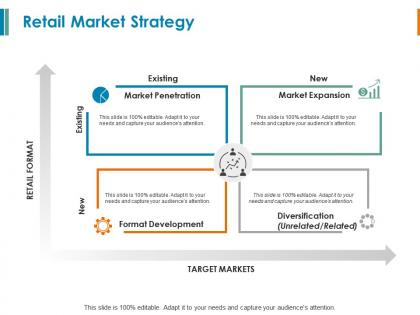
Retail market strategy market expansion ppt powerpoint presentation model summary




Try Before you Buy Download Free Sample Product
 Impress Your
Audience
 100%
Editable
 Save Hours
of Time


Bring dichotomy to an end with our Retail Market Strategy Market Expansion Ppt Powerpoint Presentation Model Summary. Ensure individual differences cease to exist.
People who downloaded this PowerPoint presentation also viewed the following :
Content of this Powerpoint Presentation
Description:
The image is a PowerPoint slide titled "Retail Store Management Icons Slide," which displays a collection of icons related to various aspects of retail store management. These icons can represent tasks, processes, or roles within retail management, such as financial transactions, customer service, inventory management, and more. Each icon is a visual representation of a component of retail operations; for example, a shopping cart for purchasing, a gear for operations, or a cash register for sales.
This collection of icons is a visual aid that can be used to enhance communication in presentations, documents, or software applications related to store management. Icons are often used in business to quickly convey ideas or functions in an easily recognizable format.
Use Cases:
These slides with icons can be used in the following industries for various purposes:
1. Retail:
Use: Training on store operations management
Presenter: Retail Operations Trainer
Audience: Store Managers, Employees
2. E-commerce:
Use: Illustrating online sales and customer service processes
Presenter: E-commerce Strategist
Audience: Customer Support Team, Online Sales Staff
3. Logistics & Supply Chain:
Use: Demonstrating logistics processes in product distribution
Presenter: Supply Chain Analyst
Audience: Logistics Managers, Warehouse Staff
4. Human Resources:
Use: Depicting HR tasks in retail hiring and training
Presenter: HR Manager
Audience: New Employees, HR Team
5. Marketing:
Use: Visualizing marketing strategies and consumer engagement
Presenter: Marketing Director
Audience: Marketing Team, Brand Managers
6. Technology & POS Solutions:
Use: Explaining point of sale (POS) system features
Presenter: Technology Product Manager
Audience: Retailers, Tech Staff
7. Financial Services:
Use: Outlining financial management in retail operations
Presenter: Financial Advisor
Audience: Store Owners, Finance Teams
Retail market strategy market expansion ppt powerpoint presentation model summary with all 5 slides:
Ensure individual differences cease to exist with our Retail Market Strategy Market Expansion Ppt Powerpoint Presentation Model Summary. Bring dichotomy to an end.


FAQs for Retail market strategy market expansion ppt powerpoint
Key indicators include strong sales growth, increased customer demand, market saturation in current locations, positive cash flow, and competitor expansion activity. These metrics enable retailers to assess market readiness by analyzing consumer behavior patterns, demographic shifts, and economic conditions, with many retail organizations finding that strategic timing ultimately delivers competitive advantage and sustainable growth in new territories.
Consumer demographics significantly influence retail market expansion strategies by determining product assortment, store locations, pricing models, marketing channels, and service offerings tailored to specific age groups, income levels, and lifestyle preferences. Retailers like Target and Walmart analyze demographic data to strategically position stores in high-growth suburban areas versus urban markets, ultimately delivering personalized shopping experiences and competitive advantage in increasingly diverse consumer landscapes.
Technological innovation drives modern retail expansion by enabling omnichannel experiences, automating inventory management, personalizing customer interactions, and streamlining supply chain operations. These technologies help retailers enter new markets more efficiently while reducing operational costs, with many companies finding that digital-first approaches deliver faster market penetration and enhanced competitive positioning.
Brick-and-mortar retailers can leverage e-commerce for expansion through omnichannel integration, online marketplaces, digital marketing, inventory optimization, and customer data analytics. These strategies enable retailers to reach new geographic markets, offer convenient pickup and delivery options, and create personalized shopping experiences, with many finding that seamless online-offline integration ultimately delivers increased revenue streams and competitive advantage.
Risks include market saturation, cultural misalignment, regulatory compliance challenges, supply chain disruptions, and intense local competition. While these present significant challenges, many retailers find that thorough market research, strategic partnerships with local suppliers, and phased expansion approaches help minimize exposure while enabling competitive positioning in increasingly diverse retail landscapes.
Retailers leverage data analytics to inform expansion strategies by analyzing customer demographics, purchasing patterns, competitor presence, location foot traffic, and market saturation levels. Through predictive modeling and geographic analysis, businesses identify optimal store locations, determine product mix preferences, and forecast revenue potential, while minimizing expansion risks, ultimately delivering strategic market entry and enhanced competitive positioning.
Best practices for selecting store locations during market expansion include demographic analysis, competitor mapping, foot traffic assessment, accessibility evaluation, and cost-benefit analysis of lease terms. Successful retailers like Target and Starbucks combine these factors by analyzing customer density, transportation hubs, and local purchasing power, ultimately delivering strategic positioning that maximizes visibility while minimizing operational costs and enhancing market penetration.
Local market research is critically important for retail expansion success, as it reveals consumer preferences, competitive landscapes, regulatory requirements, and cultural nuances that directly impact strategy effectiveness. Through comprehensive market analysis, retailers can optimize product mix, pricing strategies, and store formats while minimizing risks, with many successful expansions finding that localized insights ultimately deliver higher customer adoption rates and stronger competitive positioning.
Cultural differences significantly impact retail expansion through varying consumer preferences, shopping behaviors, communication styles, payment methods, and social values that require strategic adaptation. International retailers must navigate these complexities by localizing product offerings, adjusting marketing approaches, and modifying store experiences, with many successful brands finding that cultural sensitivity ultimately delivers stronger customer loyalty and sustainable competitive advantage in diverse markets.
Partnerships and collaborations enhance retail market expansion by providing access to new customer bases, sharing operational costs, and leveraging complementary expertise and resources. Through strategic alliances, retailers can enter new geographic markets, expand product offerings, and accelerate growth timelines, with many finding that collaborative approaches deliver faster market penetration and reduced financial risk.
Effective marketing strategies for new store openings include grand opening events, local community partnerships, targeted digital advertising, influencer collaborations, and loyalty program launches. These approaches streamline brand awareness by creating buzz, building local connections, and driving initial foot traffic, with many retailers finding that combining online promotion with in-store experiences ultimately delivers higher customer acquisition and sustained engagement.
Logistics and supply chain management significantly influence retail expansion decisions by determining cost structures, delivery capabilities, and operational feasibility in new markets. Retailers must evaluate distribution networks, warehousing infrastructure, and transportation costs, with many finding that strategic supply chain partnerships enable faster market entry while minimizing capital investment and operational complexity.
Sustainable practices for retail market expansion include energy-efficient store designs, local sourcing partnerships, waste reduction programs, sustainable packaging solutions, and community engagement initiatives. These strategies streamline operational costs while enhancing brand reputation, with many retailers finding that eco-friendly approaches attract environmentally conscious consumers, ultimately delivering competitive advantage and long-term market viability in new territories.
Success after retail expansion can be measured through revenue growth, market share gains, customer acquisition rates, store profitability metrics, and operational efficiency indicators. These measurements enable retailers to track performance across new locations, compare against established stores, and assess return on investment, while many organizations find that combining financial metrics with customer satisfaction scores delivers comprehensive insights into long-term expansion viability.
Customer experience serves as the foundation for successful retail market expansion, directly influencing brand perception, customer loyalty, repeat purchases, and word-of-mouth recommendations in new territories. Through personalized service, seamless omnichannel integration, and localized offerings, retailers can differentiate themselves from established competitors, build trust with unfamiliar customer bases, and accelerate market penetration, with many successful expansions finding that superior customer experience ultimately drives sustainable growth and competitive advantage.
No Reviews