

Retail Store Positioning And Marketing Strategies Powerpoint Presentation Slides




Try Before you Buy Download Free Sample Product
 Impress Your
 Audience
 100%
100% Editable
 Save Hours
 of Time


Our Retail Store Positioning And Marketing Strategies Powerpoint Presentation Slides are topically designed to provide an attractive backdrop to any subject. Use them to look like a presentation pro.
People who downloaded this PowerPoint presentation also viewed the following :
Content of this Powerpoint Presentation
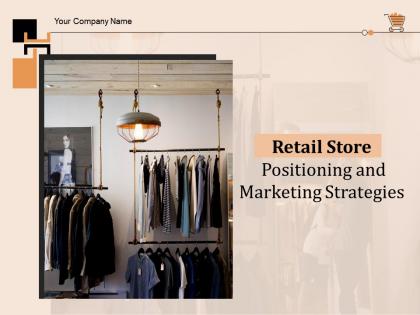
Slide 1: This slide introduces Retail Store Positioning and Marketing Strategies. State Your Company Name and begin.
Slide 2: This is an Agenda slide. State your agendas here.
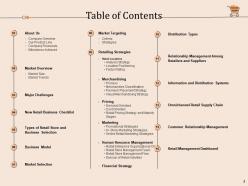
Slide 3: This slide shows Table of Content for the presentation.
Slide 4: This slide presents Table of Content for the presentation.
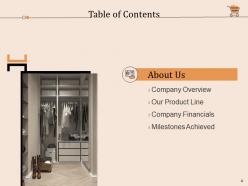
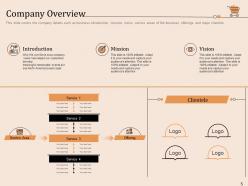
Slide 5: This slide covers the company details such as business introduction, mission, vision, service areas, etc.
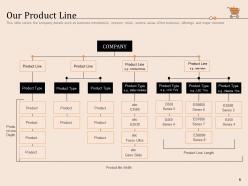
Slide 6: This slide displays the product line of the company including product types, product names and series of the products.
Slide 7: This slide represents an overview of revenue, gross profit, net profit and earning per share of the company.
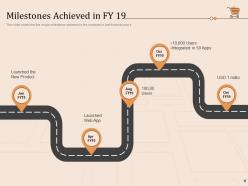
Slide 8: This slide covers the five major milestones achieved by the company in last financial year.
Slide 9: This slide presents Table of Content for the presentation.
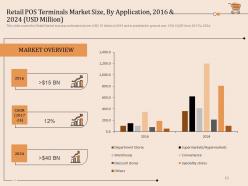
Slide 10: This slide covers the Retail Market size was estimated at over USD 15 billion in 2016.
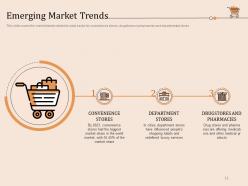
Slide 11: This slide displays the market trends related to retail sector for convenience stores, drugstores or pharmacies and departmental stores.
Slide 12: This slide represents Table of Content for the presentation.
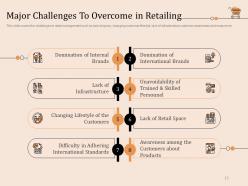
Slide 13: This slide covers the challenges in retail management such as lack of space, changing customer lifestyle, lack of infrastructure customer awareness and many more.
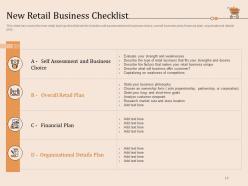
Slide 14: This slide presents new retail start-up checklist which includes self assessment and business choice, overall business plan, financial plan, etc.
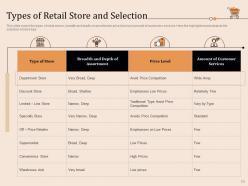
Slide 15: This slide covers the types of retail stores, breadth and depth od assortment, price level and amount of customers services.
Slide 16: This slide displays Table of Content for the presentation.
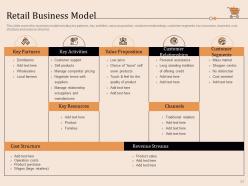
Slide 17: This slide represents the business model including key partners, key activities, value proposition, etc.
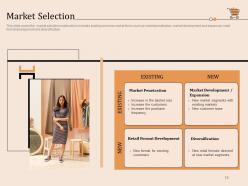
Slide 18: This slide covers the market selection matrix which includes existing and new market forms such as market penetration, market development and expansion, etc.
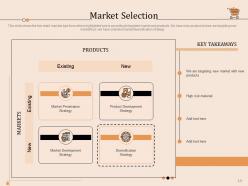
Slide 19: This slide presents the four retail markets type from where highlighted one is according to targeted market and products.
Slide 20: This slide shows Table of Content for the presentation.
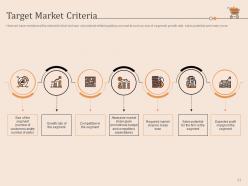
Slide 21: This slide displays Attainable market share given promotional budget and competitors expenditures.
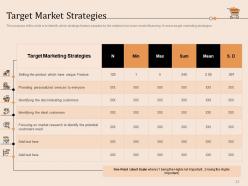
Slide 22: This slide represents strategic feature adopted by the retailers as most influencing.
Slide 23: This slide shows Table of Content highlighting Retailing Strategies.
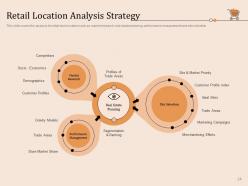
Slide 24: This slide presents the analysis for retail store location such as market research, real estate planning, performance measurement and site selection.
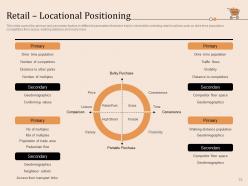
Slide 25: This slide covers the primary and secondary factors in different parameters that were kept in mind while selecting retail locations such as drive time population, competitors floor space, walking distance and many more.
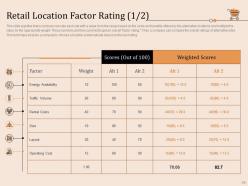
Slide 26: This slide displays that a company can rate each site with a value from the range based on the costs and benefits.
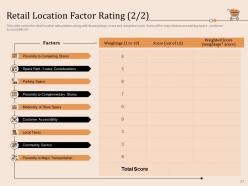
Slide 27: This slide represents the retail location rating factors along with its weightage, score and, weighted score.
Slide 28: This slide shows Table of Content highlighting Merchandising.
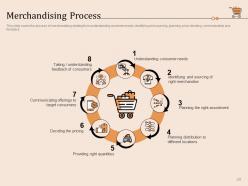
Slide 29: This slide presents the process of merchandising starting from understanding customer needs, identifying and sourcing, planning, etc.
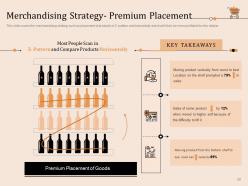
Slide 30: This slide covers the merchandising strategy such as placement of products in Z- pattern and horizontally which will likely be more profitable for the retailer.
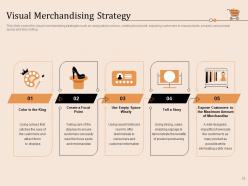
Slide 31: This slide displays the visual merchandising strategies such as using catchy colours, creating focal point, exposing customers to max products, etc.
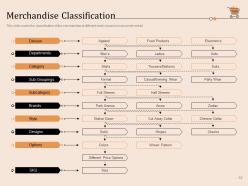
Slide 32: This slide represents the classification of the merchandise at different levels based on consumer needs.
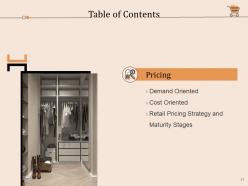
Slide 33: This slide shows Table of Content highlighting Retail Pricing Strategy and Maturity Stages.
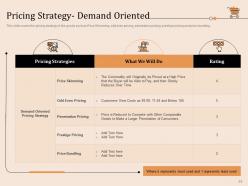
Slide 34: This slide presents the pricing strategy of the goods such as Price Skimming, odd even pricing, penetration pricing, prestige pricing and price bundling.
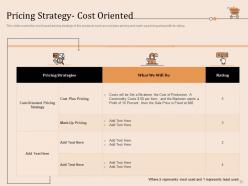
Slide 35: This slide covers the cost based pricing strategy of the products such as cost plus pricing and mark-up pricing along with its rating
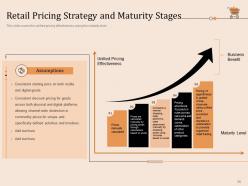
Slide 36: This slide displays the unified pricing effectiveness along the maturity level.
Slide 37: This slide represents Table of Content highlighting Marketing.
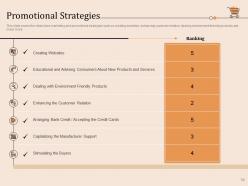
Slide 38: This slide covers the retail store marketing and promotional strategies such as creating websites, enhancing customer relation, dealing environment friendly products and many more.
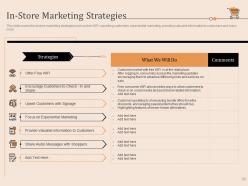
Slide 39: This slide presents the instore marketing strategies such as free WIFI, upselling customers, experiential marketing, etc.
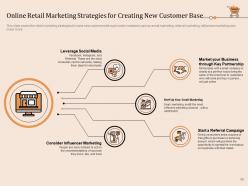
Slide 40: This slide covers the retail marketing strategies to make new customers through online mediums such as email marketing, referral marketing, influencer marketing and many more.
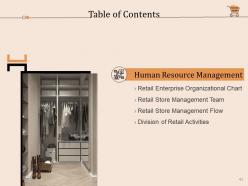
Slide 41: This slide displays Table of Content highlighting Human Resource Management.
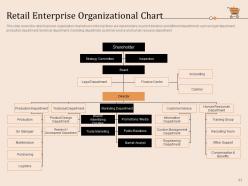
Slide 42: This slide represents the retail business organization chart where on the top there are stakeholders, board of directors and different departments.
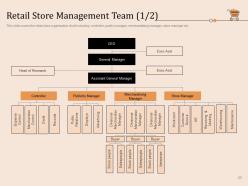
Slide 43: This slide covers the retail store organization chart including controller, public manager, merchandising manager, store manager etc.
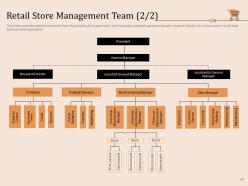
Slide 44: This slide presents the departmental store team flow starting from upper level which includes president, general manager, research director, etc.
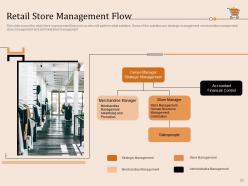
Slide 45: This slide covers the retail store management flow such as who will perform what activities.
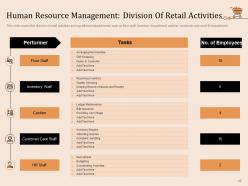
Slide 46: This slide displays Human Resource Management: Division Of Retail Activities.
Slide 47: This slide represents Table of Content highlighting Financial Strategy.
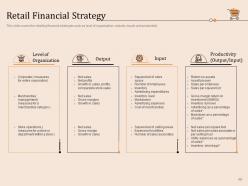
Slide 48: This slide covers the retailing financial strategies such as level of organization.
Slide 49: This slide presents Table of Content highlighting Distribution Types.
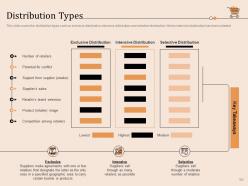
Slide 50: This slide covers the distribution types such as exclusive distribution, intensive distribution and selective distribution.
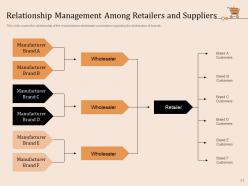
Slide 51: This slide displays the relationship of the manufacturer wholesaler and retailer regarding the distribution of brands.
Slide 52: This slide represents Table of Content highlighting Information and Distribution System.
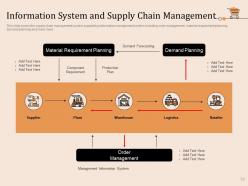
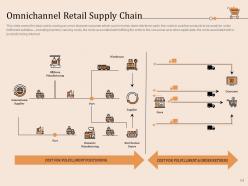
Slide 53: This slide covers the supply chain management system supporting information management system including order management, material requirement planning, demand planning and many more
Slide 54: This slide presents the total cost to serving an omni-channel consumer.
Slide 55: This slide shows Table of Content for the presentation Customer Relationship Management.
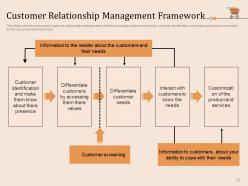
Slide 56: This slide displays the framework customer relationship management in retailing including customer screening, customer identification, customizing products and services for the consumer and many more
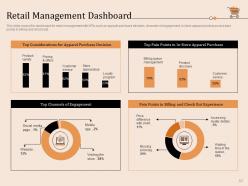
Slide 57: This slide represents the dashboard for retail management with KPIs such as apparel purchase decision, channels of engagement, in store apparel purchases, etc.
Slide 58: This slide shows Retail Store Positioning and Marketing Strategies Icons.
Slide 59: This slide is titled as Additional Slides for moving forward.
Slide 60: This is About Us slide to show company specifications etc.
Slide 61: This is Our Mission slide with related imagery and text.
Slide 62: This slide represents 30 60 90 Days Plan with text boxes.
Slide 63: This slide shows Post It Notes. Post your important notes here.
Slide 64: This is Our Team slide with names and designation.
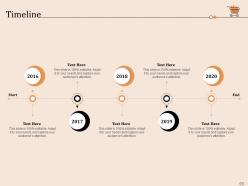
Slide 65: This is a Timeline slide. Show data related to time intervals here.
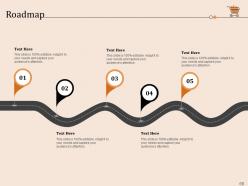
Slide 66: This slide displays Roadmap with additional textboxes.
Slide 67: This is a Thank You slide with address, contact numbers and email address.
Retail Store Positioning And Marketing Strategies Powerpoint Presentation Slides with all 67 slides:
Use our Retail Store Positioning And Marketing Strategies Powerpoint Presentation Slides to effectively help you save your valuable time. They are readymade to fit into any presentation structure.





FAQs for Retail Store Positioning And Marketing Strategies
Effective retail marketing strategies for brick-and-mortar stores include omnichannel integration, location-based mobile marketing, experiential in-store events, personalized loyalty programs, and social media integration with physical spaces. These approaches streamline customer journeys by combining digital convenience with tactile experiences, targeted promotions, and community engagement, with many retailers finding that strategic technology integration ultimately delivers enhanced customer loyalty and competitive differentiation.
Retailers leverage social media platforms through targeted advertising campaigns, user-generated content initiatives, influencer partnerships, live shopping features, and personalized customer service interactions. These strategies enable brands to build authentic relationships, showcase products in real-time, and create seamless shopping experiences, with many fashion and beauty retailers finding that social commerce drives significantly higher conversion rates and customer loyalty.
Personalized marketing enables retailers to deliver targeted content, product recommendations, and customized experiences based on individual customer data, purchase history, and behavioral patterns. Through advanced analytics and AI-driven insights, retailers enhance customer engagement, increase conversion rates, and build stronger brand loyalty, with many finding that personalized approaches significantly boost sales and customer lifetime value.
Retailers can measure marketing campaign effectiveness through key performance indicators like conversion rates, customer acquisition costs, return on ad spend, sales attribution, and customer lifetime value. Through advanced analytics and tracking tools, businesses monitor website traffic, social media engagement, and in-store foot traffic, with many retailers finding that multi-channel attribution models deliver comprehensive insights and optimize future campaign performance.
Omnichannel marketing delivers seamless customer experiences across all touchpoints, increased sales through multiple channels, enhanced customer data collection, improved brand consistency, and stronger customer loyalty. By integrating online stores, physical locations, mobile apps, and social media platforms, retailers like Target and Sephora create unified shopping journeys, ultimately driving higher conversion rates and competitive advantage.
In-store experiences can be enhanced through personalized customer service, interactive product demonstrations, seamless omnichannel integration, loyalty program touchpoints, and immersive brand storytelling. These strategies streamline customer journeys by creating memorable interactions, reducing friction points, and delivering tailored recommendations, with many retailers finding that enhanced experiences increase repeat purchases by 25-40% while building lasting customer relationships.
Innovative promotional tactics include experiential marketing events, social media contests with user-generated content, influencer partnerships, pop-up installations, and personalized loyalty programs with gamification elements. These strategies enhance customer engagement by creating memorable brand experiences, leveraging digital word-of-mouth, and building emotional connections, with many retailers finding that interactive approaches deliver higher conversion rates and sustained customer loyalty.
Retailers use data analytics to inform marketing decisions by analyzing customer behavior patterns, purchase histories, demographic trends, and seasonal fluctuations to optimize targeting strategies. Through predictive analytics and customer segmentation, retail companies enhance personalization, improve inventory allocation, and increase conversion rates, while minimizing marketing waste, ultimately delivering higher ROI and more effective customer acquisition campaigns.
Successful retail loyalty programs include personalized rewards, tiered membership structures, seamless mobile integration, data-driven customer insights, and omnichannel accessibility. These elements enhance customer retention by delivering targeted offers, exclusive experiences, and convenient redemption options, with many retailers finding that strategic personalization and seamless digital integration ultimately drive higher customer lifetime value and competitive advantage.
Environmental sustainability can be integrated into retail marketing through eco-friendly packaging, carbon-neutral shipping options, sustainable product sourcing, green store operations, and transparent supply chain communications. Many retailers like Patagonia and IKEA find that highlighting renewable materials, waste reduction programs, and environmental partnerships not only attracts eco-conscious consumers but also reduces operational costs while building long-term brand loyalty and competitive differentiation.
Retailers transitioning to e-commerce face challenges including inventory management integration, customer data migration, digital marketing adaptation, logistics restructuring, and technology platform selection. However, strategic phased implementation enables streamlined operations, enhanced customer experiences, and expanded market reach, with many retail organizations finding that comprehensive digital transformation ultimately delivers increased sales, reduced operational costs, and competitive advantage.
Consumer trends significantly influence retail marketing strategies by driving product positioning, channel selection, messaging approaches, and customer engagement tactics throughout each business cycle. Retailers increasingly adapt their promotional campaigns, digital presence, and inventory focus based on emerging lifestyle preferences, with many fashion, electronics, and food brands finding that trend-responsive marketing delivers enhanced customer loyalty and competitive market positioning.
Mobile shopping revolutionizes retail marketing by enabling personalized campaigns, location-based targeting, and real-time customer engagement through apps and social platforms. Retailers increasingly leverage mobile analytics, push notifications, and seamless checkout experiences to drive conversions, with fashion brands and grocery chains finding that mobile-first strategies significantly enhance customer loyalty and boost sales.
Influencers can be effectively utilized through authentic partnerships, targeted audience alignment, product collaborations, and performance-based campaigns that leverage their credibility and reach. Retail brands like fashion companies and beauty retailers find success by selecting micro-influencers with engaged communities, creating co-branded content, and measuring ROI through trackable links, ultimately driving brand awareness and sales conversion.
Effective in-store signage and displays require clear, compelling messaging, strategic placement at eye level and high-traffic areas, consistent brand colors and fonts, and seasonal relevance. These elements enhance customer navigation, promote impulse purchases, and reinforce brand identity, with many retailers finding that well-designed displays increase product visibility by 30% while streamlining the shopping experience and driving sales conversion.
-
Easy to edit slides with easy to understand instructions.
-
Best way of representation of the topic.
-
The content is very helpful from business point of view.
-
Awesomely designed templates, Easy to understand.
-
Top Quality presentations that are easily editable.
-
Understandable and informative presentation.
-
The content is very helpful from business point of view.