

Revolutionizing AI Rise And Potential Of Artificial General Intelligence Complete Deck Ppt Template





Try Before you Buy Download Free Sample Product
 Impress Your
Audience
 100%
Editable
 Save Hours
of Time


This PPT introduces Revolutionizing AI Rise and Potential of Artificial General Intelligence. AGI refers to the field of theoretical AI, which attempts to create software with human-like intelligence and the ability to self-teach. The aim is to allow software to be able to perform tasks that are not necessarily trained or developed for. It is theoretical pursuit to develop AI systems possessing autonomous self-control, self-understanding, and ability to learn new skills. This deck covers details related to challenges hindering AI to achieve human-level intelligence. It includes details related to the development of AI towards Artificial General Intelligence. and showcases ways in which AGI bridges gaps in AI. It consists of details related to AGI, such as its framework and key capabilities etc. It also includes approaches to AGI such as symbolic approach, connectionist approach, hybrid approach, and whole organism architecture. It caters to applications of AGI in customer support, code analysis, navigation, healthcare, education sector, manufacturing, and supply chain management. Lastly, it covers details related to real-life examples of AGI. It covers the latest and emerging trends in AGI, such as natural language processing NLP, metaverse, hyper-automation, and conversational AI chatbots. It also covers the difference between AGI and other types of AI. It also showcases threats and concerns posed by AGI. Grab it now.
People who downloaded this PowerPoint presentation also viewed the following :
Content of this Powerpoint Presentation
Slide 1: This is title slide of the presentation "Revolutionizing AI:Rise And Potential of Artificial General Intelligence."
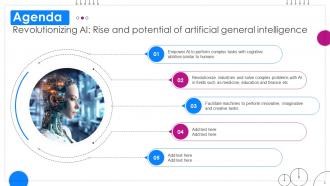
Slide 2: This is an Agenda slide. State your agendas here.
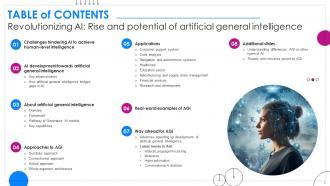
Slide 3: This slide shows Table of Content for the presentation.
Slide 4: This slide highlights title for topics that are to be covered next.
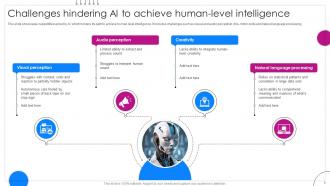
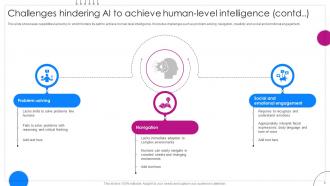
Slide 5: This slide showcases capabilities lacked by AI which hinders its path to achieve human level intelligence.
Slide 6: This slide showcases capabilities lacked by AI which hinders its path to achieve human level intelligence.
Slide 7: This is another slide highlighting title for topics that are to be covered next.
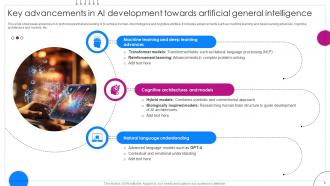
Slide 8: This slide showcases advances in AI technologies that are leading AI to achieve human-like intelligence and cognitive abilities.
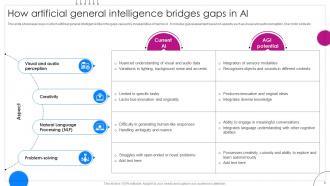
Slide 9: This slide showcases ways in which artificial general intelligence fills in the gaps caused by incapabilities of narrow AI.
Slide 10: This slide highlights title for topics that are to be covered next.
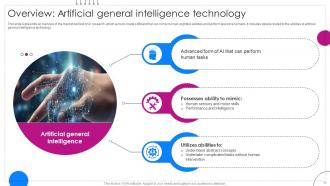
Slide 11: This slide represents an overview of the theoretical field of AI research, which aims to create software that can mimic human cognitive abilities and perform tasks like humans.
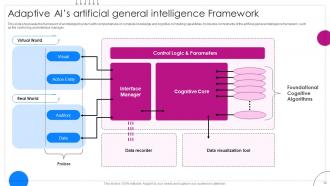
Slide 12: This slide showcases the framework of an intelligent system with comprehensive or complete knowledge and cognitive computing capabilities.
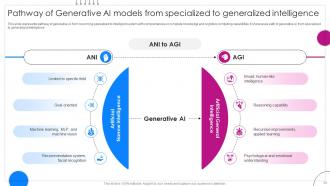
Slide 13: This slide represents pathway of generative AI from becoming specialized to intelligent system with comprehensive or complete knowledge and cognitive computing capabilities.
Slide 14: This slide highlights the capabilities of machine or software that can perform any intellectual task that a human can do.
Slide 15: This slide highlights title for topics that are to be covered next.
Slide 16: This slide showcases details related to one of the approach of theoretical field of AI research.. It includes information related to symbolic approach of AGI.
Slide 17: This slide showcases details related to one of the approach of theoretical field of AI research.It includes information related to connectionist approach of AGI.
Slide 18: This slide showcases details related to one of the approach of theoretical field of AI research.It includes information related to hybrid approach of AGI.
Slide 19: This slide showcases details related to one of the approach of theoretical field of AI research.It includes information related to whole organism architecture.
Slide 20: This slide highlights title for topics that are to be covered next.
Slide 21: This slide represents key applications of machine or software that can perform any intellectual task that a human can do.
Slide 22: This slide showcases the application of hypothetical intelligence in a machine that possesses the ability to understand or learn intellectual tasks that a human can do.
Slide 23: This slide represents key applications of machine or software.It showcases how artificial general intelligence helps in navigation, exploration, etc.
Slide 24: This slide represents key applications of machine or software.It showcases how artificial general intelligence will revolutionize healthcare sector.
Slide 25: This slide showcases how artificial general intelligence will revolutionize education sector.
Slide 26: This slide showcases how artificial general intelligence will revolutionize manufacturing and supply chain management.
Slide 27: This slide represents how artificial general intelligence will help in financial services.
Slide 28: This slide represents how artificial general intelligence will help in research and development sector.
Slide 29: This slide highlights title for topics that are to be covered next.
Slide 30: This slide showcases examples of AGI such as IBM’s Watson, Expert systems, self-driving cars etc.
Slide 31: This slide showcases examples of AGI such as Alpha Go, language model GPT-3 and GPT-4 etc.
Slide 32: This slide highlights title for topics that are to be covered next.
Slide 33: This slide represents advances that are speeding up development of an intelligent system with comprehensive or complete knowledge and cognitive computing capabilities.
Slide 34: This slide highlights title for topics that are to be covered next.
Slide 35: This slide showcases upgradation of natural language processing models such as GPT.
Slide 36: This slide showcases the rise of the metaverse as it accelerates the development of capabilities such as problem-solving, etc.
Slide 37: This slide showcases the rise of hyper automation, which allows AI systems to learn from a wide range of experiences.
Slide 38: This slide showcases the rise of conversational AI chatbots as virtual assistants.
Slide 39: This slide highlights title for topics that are to be covered next.
Slide 40: This slide showcases how artificial general intelligence differs from other types of AI.
Slide 41: This slide showcases threats and risks posed by an intelligent system with comprehensive or complete knowledge and cognitive computing capabilities.
Slide 42: This is Icons'Slide on Revolutionizing AI rise and potential of artificial general intelligence.
Slide 43: This slide is titled as Additional Slides for moving forward.
Slide 44: This is an Idea Generation slide to state a new idea or highlight information, specifications etc.
Slide 45: This slide provides 30 60 90 Days Plan with text boxes.
Slide 46: This is Our Goal slide. State your firm's goals here.
Slide 47: This is a Financial slide. Show your finance related stuff here.
Slide 48: This is a Timeline slide. Show data related to time intervals here.
Slide 49: This slide presents Roadmap with additional textboxes.
Slide 50: This slide contains Puzzle with related icons and text.
Slide 51: This slide depicts Venn diagram with text boxes.
Slide 52: This is a Timeline slide. Show data related to time intervals here.
Slide 53: This slide shows Post It Notes for reminders and deadlines. Post your important notes here.
Slide 54: This is a Thank You slide with address, contact numbers and email address.
Revolutionizing AI Rise And Potential Of Artificial General Intelligence Complete Deck Ppt Template with all 62 slides:
Use our Revolutionizing AI Rise And Potential Of Artificial General Intelligence Complete Deck Ppt Template to effectively help you save your valuable time. They are readymade to fit into any presentation structure.











FAQs for Revolutionizing AI Rise And Potential Of Artificial General Intelligence Complete
Artificial General Intelligence possesses human-like cognitive flexibility to understand, learn, and apply knowledge across diverse domains, while Narrow AI excels at specific, predefined tasks like image recognition or language translation. AGI would enable seamless adaptation between complex problem-solving scenarios, from scientific research to creative endeavors, ultimately delivering unprecedented versatility compared to today's specialized AI systems.
Progress toward AGI can be measured through comprehensive cognitive benchmarks, cross-domain learning assessments, reasoning capabilities, creative problem-solving tests, and adaptability metrics across diverse scenarios. These evaluation frameworks enable researchers to track advancement by comparing performance in language understanding, mathematical reasoning, and strategic thinking, with many institutions finding that multi-modal testing approaches deliver increasingly accurate intelligence comparisons.
Key ethical considerations for AGI include ensuring human control and oversight, preventing job displacement without social safety nets, addressing algorithmic bias and fairness, protecting privacy rights, and maintaining transparency in decision-making processes. Organizations must balance AGI's transformative potential with responsible deployment, establishing governance frameworks that prioritize human welfare while enabling competitive advantage in an increasingly automated landscape.
AGI will likely transform employment by automating complex cognitive tasks, creating new technology-focused roles while displacing traditional positions across healthcare, finance, and manufacturing sectors. This transition presents both challenges and opportunities, with many organizations finding that strategic workforce retraining, human-AI collaboration models, and emphasis on uniquely human skills like creativity and emotional intelligence ultimately deliver competitive advantage and enhanced productivity.
AGI risks include alignment challenges, economic displacement, security vulnerabilities, concentration of power, and unpredictable emergent behaviors. These concerns can be mitigated through robust safety research, gradual deployment frameworks, international governance standards, and collaborative oversight mechanisms, with many organizations finding that proactive risk management, transparent development practices, and stakeholder engagement ultimately deliver safer implementation and sustainable competitive advantage.
AGI could enhance human creativity by analyzing vast datasets to identify patterns, generating novel combinations of existing ideas, providing real-time collaborative feedback, and offering diverse perspectives across disciplines. Through strategic partnership with AGI systems, creative professionals, researchers, and innovators can accelerate ideation processes, explore unconventional solutions, and ultimately deliver breakthrough innovations while maintaining human intuition and emotional intelligence.
Emerging technologies like quantum computing and neural networks serve as foundational pillars for AGI development, with quantum systems potentially revolutionizing computational processing speeds and neural architectures enabling sophisticated pattern recognition and learning capabilities. These technologies enhance research by accelerating complex simulations, optimizing large-scale data processing, and creating more adaptive algorithms, with many research institutions finding that their strategic combination ultimately delivers breakthrough insights and competitive advantages in artificial intelligence development.
Ensuring AGI alignment requires robust value learning systems, transparent decision-making frameworks, diverse stakeholder involvement in development, and continuous monitoring protocols throughout deployment phases. These approaches enable organizations to build accountability mechanisms, establish ethical guardrails, and maintain human oversight, with many institutions finding that collaborative governance ultimately delivers safer implementation and sustained public trust.
The most promising AGI research approaches include neural architecture search, multi-modal learning, reinforcement learning frameworks, cognitive architectures, and transformer-based foundation models. These methodologies enhance artificial reasoning by combining symbolic and connectionist approaches, enabling cross-domain knowledge transfer, and scaling computational capabilities, with many research institutions finding that hybrid models deliver increasingly sophisticated problem-solving abilities across diverse applications.
Cultural perceptions of AGI vary significantly, with Western countries emphasizing ethical frameworks and regulation, while Asian nations like China prioritize technological advancement and economic competitiveness. These differing approaches present both challenges and opportunities for global collaboration, with many organizations finding that cross-cultural perspectives enhance AGI development strategies, ultimately delivering more comprehensive solutions and broader international acceptance in an increasingly interconnected technological landscape.
AGI governance requires comprehensive frameworks addressing safety standards, ethical guidelines, transparency requirements, international coordination protocols, and liability structures. These regulatory approaches must balance innovation with risk management across sectors like healthcare, finance, and defense, with many policymakers finding that adaptive, multi-stakeholder frameworks ultimately deliver responsible development while maintaining competitive advantage.
Interdisciplinary collaboration accelerates AGI development by combining cognitive science insights, ethical frameworks, computational advances, and domain expertise from neuroscience, philosophy, and engineering. Through strategic partnerships, research teams can address safety concerns, bias mitigation, and societal implications while advancing technical capabilities, with many institutions finding that diverse perspectives ultimately deliver more robust, responsible AGI systems.
AGI presents both transformative opportunities and significant security challenges for military applications, including autonomous defense systems, predictive threat analysis, strategic decision-making, and cyber warfare capabilities. While these technologies can enhance national security through faster threat detection and response, they also raise concerns about autonomous weapons, algorithmic bias in critical decisions, and the potential for adversaries to leverage AGI, ultimately requiring international cooperation and ethical frameworks to ensure responsible military implementation.
AGI could revolutionize healthcare by enabling comprehensive patient data analysis, real-time diagnostic accuracy across multiple specialties, and personalized treatment protocols tailored to individual genetic profiles. Through advanced pattern recognition, hospitals and medical institutions might deliver precise early disease detection, customized drug therapies, and streamlined care coordination, ultimately enhancing patient outcomes while reducing costs.
Historical attempts to build intelligent machines teach AGI developers that narrow, rule-based approaches have limitations, while adaptability, learning from data, and multi-modal integration prove essential for true intelligence. Early AI winters demonstrate that overpromising leads to funding shortfalls, with today's researchers increasingly focusing on incremental progress, robust testing, and ethical frameworks, ultimately delivering more sustainable advancement toward general intelligence systems.
-
The presentations are very helpful. I am always able to get appropriate templates for the different topics related to my profession.
-
“Detailed and great to save your time.”