

Ribosome Function PPT Graphics ACP





Try Before you Buy Download Free Sample Product
 Impress Your
Audience
 100%
Editable
 Save Hours
of Time


Unlock the secrets of ribosome function with our professional PowerPoint presentation deck. Featuring high-quality graphics and informative slides, this resource is perfect for educators and researchers. Enhance your understanding of protein synthesis and molecular biology with visually engaging content designed for impactful presentations. Ideal for academic and professional settings.
People who downloaded this PowerPoint presentation also viewed the following :
Ribosome Function PPT Graphics ACP with all 41 slides:
Use our Ribosome Function PPT Graphics ACP to effectively help you save your valuable time. They are readymade to fit into any presentation structure.















FAQs for Ribosome Function
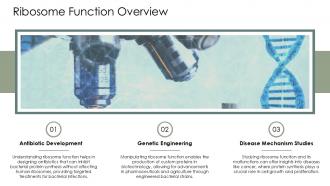
Ribosomes serve as cellular protein factories, translating messenger RNA sequences into functional proteins through peptide bond formation, amino acid assembly, and quality control mechanisms. These molecular machines enable cells to produce essential enzymes, structural components, and regulatory molecules, ultimately delivering the proteins necessary for cellular metabolism, growth, and specialized functions across all biological systems.
Ribosomes translate mRNA into amino acids by reading genetic codons, binding transfer RNA molecules carrying specific amino acids, and catalyzing peptide bond formation between amino acids. Through this coordinated process, ribosomes systematically decode messenger RNA sequences, facilitate tRNA recognition and positioning, and assemble amino acids into functional proteins, ultimately delivering the cellular machinery necessary for essential biological processes and protein synthesis.
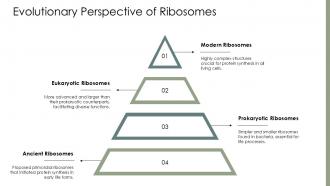
Prokaryotic ribosomes are smaller (70S) with 30S and 50S subunits, while eukaryotic ribosomes are larger (80S) with 40S and 60S subunits, differing in protein synthesis locations and antibiotic sensitivity. These structural differences enable targeted therapeutic approaches, with pharmaceutical companies leveraging prokaryotic-specific features for antibiotic development, ultimately delivering precise treatments while preserving beneficial cellular functions.
Ribosome subunits assemble on mRNA through a coordinated process where the small subunit first binds to the ribosome binding site, scans for the start codon, then recruits the large subunit to form the complete ribosome. This assembly mechanism enables precise translation initiation, ensures accurate protein synthesis, and maintains cellular efficiency, with many organisms finding that this systematic approach ultimately delivers consistent, high-fidelity protein production across diverse biological systems.
The ribosomal binding site (RBS) in mRNA is a critical sequence that determines where ribosomes attach to initiate protein synthesis, directly controlling translation efficiency and gene expression levels. This regulatory mechanism enables cells to fine-tune protein production based on metabolic needs, with biotechnology companies and pharmaceutical manufacturers increasingly leveraging RBS optimization to enhance therapeutic protein yields and reduce production costs.
Transfer RNA molecules interact with ribosomes through specific binding sites, delivering amino acids to growing protein chains during translation. The ribosome's A, P, and E sites guide tRNA movement, with each tRNA's anticodon matching messenger RNA codons, while aminoacyl-tRNA synthetases ensure accurate amino acid attachment, ultimately enabling precise protein synthesis through coordinated molecular recognition and catalytic processes.
Ribosomal RNA (rRNA) forms the structural backbone and catalytic core of ribosomes, while ribosomal proteins provide stability, facilitate assembly, and enhance functionality through strategic positioning around the RNA framework. This combination creates highly efficient protein synthesis machinery that enables cells to streamline production processes, maintain quality control, and ultimately deliver the consistent protein output essential for organizational growth and competitive advantage.
Post-translational modifications significantly enhance protein functionality by adding phosphate groups, acetyl groups, ubiquitin tags, and glycosylation patterns that regulate activity, localization, and stability. These modifications enable proteins to perform specialized roles across cellular processes, with enzymes gaining regulatory control, membrane proteins achieving proper trafficking, and signaling molecules delivering precise cellular responses, ultimately optimizing cellular efficiency and adaptive capabilities.
Ribosomes employ proofreading mechanisms including aminoacyl-tRNA selection, proofreading during peptide bond formation, and post-translational editing to ensure protein synthesis accuracy. These quality control systems work by verifying correct codon-anticodon pairing, rejecting incorrect amino acids, and enabling error correction, ultimately delivering high-fidelity protein production essential for cellular function and metabolic efficiency.
Antibiotics target bacterial ribosomes by binding to specific sites on the 30S or 50S ribosomal subunits, disrupting protein synthesis through blocking translation initiation, elongation, or termination. These mechanisms enable healthcare providers to combat infections effectively, with streptomycin targeting the 30S subunit and chloramphenicol affecting the 50S subunit, ultimately delivering targeted bacterial inhibition while preserving human cellular function.
Ribosomes represent crucial evolutionary evidence as they likely preceded DNA-based life, with their RNA-based catalytic core suggesting an ancient "RNA World" where ribosomes were among the first self-replicating molecular machines. Their universal presence across all domains of life, from bacteria to complex organisms, demonstrates their fundamental role in establishing protein synthesis as the foundation for biological complexity, ultimately enabling the evolutionary leap from simple chemical reactions to sophisticated cellular machinery that drives all modern life forms.
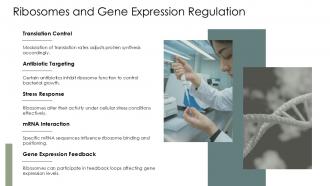
Ribosomes regulate gene expression through translational control mechanisms, including ribosome profiling, selective mRNA translation, and ribosomal protein modifications that influence protein synthesis rates. These cellular mechanisms enable precise control over which proteins are produced and when, with research laboratories and biotechnology companies finding that ribosomal regulation ultimately delivers targeted therapeutic approaches and enhanced understanding of cellular processes.
Ribosomal defects cause ribosomopathies by disrupting protein synthesis, leading to cell growth abnormalities, tissue dysfunction, and developmental disorders like Diamond-Blackfan anemia and Shwachman-Diamond syndrome. These conditions particularly affect rapidly dividing tissues such as bone marrow and intestinal cells, ultimately compromising cellular function and organ development, with many patients experiencing growth retardation and increased cancer risk.
Technologies used to study ribosome structure and function include cryo-electron microscopy, X-ray crystallography, nuclear magnetic resonance spectroscopy, ribosome profiling, and single-molecule fluorescence techniques. These advanced methods enhance research capabilities by delivering atomic-level structural detail, real-time translation monitoring, and dynamic conformational analysis, ultimately enabling pharmaceutical companies and biotechnology firms to accelerate drug discovery and therapeutic development.
Cellular stressors like heat shock, oxidative stress, and nutrient depletion significantly impact ribosome activity by altering ribosomal RNA modifications, disrupting assembly processes, and triggering stress response pathways that prioritize essential protein production. These cellular mechanisms enable organisms to streamline protein synthesis toward survival-critical functions, reduce energy expenditure on non-essential processes, and ultimately maintain cellular homeostasis during challenging environmental conditions.
-
“Immediate response, professional support, and effective solutions that were customized and immediately provided. Well done- Thank you!”
-
Graphics are very appealing to eyes.