

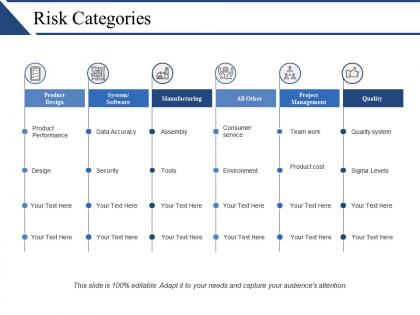
Risk categories ppt examples slides




Try Before you Buy Download Free Sample Product
 Impress Your
Audience
 100%
Editable
 Save Hours
of Time


Our Risk Categories Ppt Examples Slides get comments going. Folks feel like expressing appreciation.
People who downloaded this PowerPoint presentation also viewed the following :
Risk categories ppt examples slides with all 5 slides:
Lighten up with our Risk Categories Ppt Examples Slides. They will take up some of the burden.


FAQs for Risk categories
So there's basically four big buckets to think about. Operational stuff hits first - supply chain mess, systems crashing, your best people bailing. Financial risks are the usual suspects: market swings, credit problems, cash flow nightmares. Compliance and regulatory? Don't even get me started - feels like there's new rules every damn week. Strategic risks are trickier though. Competition blindsiding you, tech making your business model obsolete overnight, reputation going up in flames. Map these against what you actually do, then figure out which one would really screw you over. That's your starting point.
So operational risks are basically when your own stuff breaks down - system crashes, someone screws up a process, supply chain gets messed up, that kind of thing. Financial risks are more about market forces hitting your wallet, like interest rates shifting or customers defaulting on payments. Most operational problems come from inside your company (except cyberattacks obviously), but financial risks? That's usually external stuff you can't really control. Honestly, I'd map these out separately when you're doing risk planning since fixing them requires totally different approaches. Way easier to tackle them one category at a time.
Dude, regulatory stuff can literally kill your business overnight - especially in healthcare, banking, pharma where they don't mess around. One screw-up means massive fines or they just yank your license. I know companies burning like 20-30% of their budget on compliance alone, which is insane but necessary. The worst part? Regulations change constantly so you're always scrambling to keep up with new rules. My advice - bake compliance monitoring into your risk management from the start. Don't bolt it on later when you're already behind.
Oh man, yeah - bad reputation will absolutely wreck your business long-term. Customers bail for competitors, investors get spooked and pull out, good employees won't even apply. The worst part? Trust takes forever to rebuild, like years. I've seen companies still dealing with fallout from stuff that happened ages ago. It makes everything harder - launching products, expanding markets, you name it. Honestly, most people underestimate how much damage spreads over time. You should probably monitor what people say about you online and have some kind of plan ready if things go sideways.
Honestly, cyberattacks and data breaches are the big ones right now. Ransomware is brutal - I've seen companies basically held hostage. Your supply chain is probably more vulnerable than you think, and don't get me started on AI making horrible decisions that blow up on social media. Skills gaps are huge too since most teams can't keep up with how fast tech changes. Oh, and regulatory stuff will bite you if you're not careful during digital transitions. My advice? Run risk assessments regularly and have solid incident response plans ready. Better to be paranoid than sorry.
Dude, multinationals get absolutely wrecked by political chaos because they're spread everywhere. Trade wars hit. Sanctions drop out of nowhere. Supply chains break when some country decides to throw a fit - I swear it's like the worst possible timing always. Currency goes crazy, markets get blocked, sometimes governments just steal your stuff. Wild, right? Smart companies spread their suppliers around so they're not screwed if one region implodes. Keep politicians happy where you can, have backup plans for everything. Never bet your whole business on one country being stable.
Honestly, just grab a spreadsheet and start listing out what could go wrong. Get your different teams together - like IT knows cyber stuff that your finance people would never think of. Sort everything by how bad it'd be and how likely it is to happen. Those heat map things are actually pretty helpful for visualizing it all. Industry benchmarks can give you ideas too, or bring in a consultant if you're totally stuck (though that gets pricey). Don't try to tackle everything at once - start with the obvious big risks first. Way better than having one person trying to figure it all out alone.
Big companies deal with stuff they can actually predict - competitors they know, regulations that shift slowly, demand cycles they've seen before. Startups though? You're basically gambling on whether people even want your product. There's no playbook when you don't know if customers will bite. Established players have years of data to work with, but startups are just making educated guesses half the time. The cool thing is you can change direction fast when something's not working - try getting a Fortune 500 company to pivot that quickly, good luck with that.
Ugh yeah, nonprofits deal with some wild stuff. Donor dependency is brutal - one major funder pulls out and you're scrambling. Businesses at least have multiple revenue streams, you know? Then there's all the tax-exempt compliance nonsense (seriously, it's like they designed it to be confusing). Mission drift happens more than people think too. You'll chase grants that don't quite fit just because you need the money. Board issues are another headache since volunteers don't always get the business side. Oh, and definitely test different funding scenarios - helps you sleep better at night.
Start with supplier audits to spot environmental and social risks early. Map your whole supply chain first - yeah, it's boring but you can't fix what you don't know about. Create clear sustainability standards for everyone, then do regular check-ins through site visits and third-party reviews. Build actual relationships instead of just going for cheap bids. Suppliers who feel invested will stick to your standards way better. Also think about spreading suppliers across different regions so you're not putting all eggs in one basket. Focus on your riskiest suppliers first.
Keep it super visual - complex matrices just confuse people. Define your categories clearly (high, medium, low) and stick with the same colors everywhere. Real examples are gold though, way better than theoretical stuff. I always pull scenarios from similar projects or our industry. Oh and definitely adjust your pitch based on who you're talking to. Execs want the quick version, tech teams need the nitty-gritty details. Follow up with a simple one-pager they can actually use later - trust me, they'll forget half of what you said otherwise.
Look, your risk appetite basically decides how you sort and rank risks company-wide. High appetite for strategic moves but zero tolerance for compliance stuff? You're gonna bucket operational risks way differently than some ultra-conservative firm would. Think of it like organizing your worries by what actually scares the executives vs. what they can sleep through. The tricky part is making sure your categories match what you say your appetite is - otherwise you're just spinning your wheels on the wrong problems. Oh, and skip those cookie-cutter templates. Map everything to your real tolerance levels instead.
COSO ERM and ISO 31000 are probably your best bet for frameworks - they give you solid structure for identifying and managing different risk types. Risk registers and heat maps are clutch for visualization. Monte Carlo simulations are awesome if you need probability modeling (though maybe overkill depending on your situation). Start with a basic risk register template honestly. Don't get caught up in fancy tech right away. Once you're ready to scale up, GRC platforms like ServiceNow or MetricStream can automate tons of this stuff. But seriously, keep it simple at first and build based on what you actually need.
So basically you want to make a risk matrix - just draw a grid with likelihood on one side and impact on the other. Plot all your risks on there. The high impact + high probability stuff? That's your nightmare quadrant, tackle those first. Medium ones need some kind of plan and regular check-ins. Low/low risks are honestly pretty boring but document them anyway since auditors get weird about missing paperwork. I'd focus most of your energy on that top-right corner initially. For the scary high-priority ones, make actual action plans with real people assigned and deadlines. Then just work down systematically from there.
Dude, the pandemic totally broke how we think about risk management. Everything's connected now - supply chain problems trigger cyber issues, which then mess up customer trust. It's like dominoes falling everywhere. Those old risk categories we learned about? Pretty much useless when everything hits at once. You can't just look at financial risk separately from operational stuff anymore. Map out how these risks actually feed into each other instead of treating them like separate problems. Build plans that expect multiple crises to happen simultaneously, because apparently that's just how the world works now.
-
Informative design.
-
Use of icon with content is very relateable, informative and appealing.