

Risk Governance Structure Introducing A Risk Based Approach To Cyber Security




Try Before you Buy Download Free Sample Product
 Impress Your
Audience
 100%
Editable
 Save Hours
of Time


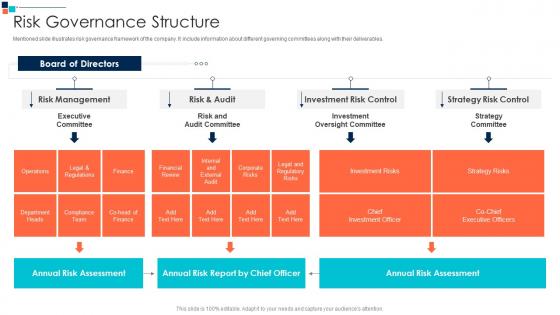
Mentioned slide illustrates risk governance framework of the company. It include information about different governing committees along with their deliverables.
People who downloaded this PowerPoint presentation also viewed the following :
Risk Governance Structure Introducing A Risk Based Approach To Cyber Security with all 6 slides:
Use our Risk Governance Structure Introducing A Risk Based Approach To Cyber Security to effectively help you save your valuable time. They are readymade to fit into any presentation structure.






FAQs for Risk Governance Structure Introducing A Risk Based Approach
Key components of an effective risk governance structure include a dedicated risk committee, clear risk appetite statements, comprehensive risk policies, robust reporting mechanisms, and defined accountability frameworks. These elements work together by establishing oversight authority, setting tolerance boundaries, and creating transparent communication channels, with many organizations finding that this integrated approach ultimately delivers better decision-making and enhanced regulatory compliance.
A well-defined risk governance framework enhances decision-making by establishing clear accountability structures, standardized risk assessment protocols, and transparent reporting mechanisms across organizational levels. Through systematic risk identification and evaluation processes, executives can make informed strategic choices while minimizing potential threats, with many organizations finding that structured frameworks ultimately deliver faster decision cycles and improved competitive positioning.
Stakeholders play crucial roles in shaping risk governance structures through board oversight, risk appetite definition, regulatory compliance guidance, and strategic input from shareholders, employees, and customers. Their diverse perspectives enable organizations to identify blind spots, establish comprehensive risk frameworks, and ensure governance structures align with business objectives, ultimately delivering enhanced decision-making and sustainable competitive advantage.
Organizations integrate risk governance with corporate governance by embedding risk considerations into board oversight, strategic planning, and decision-making processes, establishing clear risk appetite statements aligned with business objectives. This integration involves creating cross-functional risk committees, implementing consistent reporting frameworks, and ensuring risk metrics inform executive compensation and performance evaluation, with many companies finding that unified governance structures enhance transparency, accountability, and strategic resilience.
Organizations face challenges including unclear risk ownership across departments, inconsistent risk assessment methodologies, inadequate board-level risk expertise, and siloed communication between risk functions and business units. These structural gaps often result in delayed risk identification, conflicting risk priorities, and insufficient integration with strategic planning, with many enterprises finding that fragmented governance ultimately undermines comprehensive risk visibility and effective decision-making.
Technology enhances risk governance effectiveness by automating risk monitoring, providing real-time data analytics, and enabling comprehensive reporting across organizational levels. Through AI-driven platforms and integrated dashboards, financial institutions and healthcare organizations streamline compliance processes, accelerate decision-making, and improve transparency, ultimately delivering better oversight and competitive advantage in increasingly complex regulatory environments.
Essential metrics for evaluating risk governance performance include risk appetite alignment, incident response times, regulatory compliance rates, risk identification accuracy, and stakeholder communication effectiveness. These metrics enable organizations to streamline oversight processes, enhance decision-making transparency, and minimize operational disruptions, with many financial institutions and healthcare organizations finding that comprehensive measurement frameworks ultimately deliver improved regulatory confidence and competitive advantage.
Organizations ensure regulatory compliance through comprehensive risk governance frameworks that integrate regulatory requirements into policies, procedures, and oversight mechanisms, supported by dedicated compliance teams and regular monitoring systems. Financial services firms and healthcare organizations particularly benefit from automated compliance tracking, regular audits, and board-level oversight committees, ultimately delivering regulatory adherence while streamlining operational efficiency and minimizing compliance costs.
Risk appetite serves as the foundational framework that guides risk governance decisions, defining acceptable risk levels across strategic objectives, operational processes, and compliance requirements. Through established governance structures, organizations translate risk appetite into policies, monitoring mechanisms, and decision-making protocols, with financial services and healthcare sectors finding this alignment enables consistent risk-taking while maintaining regulatory compliance and operational efficiency.
Organizations foster risk awareness culture through comprehensive training programs, clear communication channels, leadership modeling, regular risk discussions, and employee incentive alignment with risk management objectives. Through interactive workshops and scenario-based learning, companies like banks and healthcare systems embed risk consciousness into daily operations, ultimately delivering enhanced decision-making capabilities and organizational resilience.
Best practices for continuous improvement in risk governance include regular framework assessments, stakeholder feedback integration, benchmarking against industry standards, technology adoption for enhanced monitoring, and establishing clear performance metrics. Through systematic reviews and data-driven insights, organizations streamline risk processes, enhance decision-making transparency, and strengthen regulatory compliance, with many financial institutions and healthcare systems finding that continuous governance evolution ultimately delivers competitive advantage and operational resilience.
Risk governance varies significantly across industries due to distinct regulatory requirements, risk profiles, and operational complexities, with financial services emphasizing credit and market risks while healthcare focuses on patient safety and compliance risks. Manufacturing sectors prioritize operational and supply chain risks, retail emphasizes cybersecurity and reputation management, and energy companies concentrate on environmental and safety protocols, ultimately enabling each industry to address sector-specific challenges while maintaining competitive advantage.
Risk governance implementation is supported by risk management frameworks like COSO and ISO 31000, governance software platforms, risk assessment tools, compliance monitoring systems, and board reporting dashboards. These resources enable organizations to streamline risk identification, enhance regulatory compliance, and automate monitoring processes, with many financial institutions and healthcare organizations finding that integrated platforms ultimately deliver improved decision-making and operational efficiency.
Organizations effectively communicate risk governance strategies through comprehensive reporting frameworks, stakeholder-specific dashboards, regular board presentations, transparent disclosure documents, and structured engagement sessions. These communication mechanisms streamline stakeholder understanding by delivering tailored risk insights, enhancing transparency across governance levels, and enabling informed decision-making, with many financial services and healthcare organizations finding that consistent, multi-channel communication ultimately strengthens stakeholder confidence and regulatory compliance.
Successful risk governance case studies reveal that effective structures integrate clear accountability frameworks, regular stakeholder communication, and adaptive response mechanisms across organizational levels. Financial institutions and healthcare organizations demonstrate that combining board-level oversight with operational risk committees, real-time monitoring systems, and cross-functional collaboration ultimately delivers enhanced decision-making speed, regulatory compliance, and competitive resilience in increasingly complex business environments.
-
SlideTeam is a great place for PPT templates. They have many templates on a single topic. It has made my life a lot easier.
-
Commendable slides with attractive designs. Extremely pleased with the fact that they are easy to modify. Great work!