

Risk Management Heat Map Low Medium High 4x4 Ppt Infographics




Try Before you Buy Download Free Sample Product
 Impress Your
 Audience
 100%
100% Editable
 Save Hours
 of Time


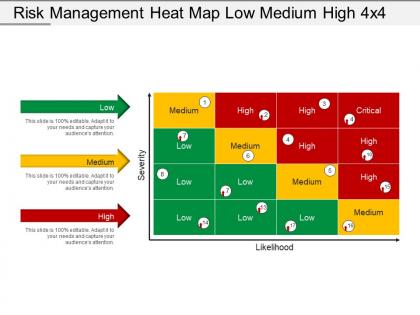
Do you want to highlight risk management analysis for your business? We are offering our intelligently designed risk management heat map low medium high 4x4 PPT infographics template to let you do it without any trouble. Companies use a variety of approaches to identify risk factors. When the risks are identified then each risk is assessed for potential probability and consequences. This risk assessment heat map template helps you to successfully display risk factors and its impact with multiple colors, where red indicates highest and green lowest magnitude of risk. PPT template also helps you to enable business conversation about mitigation strategies by successfully doing business impact analysis. This professionally drafted risk management heat map PowerPoint template is suitable for presentations related to risk evaluation and management. PPT design will be of a great help to subject matter experts, risk analysts, project managers. So, don’t take too long, download this amazing heat maps showing probability and risk and use it in your future presentations. Bulbs begin to flash with our Risk Management Heat Map Low Medium High 4x4 Ppt Infographics. Your brain will be full of bright ideas.
People who downloaded this PowerPoint presentation also viewed the following :
Risk Management Heat Map Low Medium High 4x4 Ppt Infographics with all 5 slides:
Your audience will owe you a debt of gratitude. Lead them to profit with our Risk Management Heat Map Low Medium High 4x4 Ppt Infographics.

FAQs for Risk Management Heat Map Low Medium High
Honestly, you just need four things that actually matter. Start by figuring out what could go wrong - both the obvious stuff and those random disasters that always hit when you're least ready. Rank them by how bad they'd be versus how likely. Then pick your strategy for each one: avoid it, reduce it, pass it off to someone else, or just accept the risk. Oh, and don't forget to assign owners - I've seen too many plans die because nobody's checking if things changed. Review it regularly or it'll just collect dust.
Honestly, you gotta get systematic about this stuff. Map out your main processes first, then go through each one asking "what could break here?" Sounds boring but it works. Set up a basic risk register - just rate things 1-5 for how likely they are and how much damage they'd do. Different teams will catch things you totally miss, so definitely loop them in. Oh, and don't make this a one-and-done thing. Review quarterly because risks change all the time. The trick is building it into your routine instead of scrambling when someone upstairs suddenly wants a risk assessment.
Honestly, you can't manage risk well anymore without tech backing you up. Real-time monitoring catches stuff as it happens, while predictive analytics spot problems before they blow up. The AI/machine learning side is pretty insane - like, scary good at forecasting disasters. Automated alerts grab things people miss, plus you get way better dashboards and compliance tracking. Oh, and scenario modeling lets you test "what if" situations without actually breaking anything. My advice? Figure out where you're flying blind first, then find tools that fill those gaps. Start small though - don't go crazy with some massive system right away.
Honestly, it's all about your industry. Healthcare? You're obsessing over patient safety and HIPAA stuff - nobody wants a data breach nightmare. Finance is totally different - they care about market crashes, fraud, and whether their portfolios can survive a recession. Sure, the frameworks look similar, but the day-to-day is completely different. Like, hospitals worry about infection control while banks are running stress tests all day. My advice? Figure out what would absolutely destroy your company, then work backwards from there. That's where you focus your energy first.
So a risk appetite statement is basically your company's official "here's how much crazy we're willing to handle" document. It keeps everyone aligned on what risks are cool versus what'll get you fired. Otherwise you'll have accounting being super cautious while marketing's out there making wild bets - total chaos honestly. Short sentences work best here. The whole point is using it like a compass when you're deciding on new projects or big moves. Without one, departments just wing it based on their own comfort levels, which rarely ends well.
Track your incident frequency and how much money you're losing compared to before - that's the real test. Recovery times matter too. Are you actually hitting those risk targets you set? When stuff goes wrong, do your controls kick in or just sit there looking pretty? Compliance audits are boring but they don't lie. Near-miss reports can be goldmines if you pay attention to the patterns. Also check how fast your team jumps on new risks. Do a quarterly check-in to see if you're meeting those original goals you probably wrote on a whiteboard somewhere.
Honestly, automation is your best friend here - set up alerts for the stuff that matters so you're not blindsided. Make sure everyone knows who to call when things get messy, and don't put all your eggs in one basket with critical processes. Cross-train people too because Murphy's Law guarantees your key person will be on vacation during a crisis. I do these quick 5-minute team check-ins daily (sounds cheesy but it works) to catch problems early. The trick is weaving this into your normal routine instead of scrambling when everything's already on fire.
Think of risk management as your company's built-in BS detector for decisions. Executives use it to figure out if expanding into new markets is genius or financial suicide. Middle managers lean on that same data when they're picking which projects to fund first. Even regular employees follow risk protocols daily - they just don't realize it half the time. The tricky part? You need frameworks that actually give people clear direction at every level. Can't just be some fancy document gathering dust while everyone wings it.
Oh man, where do I start? Most companies treat risk management like some one-and-done thing instead of updating it regularly. Big mistake. You'll see people obsessing over financial stuff but totally ignoring operational or reputation risks - like, hello, those matter too! Another thing that drives me crazy: keeping it all in one department instead of making everyone care about it. Either companies become so scared they can't make decisions, or they're way too chill about new threats. Honestly? Just do quarterly reviews and get your departments actually talking to each other about what worries them.
Look, good stakeholder communication is like having extra eyes on everything. They'll catch risks you totally missed because they're seeing different angles of the business. Being transparent builds trust too - people actually want to help when they're not getting blindsided by awful news later. I learned this the hard way once, honestly. Your mitigation strategies get way better buy-in because everyone understands why you're making these decisions. Set up regular check-ins. Be honest about risks AND your plans to fix them. It's basically your early warning system.
Honestly, think of risk management as your secret weapon for sustainability stuff. You're not just protecting against bad things - you're hunting for opportunities. Like when new regulations drop, you can switch to greener practices way before your competitors even notice. Map out your sustainability risks next to the regular business ones and you'll probably find some easy wins just sitting there. Investors eat this up too, especially the ESG crowd. Oh, and it keeps you from those PR nightmares that tank companies overnight. Use those same risk frameworks to check environmental and social impacts - builds trust with everyone who matters.
So basically you've gotta track all the regulations hitting your industry - SOX, GDPR, banking rules, whatever applies to you. Your risk framework needs to actually match up with these, not just be some checkbox exercise. Contractual stuff matters too, plus liability concerns. Honestly, it's kind of a pain because regulations change constantly. Document everything though - seriously, get legal involved early in your risk assessments. Oh, and set up regular compliance check-ins. Way better to catch problems before they blow up. The whole thing's basically a moving target but you can't ignore it.
Oh man, this is such a real thing. Your German teammates will freak out about compliance stuff that Brazilians just shrug off. Then it flips for other risks. Some cultures hate uncertainty while others roll with it - honestly causes so much drama in planning meetings. Plus in super hierarchical places, junior people won't say anything even when they spot problems. You've gotta build frameworks that work with these different mindsets but still give everyone the same basic rules to follow.
So the big ones right now are AI risk modeling, climate stuff, and cyber frameworks - ESG compliance is getting crazy too. Cyber's probably your best starting point since regulators won't shut up about it. Then dive into climate scenario planning once you've got that sorted. The AI thing is honestly wild - predictive analytics are getting scary good, but it changes every week so good luck keeping up lol. Real-time monitoring is replacing those useless quarterly reviews too, thank god. Those were always outdated before the ink dried anyway.
Think of scenario planning like a video game where you can test drive disasters before they hit. Pick your worst nightmares - market crashes, supply chain meltdowns, hackers, whatever - then see if your safety nets actually work. I'd start with maybe 3-5 scenarios that genuinely scare you. Map out how problems would cascade through your business. The cool thing is you can try different response strategies without real consequences. It's way better than learning during an actual crisis when everyone's panicking. You'll spot gaps in your planning you never considered before.
-
Awesome presentation, really professional and easy to edit.
-
Great quality slides in rapid time.