

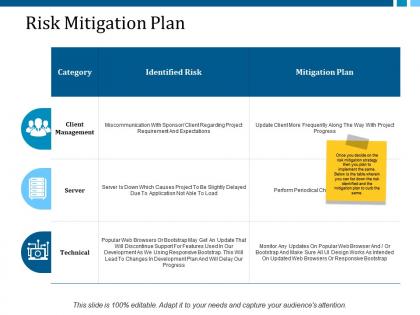
Risk mitigation plan ppt layouts information




Try Before you Buy Download Free Sample Product
 Impress Your
Audience
 100%
Editable
 Save Hours
of Time


Get folks aware of fundamental aspects with our Risk Mitigation Plan Ppt Layouts Information. It helps introduce basic concepts.
People who downloaded this PowerPoint presentation also viewed the following :
Risk mitigation plan ppt layouts information with all 5 slides:
Enlighten folks on how to draw accurate inferences with our Risk Mitigation Plan Ppt Layouts Information. It helps brief the investigators.


FAQs for Risk mitigation plan
Key components include risk identification and assessment, mitigation strategies, contingency plans, implementation timelines, and monitoring protocols. These elements work together by establishing clear accountability frameworks, defining resource allocation procedures, and creating communication channels, with many organizations finding that comprehensive documentation and regular reviews ultimately deliver operational resilience and competitive advantage.
Organizations prioritize risks by assessing probability, impact severity, regulatory requirements, business continuity implications, and resource availability through structured frameworks like risk matrices and scoring models. This strategic approach enables companies across sectors, from financial services managing credit exposure to healthcare systems addressing patient safety, to allocate limited resources effectively while maintaining operational resilience.
Risk identification tools include brainstorming sessions, SWOT analysis, expert interviews, historical data review, and risk checklists. These techniques streamline project planning by engaging diverse stakeholder perspectives, analyzing past project outcomes, and systematically evaluating potential threats, ultimately enabling organizations to develop comprehensive mitigation strategies and maintain competitive advantage through proactive risk management.
Risk tolerance and risk appetite serve as foundational parameters that directly shape mitigation strategies, resource allocation priorities, and acceptable control thresholds within organizations. Companies with higher risk appetite may focus on strategic risk monitoring and contingency planning, while risk-averse institutions typically implement comprehensive prevention measures, ultimately enabling more targeted and cost-effective risk management approaches.
Stakeholder involvement ensures comprehensive risk identification, shared ownership of mitigation strategies, and aligned resource allocation across all organizational levels. Through collaborative input, organizations enhance risk assessment accuracy, improve implementation buy-in, and strengthen monitoring effectiveness, with many finding that engaged stakeholders ultimately deliver faster response times and more sustainable risk management outcomes.
Risk mitigation plans should be reviewed quarterly at minimum, with immediate updates triggered by significant organizational changes, market shifts, regulatory updates, or emerging threats. Many organizations implement continuous monitoring systems alongside scheduled reviews, enabling real-time adjustments when new risks surface, while industries like financial services and healthcare often require monthly assessments, ultimately ensuring proactive risk management and sustained operational resilience.
Common pitfalls include inadequate risk assessment, lack of stakeholder buy-in, insufficient resource allocation, poor communication protocols, and failure to regularly update strategies. Organizations often underestimate implementation complexity, with many financial services and healthcare institutions finding that siloed approaches and inadequate training ultimately compromise effectiveness, requiring integrated frameworks and ongoing monitoring for sustainable risk management.
Scenario analysis enhances Risk Mitigation Plans by testing strategies against multiple potential outcomes, identifying vulnerabilities before they occur, and enabling proactive response development. Through systematic evaluation of best-case, worst-case, and probable scenarios, organizations can strengthen contingency planning, allocate resources more strategically, and ultimately build more resilient risk frameworks that deliver competitive advantage.
Risk mitigation success metrics include risk occurrence frequency, impact severity reduction, response time effectiveness, cost-benefit ratios, and compliance adherence rates. These measurements enable organizations to track prevention effectiveness, response efficiency, and financial protection across departments, with many companies finding that regular metric analysis enhances strategic planning and delivers measurable competitive advantage.
Technology and software enhance Risk Mitigation Plans by automating risk assessments, providing real-time monitoring dashboards, and enabling predictive analytics for early threat detection. Through cloud-based platforms and AI-driven tools, organizations streamline risk identification, automate compliance reporting, and facilitate cross-departmental collaboration, ultimately delivering faster response times and more comprehensive risk coverage.
Proactive risk mitigation involves identifying and addressing potential threats before they occur through strategic planning, monitoring systems, and preventive measures, while reactive mitigation responds to risks after they materialize through contingency plans and damage control. Proactive approaches work best for predictable risks in sectors like manufacturing and healthcare, while reactive strategies are essential for unforeseen events, with successful organizations combining both approaches to ensure comprehensive protection.
Lessons learned from past projects enhance future Risk Mitigation Plans by identifying recurring risk patterns, documenting effective mitigation strategies, and revealing gaps in previous approaches. These insights enable organizations to proactively address similar challenges, refine response protocols, and build more comprehensive risk frameworks, with many companies finding that systematic knowledge transfer reduces project delays and improves overall success rates.
Financial risk mitigation strategies include diversifying revenue streams, maintaining adequate cash reserves, implementing robust internal controls, securing appropriate insurance coverage, and conducting regular financial audits. These approaches streamline operations by reducing exposure to market volatility, credit defaults, and operational disruptions, with many organizations finding that strategic risk management ultimately delivers enhanced stability and competitive advantage.
Cultural factors significantly influence risk perception through varying attitudes toward uncertainty, hierarchy, time orientation, and communication styles across different regions and societies. In global projects, teams from high-context cultures may prioritize relationship-based mitigation strategies, while low-context cultures focus on systematic documentation and processes, with many multinational organizations finding that culturally-adapted approaches ultimately deliver more effective risk management and stakeholder buy-in.
Communication strategies integrate into Risk Mitigation Plans through regular stakeholder briefings, escalation protocols, transparent reporting dashboards, and predefined communication channels for different risk scenarios. These approaches streamline decision-making by ensuring all parties understand risk thresholds, response procedures, and accountability structures, ultimately delivering faster incident resolution and stronger organizational resilience across teams.
No Reviews