

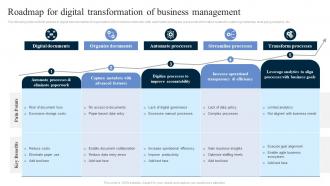
Roadmap For Digital Transformation Of Business Management





Try Before you Buy Download Free Sample Product
 Impress Your
 Audience
 100%
100% Editable
 Save Hours
 of Time


The following slide exhibits phases in digital transformation of organization which reduces data entry with automated processes. It presents information related to capturing metadata, leveraging analytics, etc.
People who downloaded this PowerPoint presentation also viewed the following :
Roadmap For Digital Transformation Of Business Management with all 6 slides:
Use our Roadmap For Digital Transformation Of Business Management to effectively help you save your valuable time. They are readymade to fit into any presentation structure.





FAQs for Roadmap For Digital Transformation
Key components include cloud infrastructure, data analytics platforms, process automation tools, cybersecurity frameworks, and change management programs. These technologies streamline operations by enhancing scalability, improving decision-making capabilities, and reducing manual workflows, with many organizations finding that strategic integration of these elements ultimately delivers competitive advantage and operational efficiency.
Organizational culture significantly influences digital transformation success by shaping employee adoption, resistance to change, and leadership commitment to new technologies. Companies with collaborative, innovation-focused cultures experience faster implementation and better outcomes, while rigid, risk-averse environments often struggle with user engagement and process adaptation, ultimately determining whether transformation initiatives deliver competitive advantage or stagnate.
Cloud computing, artificial intelligence, data analytics, automation tools, and customer relationship management systems are the most commonly adopted technologies during digital transformation. These technologies streamline operations by enhancing data accessibility, automating routine processes, and improving customer interactions, with many organizations finding that this strategic combination delivers operational efficiency and competitive advantage.
Companies measure digital transformation success through key performance indicators like revenue growth, operational efficiency improvements, customer satisfaction scores, employee productivity metrics, and cost reduction percentages. These measurements enable organizations to track tangible outcomes across departments, with many businesses finding that combining financial metrics with user experience data delivers comprehensive insights into transformation effectiveness and competitive positioning.
Leadership drives digital transformation by establishing clear vision, securing necessary resources, fostering cultural change, and ensuring strategic alignment across all organizational levels. Effective leaders champion innovation while managing resistance, with many successful transformations finding that executive commitment, cross-functional collaboration, and continuous communication ultimately determine whether digital initiatives deliver competitive advantage and sustainable growth.
Businesses can assess digital maturity through technology infrastructure audits, data management evaluations, employee digital skills assessments, customer experience analytics, and process automation reviews. This comprehensive analysis enables organizations to identify gaps, prioritize investments, and develop targeted transformation roadmaps, with many companies finding that structured maturity assessments accelerate strategic planning and deliver measurable competitive advantages.
Common digital transformation obstacles include resistance to change, legacy system integration challenges, skills gaps, insufficient budget allocation, and lack of clear strategic vision. These barriers can significantly impact implementation timelines, with many organizations finding that addressing cultural readiness and employee training early streamlines adoption processes and ultimately delivers better transformation outcomes.
Customer experience transforms through personalized recommendations, omnichannel interactions, self-service portals, real-time support, and data-driven insights during digital transformation. These enhancements streamline customer journeys by reducing friction, accelerating response times, and delivering tailored solutions, with many organizations finding that integrated digital platforms ultimately boost satisfaction while reducing operational costs.
Data analytics drives decision-making in digital transformation by providing real-time insights, predictive modeling capabilities, and performance metrics that guide strategic initiatives. Through advanced analytics platforms, organizations streamline operations, enhance customer experiences, and optimize resource allocation, with many companies finding that data-driven approaches deliver measurable competitive advantages and accelerated transformation outcomes.
Digital transformation significantly enhances employee engagement and productivity by streamlining workflows, automating repetitive tasks, and enabling flexible work arrangements through cloud-based collaboration tools. These technologies empower employees with real-time data access, mobile capabilities, and integrated platforms, with many organizations finding that digital tools reduce administrative burden while fostering innovation and job satisfaction.
Small businesses can approach digital transformation with greater agility, faster decision-making, and lower implementation costs compared to large enterprises that face complex legacy systems and bureaucratic processes. While enterprises require extensive planning and phased rollouts, small businesses can implement cloud-based solutions, automation tools, and digital customer experiences more rapidly, ultimately delivering competitive advantages through streamlined operations and enhanced customer engagement.
**INPUT**: What cybersecurity considerations should be taken into account during digital transformation? **OUTPUT**: Cybersecurity considerations include data encryption, access controls, network security, compliance frameworks, and threat monitoring systems. These strategic measures streamline protection by establishing multi-layered defenses, automating threat detection, and ensuring regulatory compliance, with many organizations finding that integrated security approaches ultimately deliver enhanced operational resilience and competitive advantage. [Word count: 51 words]
Digital transformation revolutionizes supply chain management by enabling real-time visibility, predictive analytics, automated processes, and seamless integration across all stakeholders. Through IoT sensors, AI-driven demand forecasting, and cloud-based platforms, companies streamline inventory management, reduce operational costs, and enhance customer responsiveness, with manufacturing and retail sectors finding significantly improved efficiency and competitive advantage.
Healthcare, financial services, retail, manufacturing, and logistics are experiencing the most substantial digital transformation benefits through enhanced operational efficiency, customer experiences, and competitive positioning. These sectors leverage automation, data analytics, and cloud technologies to streamline processes, reduce costs, and deliver faster services, with many organizations finding significant improvements in scalability and market responsiveness.
Organizations ensure digital transformation alignment by establishing clear strategic objectives, conducting comprehensive needs assessments, creating cross-functional governance committees, and implementing regular progress reviews against defined KPIs. Through strategic roadmapping and stakeholder engagement, companies streamline resource allocation, enhance operational efficiency, and accelerate goal achievement, with many enterprises finding that integrated planning approaches ultimately deliver measurable ROI and sustainable competitive advantage.
-
Their templates are super easy to edit and use even for the one like me who is not familiar with PowerPoint. Great customer support.
-
Awesome use of colors and designs in product templates.