

Robotics And Automation In The Food Manufacturing Industry Implementation Of Robotic Automation In Business




Try Before you Buy Download Free Sample Product
 Impress Your
 Audience
 100%
100% Editable
 Save Hours
 of Time


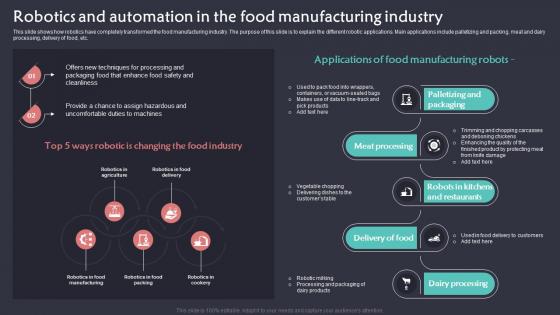
This slide shows how robotics have completely transformed the food manufacturing industry. The purpose of this slide is to explain the different robotic applications. Main applications include palletizing and packing, meat and dairy processing, delivery of food, etc.
People who downloaded this PowerPoint presentation also viewed the following :
Robotics And Automation In The Food Manufacturing Industry Implementation Of Robotic Automation In Business with all 9 slides:
Use our Robotics And Automation In The Food Manufacturing Industry Implementation Of Robotic Automation In Business to effectively help you save your valuable time. They are readymade to fit into any presentation structure.








FAQs for Robotics And Automation In The Food Manufacturing Industry Implementation Of Robotic
Key benefits include enhanced food safety through reduced contamination risks, increased production speed and consistency, improved quality control with precision handling, lower labor costs, and 24/7 operational capability. These technologies streamline packaging, sorting, and processing operations, with dairy, meat processing, and beverage companies finding that automation delivers faster production cycles, minimized waste, and ultimately greater competitive advantage in increasingly demanding markets.
Robotic systems enhance food production efficiency by automating repetitive tasks, maintaining consistent quality standards, and operating continuously without breaks or fatigue. These technologies streamline packaging, sorting, and assembly processes while reducing labor costs and minimizing contamination risks, with many food manufacturers finding that robotic integration delivers faster throughput and improved safety compliance.
The most common robots in food manufacturing include articulated robots for packaging and palletizing, delta robots for high-speed picking and sorting, SCARA robots for assembly tasks, collaborative robots for quality inspection, and specialized food-grade robots for direct product handling. These technologies streamline production by reducing contamination risks, increasing throughput speeds, and ensuring consistent quality standards, with many food processors finding that robotic integration delivers significant cost savings while maintaining strict hygiene requirements.
Robotic automation enhances food safety and hygiene standards by minimizing human contact with products, maintaining consistent sanitization protocols, and ensuring precise temperature and quality controls throughout production. These automated systems enable food manufacturers to reduce contamination risks, accelerate cleaning processes, and deliver consistent compliance with regulatory standards, ultimately providing safer products and operational efficiency.
Machine learning enables robotic systems in food manufacturing to adapt to variations in ingredients, optimize processing parameters, and predict maintenance needs through continuous data analysis. These intelligent systems enhance quality control by detecting defects, streamline production workflows, and reduce waste, with food processors finding that ML-driven automation delivers consistent product quality while significantly lowering operational costs.
Small and medium-sized food manufacturers can adopt robotic automation through leasing programs, collaborative robots designed for smaller operations, phased implementation starting with high-impact processes, and government grants for manufacturing modernization. Many companies begin with affordable cobots for packaging or quality control, gradually scaling their automation investments as operational efficiency improves and costs decrease, ultimately achieving competitive advantages previously available only to larger manufacturers.
Food manufacturers face challenges including high upfront costs, complex integration with legacy equipment, staff retraining requirements, maintaining food safety standards, and adapting to diverse product specifications. While these obstacles require careful planning and investment, many facilities find that strategic implementation ultimately delivers enhanced efficiency, consistent quality control, and reduced contamination risks across production lines.
Robotics addresses labor shortages in food manufacturing by automating repetitive tasks, operating continuously without breaks, and handling physically demanding processes like packaging and palletizing. Through advanced robotic systems, food manufacturers streamline production lines, reduce dependency on manual labor, and maintain consistent output levels, while enabling existing workers to focus on higher-value supervisory roles, ultimately delivering operational resilience and competitive advantage.
Robots improve food production quality control through automated visual inspection, precise contamination detection, consistent temperature monitoring, real-time defect identification, and standardized packaging verification. These technologies streamline operations by eliminating human error, accelerating inspection processes, and maintaining uniform quality standards, with many food manufacturers finding that robotic systems ultimately deliver faster production cycles and enhanced consumer safety.
Robotic automation significantly reduces food production costs by minimizing labor expenses, decreasing waste through precision handling, and enhancing operational efficiency. While initial investment can be substantial, manufacturers in sectors like meat processing, packaging, and dairy operations find that automated systems deliver faster throughput, consistent quality control, and lower long-term operational costs, ultimately providing competitive advantage in an increasingly cost-sensitive market.
Collaborative robots in food manufacturing are designed to work safely alongside humans without safety barriers, featuring advanced sensors, lighter construction, and intuitive programming compared to traditional industrial robots that require isolated workspaces. While traditional robots excel at high-speed, heavy-duty tasks like palletizing, cobots enhance flexibility in food processing, packaging, and quality inspection, with many manufacturers finding that cobots streamline operations while maintaining food safety standards.
The future of robotic automation in food manufacturing involves AI-driven predictive maintenance, IoT-enabled real-time monitoring, adaptive production systems, enhanced quality control, and fully integrated smart factories. These technologies will revolutionize operations by reducing waste, optimizing supply chains, and enabling mass customization, with food manufacturers increasingly finding that strategic automation delivers significant cost savings, improved safety standards, and competitive advantages in an evolving market landscape.
Food manufacturers can ensure robotic system reliability through preventive maintenance schedules, real-time monitoring sensors, staff training programs, and strategic partnerships with automation vendors. These approaches enable manufacturers to minimize downtime, reduce maintenance costs, and maintain consistent production quality, with many food processing facilities finding that predictive maintenance technologies ultimately deliver 30-40% fewer unexpected breakdowns while enhancing overall operational efficiency.
Ethical considerations in robotic food production include worker displacement concerns, food safety accountability, equitable access to automated benefits, transparency in robotic decision-making, and maintaining human oversight in critical processes. While automation enhances consistency and reduces contamination risks, manufacturers must balance efficiency gains with workforce retraining programs and ensure that cost savings ultimately benefit consumers through safer, more affordable food options.
Regional approaches to robotic automation in food manufacturing vary significantly based on labor costs, regulatory frameworks, and technological infrastructure. European countries emphasize precision and food safety compliance, Asian markets like Japan and South Korea focus on addressing labor shortages through advanced robotics, while North American facilities prioritize scalability and operational efficiency, with many manufacturers finding that localized automation strategies deliver faster production cycles and enhanced quality control.
-
Excellent products for quick understanding.
-
Wow, never been this impressed with any online service provider. Really appreciate the customer support all along from the navigation to purchasing the right products.