

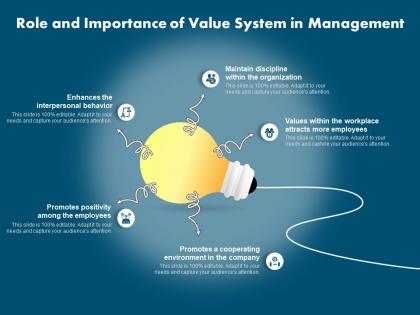
Role and importance of value system in management




Try Before you Buy Download Free Sample Product
 Impress Your
Audience
 100%
Editable
 Save Hours
of Time


Counter any critics with our Role And Importance Of Value System In Management. You will come up with cogent arguments.
People who downloaded this PowerPoint presentation also viewed the following :
Role and importance of value system in management with all 2 slides:
Our Role And Importance Of Value System In Management help generate cogent arguments. They help counter any critics.


FAQs for Role and importance of value
A value system serves as the foundational framework that defines organizational culture by establishing behavioral norms, decision-making principles, communication styles, and employee expectations across all levels. These core values influence hiring practices, performance evaluation, leadership approaches, and strategic priorities, with many organizations finding that clearly articulated values enhance employee engagement, streamline operations, and ultimately deliver stronger competitive advantage.
Leaders effectively communicate their value systems through consistent modeling of behaviors, transparent decision-making processes, regular team discussions about organizational principles, and integrating values into performance evaluations and recognition programs. Through storytelling, town halls, and one-on-one meetings, managers across industries like healthcare and financial services create alignment and trust, ultimately delivering stronger employee engagement and organizational cohesion.
Value systems influence management decision-making by establishing ethical frameworks, priority hierarchies, and cultural guidelines that shape strategic choices, resource allocation, and stakeholder considerations. Through these foundational principles, managers in sectors like healthcare, finance, and manufacturing make consistent choices that reflect organizational culture, maintain stakeholder trust, and drive long-term sustainability, ultimately delivering competitive advantage.
A strong value system enhances employee engagement by creating purpose-driven work environments, establishing clear behavioral expectations, fostering trust through consistent leadership decisions, and aligning individual goals with organizational mission. These foundations streamline workplace relationships and decision-making processes, with many organizations finding that employees demonstrate higher retention rates, increased productivity, and stronger commitment when values guide daily operations, ultimately delivering sustainable competitive advantage.
Implementing a new value system presents both challenges and opportunities, including employee resistance to change, alignment difficulties across departments, communication gaps, and potential conflicts with existing processes and culture. While organizations may face initial productivity dips and skepticism, many companies find that strategic implementation through consistent leadership modeling, comprehensive training, and gradual integration ultimately delivers stronger organizational cohesion and competitive advantage.
Cultural differences significantly shape value system perceptions in global management through varying attitudes toward hierarchy, decision-making processes, communication styles, time orientation, and relationship-building approaches. These cultural variations create both challenges and opportunities, with many multinational organizations finding that embracing diverse value perspectives enhances innovation, broadens market understanding, and ultimately delivers competitive advantage in increasingly globalized business environments.
Metrics for assessing value-system alignment include employee engagement scores, customer satisfaction ratings, retention rates, ethical compliance measures, and performance indicators tied to core values. Through regular culture surveys, behavioral assessments, and goal-achievement tracking, organizations can measure how effectively their values translate into business outcomes, with many companies finding that strong value alignment significantly enhances operational efficiency and competitive advantage.
Value systems significantly influence stakeholder relationships by shaping trust, transparency, and ethical decision-making across all corporate interactions. Companies with strong ethical frameworks enhance stakeholder engagement through consistent communication, fair business practices, and genuine commitment to social responsibility, with organizations in sectors like banking and retail finding that aligned values strengthen customer loyalty, investor confidence, and community partnerships, ultimately delivering competitive advantage and sustainable growth.
Organizations can reinforce their value systems through consistent leadership modeling, transparent communication channels, values-based hiring and performance evaluations, and regular recognition programs. These practices strengthen organizational culture by embedding values into daily operations, decision-making processes, and employee interactions, with many companies finding that systematic reinforcement ultimately delivers improved employee engagement, better customer relationships, and sustained competitive advantage.
Employee feedback can be integrated through structured surveys, focus groups, one-on-one discussions, anonymous suggestion systems, and cross-departmental workshops that capture diverse perspectives on organizational values. This collaborative approach enables management to identify gaps between stated and lived values, while ensuring employees feel heard and invested, ultimately delivering stronger value alignment, enhanced workplace culture, and improved retention across all organizational levels.
A company's value system serves as the foundational framework that directly shapes and authenticates its brand identity, influencing messaging, customer interactions, and market positioning. When values align with brand expression, organizations create deeper customer connections and stronger market differentiation, with companies like Patagonia and Ben & Jerry's demonstrating how authentic value-driven branding ultimately delivers sustained competitive advantage and customer loyalty.
A value system drives innovation by fostering psychological safety, encouraging calculated risk-taking, and rewarding creative problem-solving across all organizational levels. When companies embed innovation-focused values like experimentation and learning from failure, teams in sectors like technology and pharmaceuticals develop breakthrough products faster, ultimately delivering competitive advantage and sustained growth in increasingly dynamic markets.
**Essential training for promoting strong managerial value systems includes ethics workshops, leadership development programs, cultural competency training, decision-making frameworks, and mentorship initiatives. These comprehensive approaches enhance organizational integrity by establishing clear behavioral expectations, fostering inclusive environments, and building consistent decision-making capabilities, with many organizations finding that structured value-based training ultimately delivers improved employee engagement and sustainable competitive advantage.** [Word count: 60]
Value systems evolve through continuous organizational learning, stakeholder feedback integration, market trend analysis, and competitive landscape assessment. Companies like Netflix and Amazon demonstrate this by regularly updating their core principles to embrace digital transformation, sustainability demands, and changing consumer expectations, ultimately delivering enhanced customer experiences and maintaining competitive advantage in increasingly dynamic markets.
Patagonia's environmental commitment, Johnson & Johnson's Credo-driven crisis management, and Unilever's Sustainable Living Plan demonstrate successful value integration into business strategy. These companies streamline decision-making, enhance brand loyalty, and drive long-term profitability by embedding core values throughout operations, with many organizations finding that authentic value alignment delivers competitive advantage and sustainable growth.
No Reviews