

Role Of CRM System In Products Marketing Customer Relationship Management System





Try Before you Buy Download Free Sample Product
 Impress Your
Audience
 100%
Editable
 Save Hours
of Time


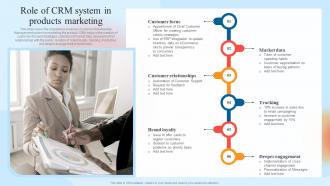
This slide covers the importance of using a Customer Relationship Management system in marketing the product. CRM helps in the creation of customer focused strategies, collection of market data, development of relationships with the public, creation of brand loyalty, tracking of activities, and deeper engagement of customers.
People who downloaded this PowerPoint presentation also viewed the following :
Role Of CRM System In Products Marketing Customer Relationship Management System with all 6 slides:
Use our Role Of CRM System In Products Marketing Customer Relationship Management System to effectively help you save your valuable time. They are readymade to fit into any presentation structure.





FAQs for Role Of CRM System In Products Marketing Customer
Effective CRM systems should include contact management, sales pipeline tracking, automated marketing tools, customer service integration, and detailed analytics reporting. These features streamline operations by centralizing customer data, automating follow-ups, and providing actionable insights, with many organizations finding that comprehensive CRM platforms ultimately enhance customer relationships and drive revenue growth.
CRM systems improve customer relationship management by centralizing customer data, automating follow-ups, and tracking interaction history across all touchpoints. These platforms enable sales teams to personalize communications, identify upselling opportunities, and respond faster to customer inquiries, while marketing departments can segment audiences more effectively, ultimately delivering enhanced customer experiences and stronger long-term relationships.
Data analytics plays a crucial role in CRM optimization by identifying customer behavior patterns, predicting purchasing trends, segmenting audiences, and measuring campaign effectiveness. Through advanced analytics, organizations can personalize customer interactions, optimize sales funnels, and enhance retention strategies, with many retail and financial services companies finding that data-driven CRM approaches deliver significantly higher conversion rates and customer lifetime value.
CRM systems can be extensively customized through industry-specific modules, custom fields, automated workflows, specialized reporting dashboards, and integration capabilities with sector-relevant tools. Healthcare providers leverage patient management features, financial services utilize compliance tracking and risk assessment tools, while retail organizations implement loyalty programs and inventory integration, ultimately delivering enhanced operational efficiency and improved customer experiences across diverse business environments.
Common CRM implementation challenges include data migration complexities, user adoption resistance, integration difficulties with existing systems, inadequate training programs, and insufficient customization for specific workflows. These obstacles often arise from poor change management and unrealistic timeline expectations, with many organizations finding that phased rollouts, comprehensive staff training, and executive sponsorship significantly improve adoption rates and ultimately deliver better customer experiences.
Mobile accessibility enhances CRM functionality by enabling real-time data access, instant customer updates, and seamless field operations from any location. Sales teams can update prospects during client meetings, service representatives can access customer histories on-site, and managers can monitor performance metrics remotely, ultimately delivering faster response times and improved customer experiences.
**INPUT**: What are the best practices for training employees to use a CRM system effectively? **OUTPUT**: Best practices for CRM training include role-specific modules, hands-on workshops, phased rollouts, ongoing support systems, and performance tracking mechanisms. These approaches streamline adoption by connecting daily workflows to system features, providing real-world scenarios, and establishing feedback loops, with many organizations finding that comprehensive training programs ultimately deliver higher user engagement, improved data quality, and enhanced customer relationship management across teams. **Word count: 60 words**
CRM systems streamline sales processes by automating lead tracking, centralizing customer data, and providing real-time pipeline visibility across teams. These platforms enhance efficiency by eliminating manual data entry, accelerating follow-up communications, and delivering predictive analytics for better forecasting, with many sales organizations finding that automated workflows ultimately reduce cycle times and increase conversion rates.
CRM systems significantly enhance customer satisfaction and loyalty by centralizing customer data, enabling personalized interactions, tracking service history, and facilitating faster issue resolution. Through automated follow-ups and targeted communications, businesses deliver more responsive customer experiences, with many retail and financial services organizations finding that comprehensive CRM implementation reduces response times while increasing repeat customer rates.
Integration capabilities significantly enhance CRM performance by enabling seamless data flow, eliminating silos, and creating unified customer views across all touchpoints. Through strategic integrations with marketing automation, accounting software, and communication tools, organizations streamline workflows, reduce manual data entry, and deliver more personalized customer experiences, ultimately achieving better sales outcomes and operational efficiency.
Cloud-based CRM systems offer enhanced accessibility, automatic updates, lower upfront costs, superior scalability, and seamless integration capabilities compared to on-premise solutions. These advantages enable organizations to access customer data anywhere, reduce IT maintenance burdens, and scale operations efficiently, with many businesses finding that cloud solutions deliver faster deployment and ultimately provide greater competitive advantage.
Small businesses can leverage CRM systems to compete with larger companies by automating customer interactions, personalizing marketing campaigns, and streamlining sales processes to deliver enterprise-level customer experiences. These systems enable smaller organizations to maximize limited resources, respond faster to customer needs, and build stronger relationships through data-driven insights, ultimately delivering the personalized service that larger competitors often struggle to provide at scale.
Key CRM success metrics include customer acquisition cost, customer lifetime value, sales conversion rates, customer retention rates, and average deal size. These metrics enable businesses to measure ROI by tracking revenue growth, sales cycle efficiency, and customer satisfaction improvements, with many organizations finding that comprehensive CRM analytics ultimately deliver competitive advantage and enhanced operational performance.
Automation within CRM systems improves efficiency by streamlining lead scoring, automating follow-up sequences, synchronizing data across platforms, and eliminating manual data entry tasks. These automated processes enable sales teams to focus on relationship building while reducing response times, with many organizations finding that automated workflows increase conversion rates and deliver faster customer service.
Future CRM trends include AI-powered predictive analytics, voice-activated interfaces, blockchain for data security, omnichannel integration, and real-time personalization engines. These technologies enhance customer experiences by automating routine tasks, predicting customer needs, and streamlining interactions across multiple touchpoints, with many organizations finding that early adoption delivers significant competitive advantages.
-
Appreciate the research and its presentable format.
-
I have just started downloading templates for my presentations and I must say this is a great design. It helped accelerate my presentation design process and made it more visually appealing.