


Role of digital twin and iot in limiting costs post covid era powerpoint presentation slides




Try Before you Buy Download Free Sample Product
 Impress Your
 Audience
 100%
100% Editable
 Save Hours
 of Time


Need to know how to assess potential maintenance concerns while adopting IoT technology to reduce overall costs while increasing production life efficacy. Here is a professionally designed Role of Digital Twin and IoT In Limiting Costs template that will cater details about current situation assessment, including critical challenges faced by different industries while IoT implementation, barriers in investing in IoT technology, etc. It covers IoT and digital twin implementation across transportation, supply chain, healthcare, and oil and gas sectors. The module caters to details on how digital twin and IoT are implemented in the oil and gas industry, how the industry will be transformed and perform post-COVID, COVID 19 on rail transportation, and how it will be changed to reduce overall costs. Similarly, the role of IoT and digital twin will be discussed in the supply chain through optimization of supply chain operations, the impact of COVID 19 on healthcare expenditure, how IoT and digital twin implementation will reduce healthcare expenditure. Later, it will elaborate on IoTs impact, digital twin implementation, and cost benefits post COVID 19 across various industries. Get access now.
People who downloaded this PowerPoint presentation also viewed the following :
Content of this Powerpoint Presentation
Slide 1: This slide introduces Role of Digital Twin and IoT in Limiting Costs Post COVID Era. State Your Company Name and begin.
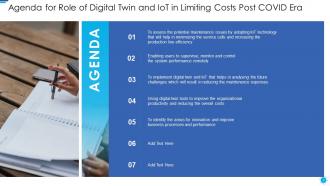
Slide 2: This slide shows Agenda for Role of Digital Twin and IoT in Limiting Costs Post COVID Era.
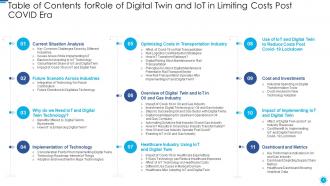
Slide 3: This slide presents Table of Content for the presentation.
Slide 4: This slide shows title for five topics that are to be covered next in the template.
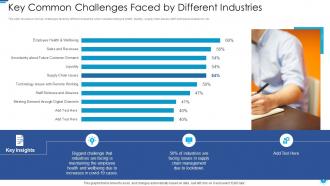
Slide 5: This slide focuses on the key challenges faced by different industries which includes employee health, liquidity, etc.
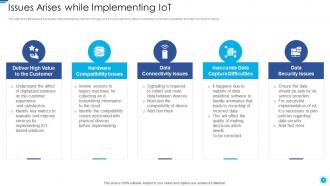
Slide 6: This slide shows the issues that arises while implementing internet of things which covers delivering value to customers, etc.
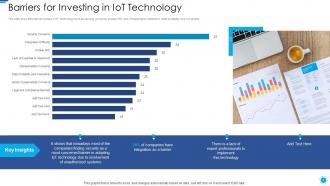
Slide 7: This slide shows the barriers arises in IoT technology such as security concerns, unclear ROI, lack of expertise to implement, etc.
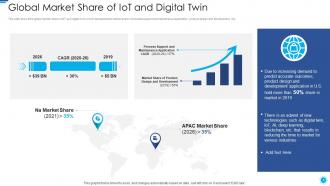
Slide 8: This slide shows the global market share of IoT and digital twin which represents the market share of process support.
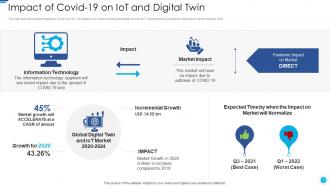
Slide 9: This slide shows the impact analysis of Covid-19 on IoT and digital twin which includes global digital twin.
Slide 10: This slide shows title for next two topics that are to be covered in the template.
Slide 11: This slide shows the integration of IoT and digital twin technology for future contribution which covers IoT sensors, etc.
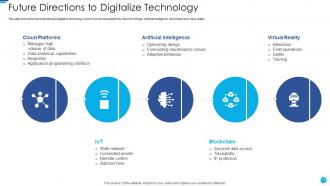
Slide 12: This slide shows the future directions to digitalize technology which involves cloud platforms, internet of things, artificial intelligence, etc.
Slide 13: This slide shows title for next two topics that are to be covered in the template.
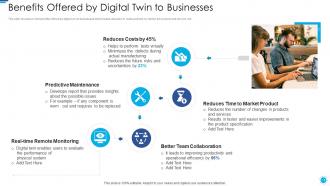
Slide 14: This slide focuses on the benefits offered by digital twin to businesses that includes reduction in costs and time.
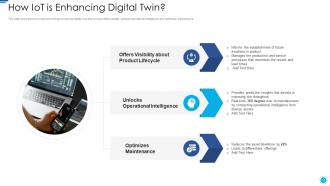
Slide 15: This slide shows the how internet of things enhances digital twin that covers offers visibility, unlocks operational intelligence, etc.
Slide 16: This slide shows title for next three topics that are to be covered in the template.
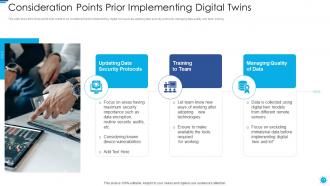
Slide 17: This slide shows the three points that needs to be considered before implementing digital twin such as updating data security protocols, etc.
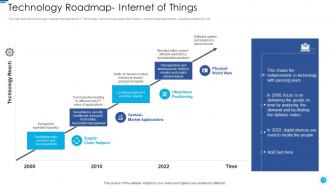
Slide 18: This slide shows the technology roadmap that depicts the IoT technology reach such as supply chain helpers, vertical-market applications, etc.
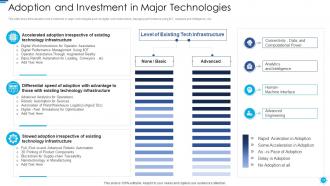
Slide 19: This slide shows the adoption and investment in major technologies such as digital work instructions, managing performance using IIoT, etc.
Slide 20: This slide shows title for next eight topics that are to be covered in the template.
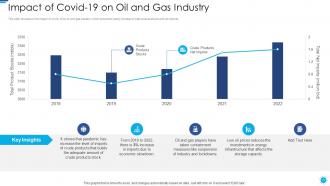
Slide 21: This slide focuses on the impact of covid-19 on oil and gas industry which shows the yearly increase in total product stocks and net imports.
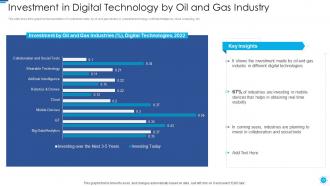
Slide 22: This slide shows the graphical representation of investments made by oil and gas industry in wearable technology, artificial intelligence, etc.
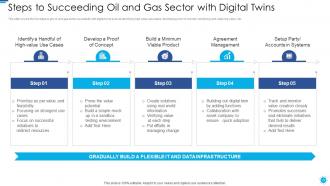
Slide 23: This slide covers the five steps to get oil and gas sector successful with digital twins such as identifying high value use cases, etc.
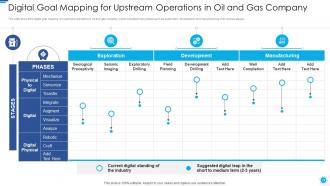
Slide 24: This slide shows the digital goal mapping for upstream operations in oil and gas company which includes three phases such as exploration, etc.
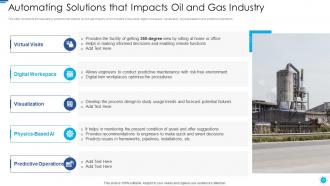
Slide 25: This slide represents the automating solutions that impacts oil and gas industry which includes virtual visits, digital workspace, etc.
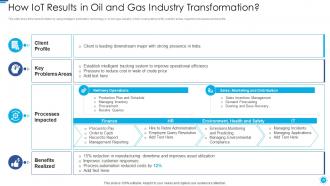
Slide 26: This slide shows the transformation by using intelligent automation technology in oil and gas industry which covers client profile, problem areas, etc.
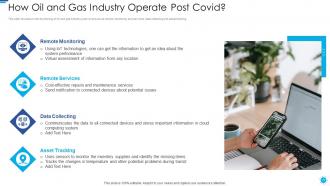
Slide 27: This slide focuses on the functioning of oil and gas industry post covid such as remote monitoring and services, data collecting and asset tracking.
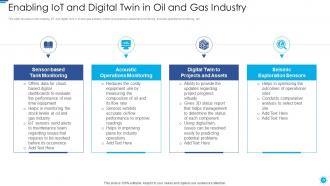
Slide 28: This slide focuses on the enabling IoT and digital twin in oil and gas industry which covers sensor-based tank monitoring, acoustic operations monitoring, etc.
Slide 29: This slide shows title for next six topics that are to be covered in the template.
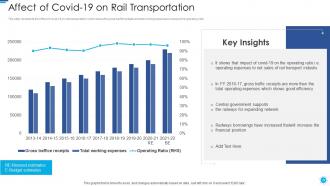
Slide 30: This slide represents the affect of covid-19 on rail transportation which shows the gross traffic receipts and total working expenses.
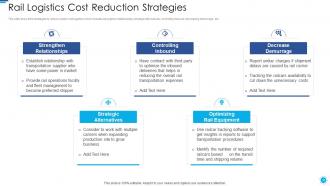
Slide 31: This slide shows the strategies to reduce costs in rail logistics which includes strengthen relationships, strategic alternatives, etc.
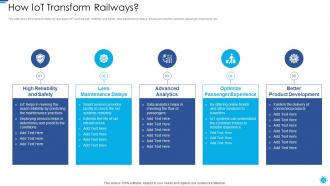
Slide 32: This slide shows the transformation of railways by IoT such as high reliability and safety, less maintenance delays, advanced analytics, etc.
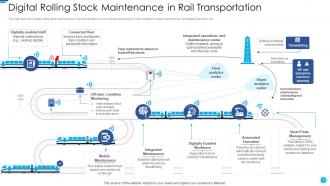
Slide 33: This slide shows the digital rolling stock maintenance in rail transportation which includes monitoring off-train conditions, mobile maintenance, etc.
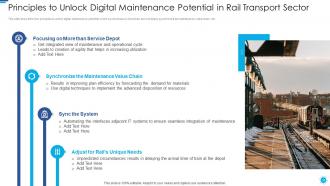
Slide 34: This slide shows the four principles to unlock digital maintenance potential which covers focus on more than service depot, etc.
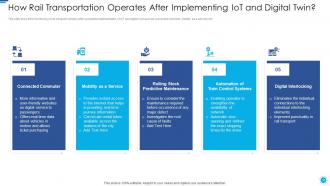
Slide 35: This slide shows the functioning of rail transport industry after successful implementation of IoT and digital twin such as connected commuter, etc.
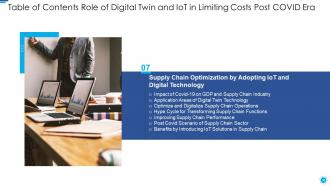
Slide 36: This slide shows title for next seven topics that are to be covered in the template.
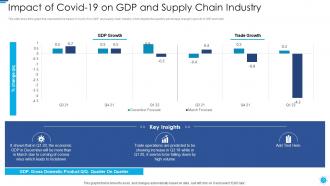
Slide 37: This slide shows the graph that represents the impact of Covid-19 on GDP and supply chain industry.
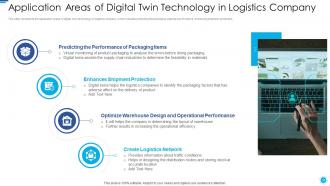
Slide 38: This slide represents the application areas of digital twin technology in logistics company.
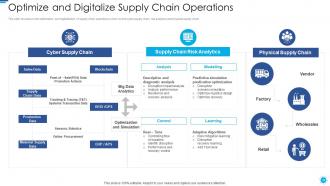
Slide 39: This slide focuses on the optimization and digitalization of supply chain operations which covers cyber supply chain, etc.
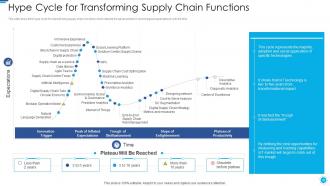
Slide 40: This slide shows the hype cycle for transforming supply chain functions which depicts the advancement in technological expectations with the time.
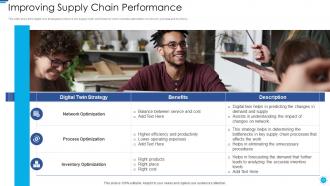
Slide 41: This slide shows the digital twin strategies to improve the supply chain performance which includes optimization of network, process and inventory.
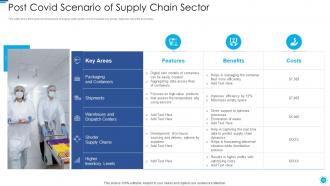
Slide 42: This slide shows the post covid scenario of supply chain sector which includes key areas, features, benefits and costs.
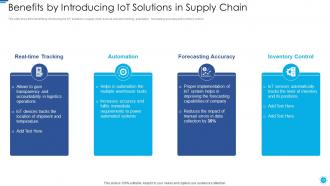
Slide 43: This slide shows the benefits by introducing the IoT solutions in supply chain such as real-time tracking, automation, etc.
Slide 44: This slide shows title for next five topics that are to be covered in the template.
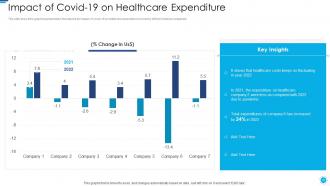
Slide 45: This slide shows the graphical presentation that depicts the impact of covid-19 on healthcare expenditure incurred by different medical companies.
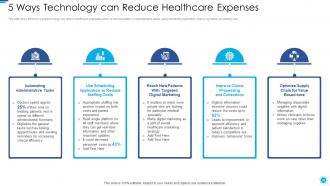
Slide 46: This slide shows the five ways technology can reduce healthcare expenses which covers automation of administrative tasks, etc.
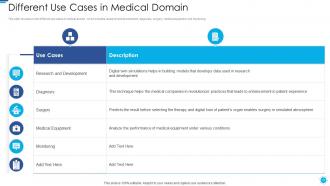
Slide 47: This slide focuses on the different use cases in medical domain which includes research and development, diagnosis, surgery, etc.
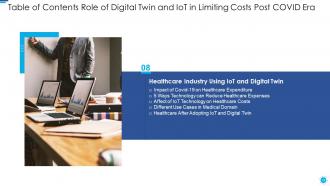
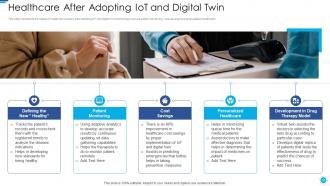
Slide 48: This slide represents the status of healthcare industry after adopting IoT and digital twin technology such as patient monitoring, etc.
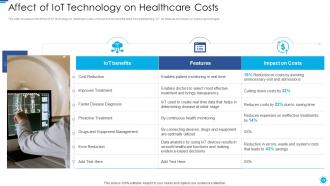
Slide 49: This slide focuses on the affect of IoT technology on healthcare costs which shows the benefits arise from implementing IoT, etc.
Slide 50: This slide shows title for next topic that are to be covered in the template.
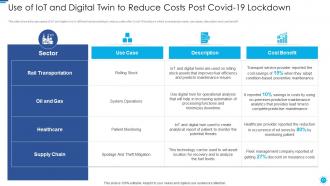
Slide 51: This slide shows the use cases of IoT and digital twin in different sectors aiming to reduce costs after Covid-19 lockdown.
Slide 52: This slide shows title for two topics that are to be covered next in the template.
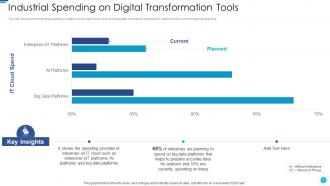
Slide 53: This slide focuses on the industrial spending on digital transformation tools which shows big data, artificial and enterprise IoT platforms.
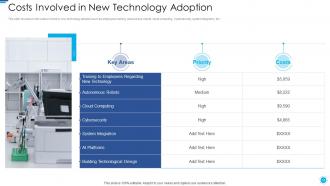
Slide 54: This slide focuses on the costs involved in new technology adoption such as employees training, autonomous robots, cloud computing, etc.
Slide 55: This slide shows title for two topics that are to be covered next in the template.
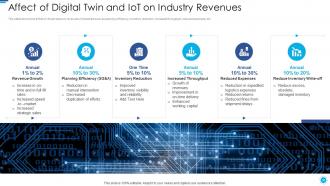
Slide 56: This slides shows the affect of virtual replica on revenues of industries such as planning efficiency, inventory reduction, etc.
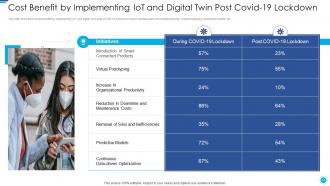
Slide 57: This slide shows the costs benefits by implementing IoT and digital twin post COVID-19 lockdown which includes smart connected products, etc.
Slide 58: This slide shows title for three topics that are to be covered next in the template.
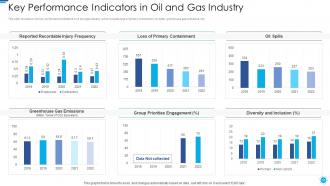
Slide 59: This slide focuses on the key performance indicators in oil and gas industry which includes loss of primary containment, oil spills, etc.
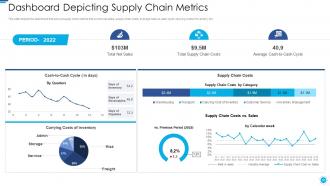
Slide 60: This slide depicts the dashboard that shows supply chain metrics that covers net sales, supply chain costs, average cash-to-cash cycle, etc.
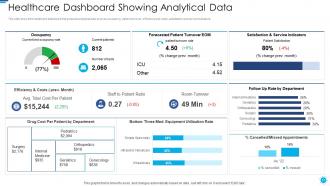
Slide 61: This slide shows the healthcare dashboard that presents analytical data such as occupancy, patient turnover, efficiency and costs, etc.
Slide 62: This slide displays Icons for Role of Digital Twin and IoT in Limiting Costs Post COVID Era.
Slide 63: This slide is titled as Additional Slides for moving forward.
Slide 64: This slide provides 30 60 90 Days Plan with text boxes.
Slide 65: This slide shows Post It Notes. Post your important notes here.
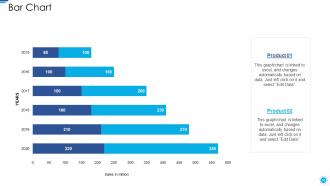
Slide 66: This slide presents Bar chart with two products comparison.
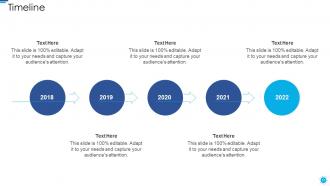
Slide 67: This is a Timeline slide. Show data related to time intervals here.
Slide 68: This is a Thank You slide with address, contact numbers and email address.
Role of digital twin and iot in limiting costs post covid era powerpoint presentation slides with all 73 slides:
Use our Role Of Digital Twin And IoT In Limiting Costs Post Covid Era Powerpoint Presentation Slides to effectively help you save your valuable time. They are readymade to fit into any presentation structure.









FAQs for Role of digital twin and iot in limiting costs post covid era
Digital twin technology in IoT systems delivers cost savings through predictive maintenance reducing equipment downtime, optimized resource allocation minimizing waste, and virtual testing eliminating physical prototyping expenses. Manufacturing companies and utilities increasingly find that these digital replicas enable faster problem resolution, streamlined operations, and enhanced asset performance, ultimately delivering significant operational efficiency and competitive advantage.
Businesses can quantify digital twin ROI by measuring reduced maintenance costs, minimized downtime, optimized resource allocation, and enhanced operational efficiency against implementation expenses. Manufacturing companies typically see 20-30% maintenance savings, while energy firms report significant asset optimization benefits, with many organizations finding that predictive capabilities and streamlined processes deliver measurable competitive advantages within 12-18 months.
Digital twins have delivered significant cost reductions in manufacturing, aerospace, energy, and healthcare, with companies like GE reducing maintenance costs by 10-15% and automotive manufacturers cutting production downtime by 20-30%. These industries demonstrate that strategic sensor placement, predictive analytics integration, and cross-functional collaboration are essential, with many organizations finding that focusing on high-impact use cases first maximizes ROI before scaling enterprise-wide.
Companies face integration complexity with existing IoT infrastructure, data quality issues from inconsistent sensor inputs, high upfront investment costs, and skills gaps in digital modeling expertise. While these challenges require strategic planning and resource allocation, organizations across manufacturing, energy, and logistics increasingly find that phased implementation approaches, starting with pilot projects, ultimately deliver significant operational efficiencies and competitive advantages.
Data accuracy directly determines digital twin reliability by ensuring real-time synchronization, predictive maintenance precision, and operational optimization capabilities. Through accurate sensor data and analytics, organizations achieve significant cost reductions in manufacturing, energy management, and asset maintenance, with many companies finding that higher data fidelity translates to enhanced decision-making and measurable efficiency gains.
Real-time analytics enables digital twin applications to deliver immediate insights for predictive maintenance, resource optimization, and operational efficiency improvements, significantly reducing unexpected downtime costs. Through continuous data processing, manufacturing plants and energy facilities can identify performance anomalies early, streamline maintenance schedules, and minimize waste, ultimately achieving 15-30% cost reductions while enhancing competitive advantage.
Yes, digital twins significantly reduce maintenance costs by enabling predictive maintenance, optimizing resource allocation, and minimizing unexpected downtime through real-time monitoring and advanced analytics. Manufacturing plants, energy facilities, and transportation companies leverage these virtual replicas to identify potential equipment failures before they occur, ultimately delivering 20-30% cost savings while enhancing operational efficiency.
Digital twin technology delivers significantly greater long-term financial returns than traditional IoT through predictive maintenance capabilities, reduced downtime costs, optimized resource allocation, and enhanced operational efficiency across entire systems. Manufacturing companies and energy providers increasingly find that while initial investments are higher, digital twins ultimately generate 20-30% more cost savings by preventing failures rather than reacting to them.
Digital twin technology reduces costs through scalable infrastructure, shared computational resources, and standardized implementation frameworks that spread development expenses across multiple applications. As organizations scale these systems across facilities, departments, and processes, they achieve significant economies of scale while streamlining operations, minimizing maintenance costs, and ultimately delivering enhanced operational efficiency and competitive advantage.
Digital twins enable predictive maintenance by creating real-time virtual replicas that monitor equipment performance, predict failures, and optimize maintenance schedules before breakdowns occur. Through continuous data analysis and machine learning algorithms, manufacturing plants and energy facilities reduce maintenance costs by 20-30%, minimize unplanned downtime, and extend asset lifecycles, ultimately delivering significant operational savings and enhanced equipment reliability.
Businesses leverage digital twin simulations to optimize supply chain management by creating virtual replicas of warehouses, transportation networks, and inventory systems that enable real-time monitoring and predictive analytics. These digital models help companies identify bottlenecks, optimize routing decisions, and forecast demand more accurately, with manufacturing and retail organizations finding that such simulations reduce operational costs while enhancing delivery speed and customer satisfaction.
Initial setup costs for digital twins include IoT sensor deployment, data infrastructure development, modeling software licensing, system integration services, and staff training programs. These expenses can be mitigated through phased implementation approaches, cloud-based platforms, vendor partnerships, and pilot project strategies, with many organizations finding that strategic planning and scalable architectures ultimately deliver significant operational cost reductions.
Digital twin software platforms vary significantly in cost-effectiveness based on licensing models, implementation complexity, scalability requirements, and feature sets. Enterprise solutions like PTC ThingWorx or Siemens MindSphere offer comprehensive capabilities but require substantial upfront investment, while cloud-based platforms like Microsoft Azure Digital Twins or AWS IoT TwinMaker provide pay-as-you-scale models that reduce initial costs, ultimately delivering better ROI for growing organizations.
Organizations can ensure cost-effective digital twin implementations by establishing clear performance metrics, regularly auditing data quality and system efficiency, and strategically scaling applications based on proven ROI. Through continuous monitoring and optimization, companies in manufacturing, healthcare, and logistics streamline operations, reduce maintenance costs, and enhance predictive capabilities, ultimately delivering sustained competitive advantage while minimizing long-term operational expenses.
Cross-departmental collaboration maximizes digital twin IoT cost reductions by aligning operational insights, sharing real-time data, and coordinating optimization strategies across manufacturing, maintenance, and supply chain teams. This strategic integration enables organizations to identify system-wide inefficiencies, streamline resource allocation, and implement comprehensive solutions, ultimately delivering enhanced operational efficiency and competitive advantage.
-
Topic best represented with attractive design.
-
Qualitative and comprehensive slides.