

Role Of IoT And Technology In Healthcare Industry Powerpoint Presentation Slides IoT CD V




Try Before you Buy Download Free Sample Product
 Impress Your
 Audience
 100%
100% Editable
 Save Hours
 of Time


Here is a competently designed Role of IoT and Technology in Healthcare Industry PPT that embarks on a journey through the realm of IoTs pivotal role, its manifold benefits and the diverse architecture levels it operates within. This Remote Patient Monitoring presentation deck takes you beyond theoretical concepts, delving into real life applications such as virtual hospitals, wearable biosensors and smart inhalers. Moreover, our Virtual Hospitals PowerPoint presentation offers a comprehensive exploration of IoT applications in healthcare, including remote patient monitoring, telemedicine and the evolution of smart hospitals. Further, the AI Medical Devices Template delves into ethical considerations, security protocols, and the transformative potential of healthcare analytics. Lastly, the IoT Applications in Healthcare PowerPoint presentation discovers budgetary considerations and delves into real world case studies showcasing how IoT reshapes healthcare practices and saves lives. With a spotlight on advancements like robotic surgery and wearable AI medical devices, witness firsthand the groundbreaking impact IoT has on patient care and management. Get access now to stay ahead in the healthcare revolution.
People who downloaded this PowerPoint presentation also viewed the following :
Content of this Powerpoint Presentation
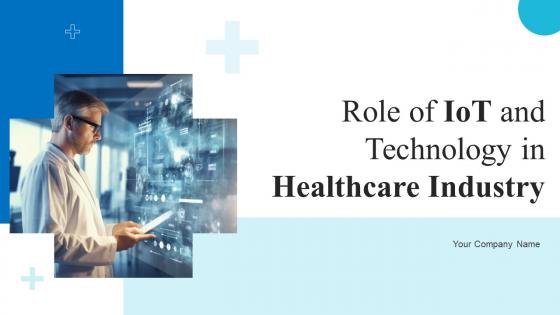
Slide 1: This slide introduces Role of IoT and Technology in Healthcare Industry. State your company name and begin.
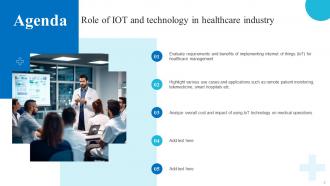
Slide 2: This slide states Agenda of the presentation.
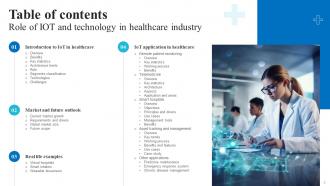
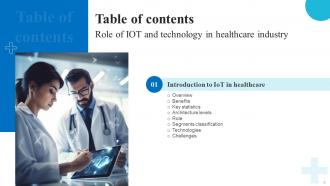
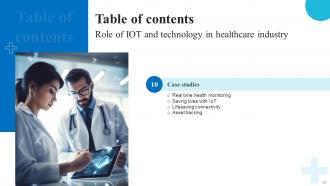
Slide 3: This slide shows Table of Content for the presentation.
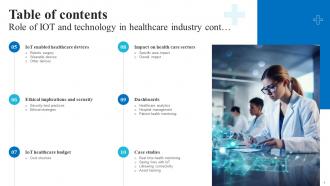
Slide 4: This is another slide continuing Table of Content for the presentation.
Slide 5: This slide highlights title for topics that are to be covered next in the template.
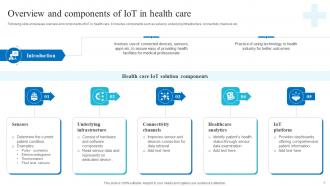
Slide 6: This slide displays Practice of using technology in health industry for better outcomes.
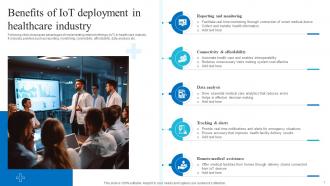
Slide 7: This slide represents Benefits of IoT deployment in healthcare industry.
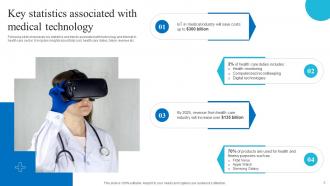
Slide 8: This slide showcases Key statistics associated with medical technology.
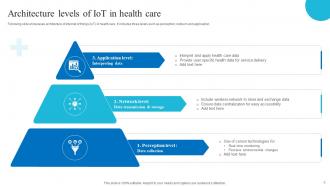
Slide 9: This slide shows Architecture levels of IoT in health care.
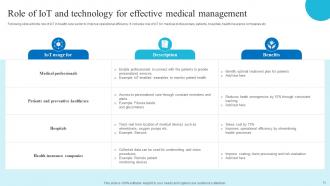
Slide 10: This slide presents Role of IoT and technology for effective medical management.
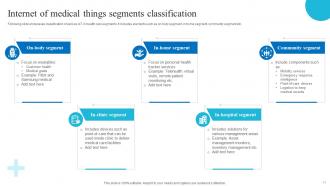
Slide 11: This slide displays Internet of medical things segments classification.
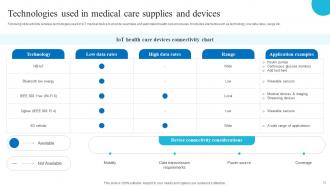
Slide 12: This slide represents Technologies used in medical care supplies and devices.
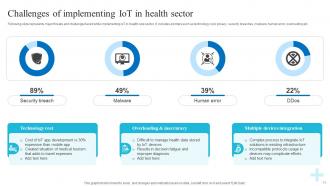
Slide 13: This slide showcases Challenges of implementing IoT in health sector.
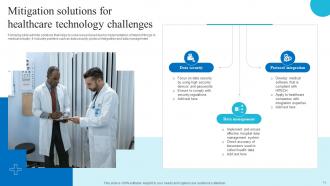
Slide 14: This slide shows Mitigation solutions for healthcare technology challenges.
Slide 15: This slide highlights title for topics that are to be covered next in the template.
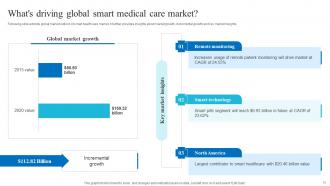
Slide 16: This slide presents What's driving global smart medical care market.
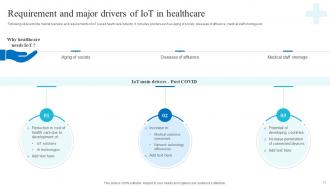
Slide 17: This slide displays Requirement and major drivers of IoT in healthcare.
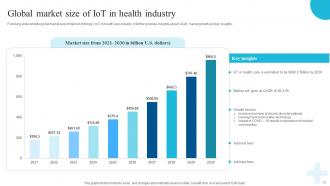
Slide 18: This slide represents Global market size of IoT in health industry.
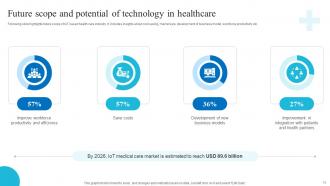
Slide 19: This slide showcases Future scope and potential of technology in healthcare.
Slide 20: This slide highlights title for topics that are to be covered next in the template.
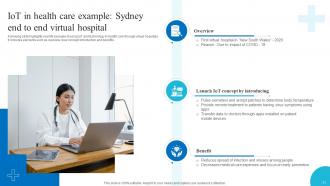
Slide 21: This slide shows IoT in health care example: Sydney end to end virtual hospital.
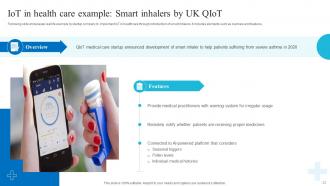
Slide 22: This slide presents IoT in health care example: Smart inhalers by UK QIoT.
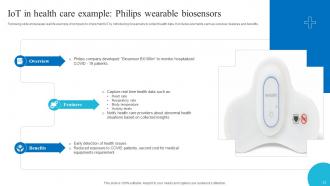
Slide 23: This slide displays IoT in health care example: Philips wearable biosensors.
Slide 24: This slide highlights title for topics that are to be covered next in the template.
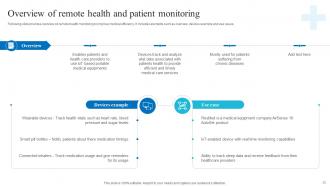
Slide 25: This slide represents Overview of remote health and patient monitoring.
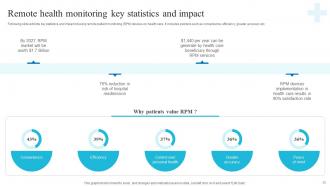
Slide 26: This slide showcases Remote health monitoring key statistics and impact.
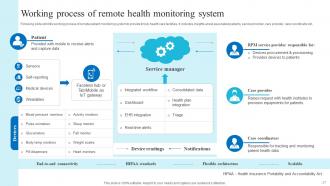
Slide 27: This slide shows Working process of remote health monitoring system.
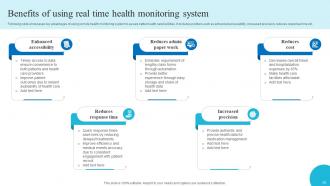
Slide 28: This slide presents Benefits of using real time health monitoring system.
Slide 29: This slide highlights title for topics that are to be covered next in the template.
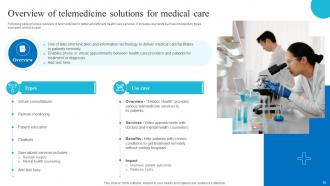
Slide 30: This slide displays Overview of telemedicine solutions for medical care.
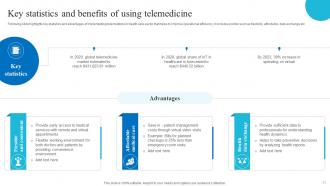
Slide 31: This slide represents Key statistics and benefits of using telemedicine.
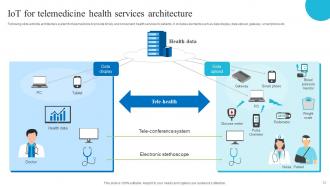
Slide 32: This slide showcases IoT for telemedicine health services architecture.
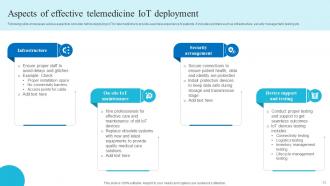
Slide 33: This slide shows Aspects of effective telemedicine IoT deployment.
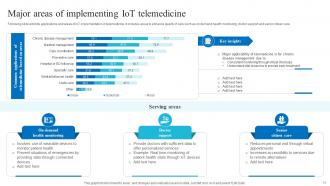
Slide 34: This slide presents Major areas of implementing IoT telemedicine.
Slide 35: This slide highlights title for topics that are to be covered next in the template.
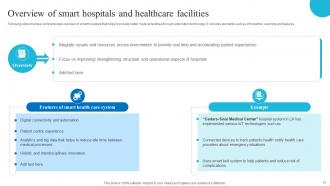
Slide 36: This slide displays Overview of smart hospitals and healthcare facilities.
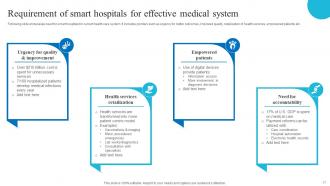
Slide 37: This slide represents Requirement of smart hospitals for effective medical system.
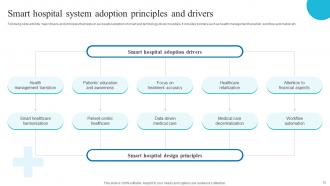
Slide 38: This slide showcases Smart hospital system adoption principles and drivers.
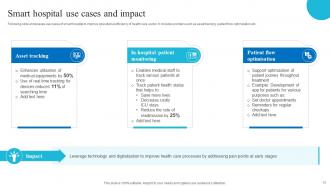
Slide 39: This slide shows Smart hospital use cases and impact.
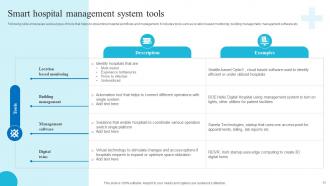
Slide 40: This slide presents Smart hospital management system tools.
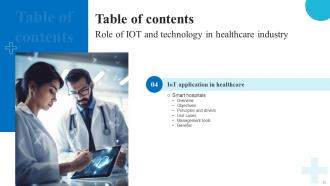
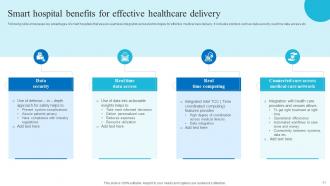
Slide 41: This slide displays Smart hospital benefits for effective healthcare delivery.
Slide 42: This slide highlights title for topics that are to be covered next in the template.
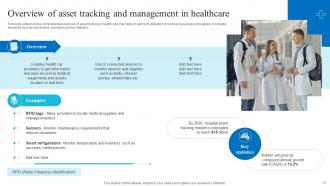
Slide 43: This slide represents Overview of asset tracking and management in healthcare.
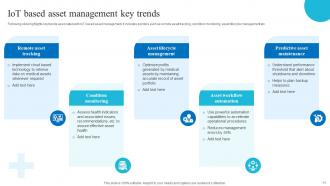
Slide 44: This slide showcases IoT based asset management key trends.
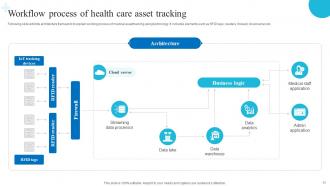
Slide 45: This slide shows Workflow process of health care asset tracking.
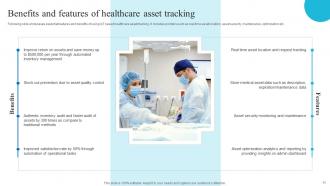
Slide 46: This slide presents Benefits and features of healthcare asset tracking.
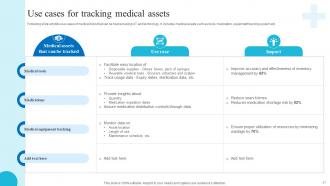
Slide 47: This slide displays Use cases for tracking medical assets.
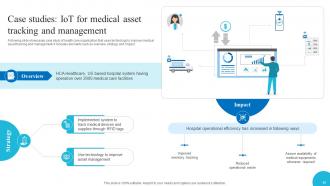
Slide 48: This slide represents Case studies: IoT for medical asset tracking and management.
Slide 49: This slide highlights title for topics that are to be covered next in the template.
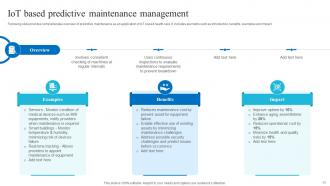
Slide 50: This slide showcases IoT based predictive maintenance management.
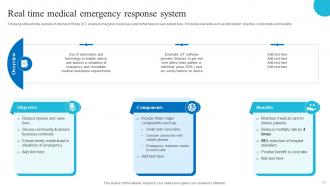
Slide 51: This slide shows Real time medical emergency response system.
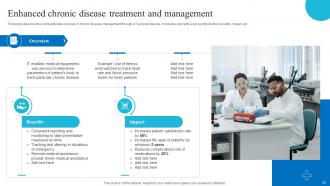
Slide 52: This slide presents Enhanced chronic disease treatment and management.
Slide 53: This slide highlights title for topics that are to be covered next in the template.
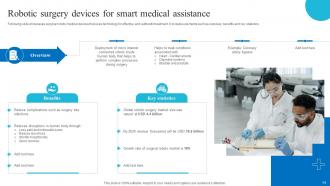
Slide 54: This slide displays Robotic surgery devices for smart medical assistance.
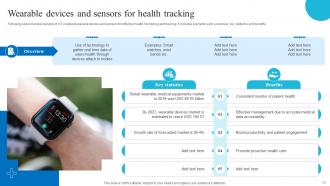
Slide 55: This slide represents Wearable devices and sensors for health tracking.
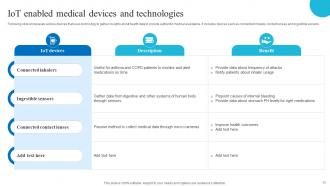
Slide 56: This slide showcases IoT enabled medical devices and technologies.
Slide 57: This slide highlights title for topics that are to be covered next in the template.
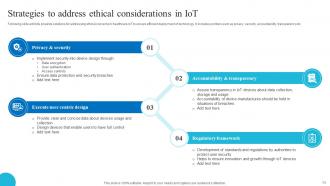
Slide 58: This slide shows Strategies to address ethical considerations in IoT.
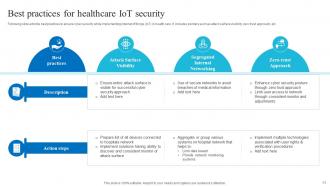
Slide 59: This slide presents Best practices for healthcare IoT security.
Slide 60: This slide highlights title for topics that are to be covered next in the template.
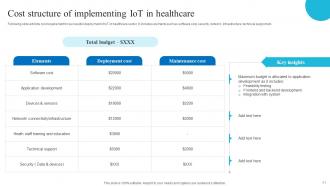
Slide 61: This slide displays Cost structure of implementing IoT in healthcare.
Slide 62: This slide highlights title for topics that are to be covered next in the template.
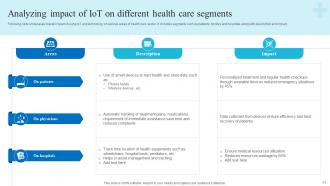
Slide 63: This slide represents Analyzing impact of IoT on different health care segments.
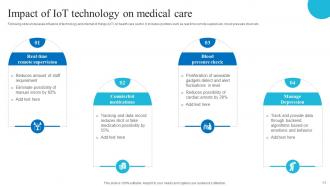
Slide 64: This slide showcases Impact of IoT technology on medical care.
Slide 65: This slide highlights title for topics that are to be covered next in the template.
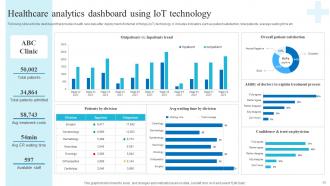
Slide 66: This slide shows Healthcare analytics dashboard using IoT technology.
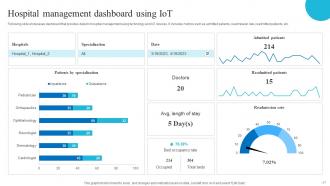
Slide 67: This slide presents Hospital management dashboard using IoT.
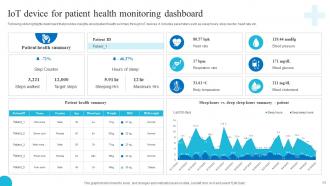
Slide 68: This slide displays IoT device for patient health monitoring dashboard.
Slide 69: This slide highlights title for topics that are to be covered next in the template.
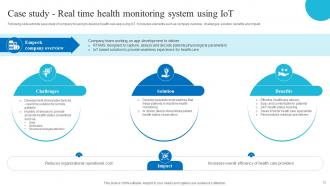
Slide 70: This slide represents Case study – Real time health monitoring system using IoT.
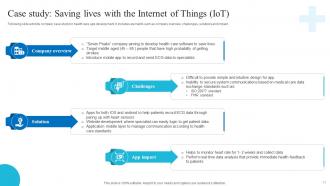
Slide 71: This slide showcases Case study: Saving lives with the Internet of Things (IoT).
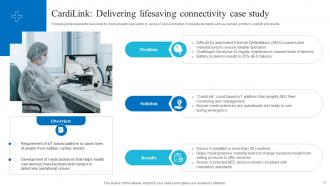
Slide 72: This slide shows CardiLink: Delivering lifesaving connectivity case study.
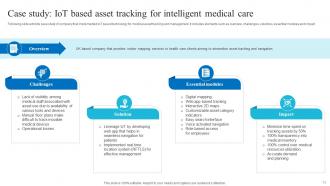
Slide 73: This slide presents Case study: IoT based asset tracking for intelligent medical care.
Slide 74: This slide contains all the icons used in this presentation.
Slide 75: This slide is titled as Additional Slides for moving forward.
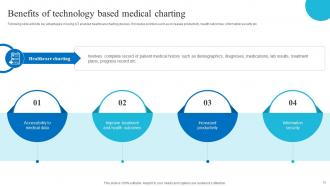
Slide 76: This slide displays Benefits of technology based medical charting.
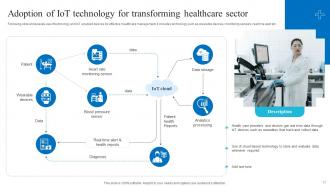
Slide 77: This slide represents Adoption of IoT technology for transforming healthcare sector.
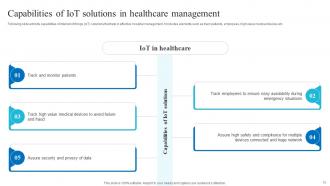
Slide 78: This slide showcases Capabilities of IoT solutions in healthcare management.
Slide 79: This is a Timeline slide. Show data related to time intervals here.
Slide 80: This slide depicts Venn diagram with text boxes.
Slide 81: This is a Thank You slide with address, contact numbers and email address.
Role Of IoT And Technology In Healthcare Industry Powerpoint Presentation Slides IoT CD V with all 90 slides:
Use our Role Of IoT And Technology In Healthcare Industry Powerpoint Presentation Slides IoT CD V to effectively help you save your valuable time. They are readymade to fit into any presentation structure.








FAQs for Role Of IoT And Technology In Healthcare Industry Powerpoint Presentation Slides
IoT integration in patient monitoring systems delivers continuous real-time tracking, automated alert systems, remote monitoring capabilities, predictive health analytics, and seamless data integration across medical platforms. These technologies enhance patient outcomes by enabling early intervention, reducing hospital readmissions, and streamlining clinical workflows, while hospitals increasingly find that connected devices minimize staff workload and improve care efficiency.
IoT improves medication adherence through smart pill dispensers, wearable reminders, connected inhalers, and real-time monitoring systems that track patient compliance automatically. These technologies streamline care coordination by sending alerts to healthcare providers, enabling personalized interventions, and delivering comprehensive adherence data, with hospitals and clinics finding significantly improved patient outcomes and reduced readmission rates.
IoT devices enhance remote patient care through continuous vital sign monitoring, medication adherence tracking, real-time health data transmission, and automated alert systems for medical emergencies. These technologies enable healthcare providers to deliver personalized care remotely, reduce hospital readmissions, and improve patient outcomes, with many telemedicine platforms finding that IoT integration streamlines diagnosis while enhancing patient engagement.
IoT healthcare devices face cybersecurity vulnerabilities, data privacy breaches, unauthorized access, weak authentication protocols, and inadequate encryption standards. Healthcare organizations mitigate these challenges through multi-layered security frameworks, regular software updates, network segmentation, and comprehensive staff training, with many hospitals finding that proactive cybersecurity strategies ultimately protect patient data while enabling innovative care delivery.
Healthcare facilities leverage IoT data for predictive analytics through real-time patient monitoring, equipment performance tracking, and environmental sensors that detect patterns indicating potential health events or system failures. Hospitals use this data to predict patient deterioration, optimize staffing levels, and prevent costly equipment breakdowns, ultimately delivering faster interventions and reduced operational costs.
Interoperability enables seamless data exchange between diverse IoT devices, electronic health records, and healthcare systems, ensuring comprehensive patient monitoring and coordinated care delivery. This connectivity allows hospitals and clinics to integrate wearable sensors, diagnostic equipment, and treatment devices into unified workflows, ultimately reducing medical errors, accelerating diagnosis times, and enhancing patient outcomes across care teams.
IoT devices enhance hospital operational efficiency by automating patient monitoring, optimizing asset tracking, streamlining workflow management, and enabling predictive maintenance of medical equipment. Through connected sensors and real-time data analytics, hospitals reduce manual tasks, minimize equipment downtime, and accelerate patient care delivery, with many healthcare systems finding that IoT integration significantly reduces operational costs while improving patient outcomes.
**INPUT**: What are the ethical considerations surrounding patient data collected via IoT devices? **OUTPUT**: Ethical considerations include patient consent transparency, data ownership rights, security breach accountability, algorithmic bias prevention, and cross-border data transfer regulations. These challenges present both privacy risks and care improvement opportunities, with many healthcare institutions finding that robust governance frameworks, encrypted storage protocols, and patient-controlled access permissions ultimately deliver enhanced trust while enabling personalized treatment innovations. [Word count: 56 words]
Wearables revolutionize chronic disease management by continuously monitoring vital signs, tracking medication adherence, and providing real-time health data to healthcare providers. Through IoT connectivity, patients with diabetes, heart conditions, and hypertension receive personalized alerts and automated care adjustments, while physicians access comprehensive patient data remotely, ultimately delivering proactive interventions and improved health outcomes.
Patient data privacy in IoT-enabled healthcare systems requires comprehensive encryption, multi-factor authentication, regular security audits, strict access controls, and HIPAA-compliant data handling protocols. These measures work together by securing data transmission, verifying user identities, and monitoring system vulnerabilities, with many hospitals and clinics finding that layered security approaches ultimately deliver enhanced patient trust while maintaining operational efficiency.
IoT devices facilitate real-time health monitoring for elderly patients by continuously tracking vital signs, detecting falls, and monitoring medication adherence through wearable sensors and smart home technologies. These connected systems enable healthcare providers to receive instant alerts about emergencies, track chronic conditions remotely, and deliver proactive interventions, ultimately reducing hospital readmissions while enhancing patient independence and safety.
Emerging IoT innovations for surgical and emergency care include smart surgical instruments with real-time feedback, connected monitoring devices for vital signs tracking, automated medication dispensing systems, GPS-enabled ambulance coordination, and AI-powered diagnostic tools. These technologies streamline emergency response times, enhance surgical precision, and improve patient outcomes by enabling seamless data sharing between medical teams, ultimately delivering faster interventions and reducing critical care complications.
IoT reduces healthcare costs by enabling remote patient monitoring, predictive maintenance of medical equipment, automated inventory management, and early disease detection through wearable devices. In urban hospitals, IoT streamlines operations and reduces readmissions, while rural clinics leverage telemedicine and remote diagnostics to minimize transportation costs, ultimately delivering more efficient care with lower overhead expenses.
IoT enables comprehensive crisis management through real-time population monitoring, contact tracing systems, resource allocation optimization, symptom surveillance networks, and predictive analytics for outbreak patterns. These interconnected technologies streamline emergency response by automating data collection, enhancing coordination between healthcare facilities, and enabling proactive interventions, ultimately delivering faster containment strategies and more efficient resource distribution during critical health emergencies.
Machine learning analyzes vast IoT health data streams from wearables, smart monitors, and medical devices to deliver personalized treatment recommendations, predictive diagnostics, and real-time health insights. Healthcare providers increasingly leverage these integrated systems to customize patient care, predict health risks, and optimize treatment outcomes, ultimately enhancing patient experiences while reducing costs.
-
I have just started downloading templates for my presentations and I must say this is a great design. It helped accelerate my presentation design process and made it more visually appealing.
-
Every time I ask for something out-of-the-box from them and they never fail in delivering that. No words for their excellence!