

Roles And Responsibilities Of Customer Solution Engineer





Try Before you Buy Download Free Sample Product
 Impress Your
Audience
 100%
Editable
 Save Hours
of Time


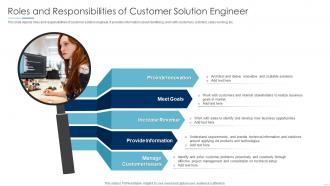
This slide depicts roles and responsibilities of customer solution engineer. It provides information about identifying, work with customers, architect, sales working, etc.
People who downloaded this PowerPoint presentation also viewed the following :
Roles And Responsibilities Of Customer Solution Engineer with all 6 slides:
Use our Roles And Responsibilities Of Customer Solution Engineer to effectively help you save your valuable time. They are readymade to fit into any presentation structure.





FAQs for Roles And Responsibilities Of
Customer Solution Engineers handle technical consultation, solution design, implementation support, customer training, and ongoing relationship management to ensure successful product adoption. These professionals bridge engineering and customer success by translating complex technical capabilities into business solutions, troubleshooting integration challenges, and delivering customized configurations, with many tech companies finding that this role significantly enhances customer satisfaction and retention rates.
Customer Solution Engineers focus on post-sale implementation, ongoing support, and long-term customer success through technical guidance and relationship management. While Sales Engineers concentrate on pre-sale technical demonstrations and closing deals, Customer Solution Engineers ensure seamless product adoption, troubleshoot implementation challenges, and drive expansion opportunities, ultimately delivering sustained value and reducing churn for organizations.
Essential skills include technical expertise in relevant technologies, strong problem-solving abilities, excellent communication skills, project management capabilities, and deep customer relationship management experience. These competencies enable engineers to bridge technical complexity with business needs, translate customer requirements into actionable solutions, and deliver seamless implementations across industries like software, telecommunications, and manufacturing, ultimately enhancing customer satisfaction and driving revenue growth.
Customer Solution Engineers collaborate with product development teams by translating customer feedback into technical requirements, participating in product roadmap discussions, and conducting feasibility assessments for new features. They bridge the gap between customer needs and engineering capabilities through regular cross-functional meetings, user story development, and beta testing coordination, ultimately ensuring products deliver market-relevant solutions that enhance customer satisfaction and drive competitive advantage.
Customer Solution Engineers typically work with CRM platforms, API integration tools, cloud computing services, data analytics software, and technical documentation systems. These technologies enable engineers to streamline customer implementations, automate troubleshooting processes, and deliver faster resolutions, with many organizations finding that this strategic combination enhances operational efficiency and ultimately drives superior customer experiences.
Customer Solution Engineers typically progress from technical support roles to senior solution architect positions, advancing through customer success manager, principal engineer, and team lead roles. This career path enables professionals to develop expertise in client relationship management, technical problem-solving, and strategic consulting, with many finding that strong communication skills and deep product knowledge ultimately deliver opportunities in executive leadership, entrepreneurship, or specialized consulting across industries.
Customer feedback directly shapes solution design by revealing pain points, usage patterns, and performance gaps that engineers address through iterative improvements, feature enhancements, and workflow optimizations. This feedback loop enables organizations to deliver more targeted solutions, reduce implementation time, and increase user adoption rates, with many companies finding that customer-driven iterations ultimately enhance satisfaction and accelerate business outcomes.
Customer Solution Engineers guide software implementation by assessing client requirements, customizing configurations, managing data migration, and providing comprehensive training to end users. They bridge the technical and business aspects of deployment, working closely with clients throughout the integration process, troubleshooting challenges, and ensuring seamless adoption, ultimately delivering faster time-to-value and enhanced user experiences.
Customer Solution Engineers ensure satisfaction by conducting thorough needs assessments, providing tailored product demonstrations, and maintaining consistent communication throughout the evaluation process. They collaborate closely with sales teams to address technical concerns, customize proposals based on specific requirements, and facilitate proof-of-concept implementations, ultimately delivering solutions that align with customer objectives and accelerate purchase decisions.
Customer Solution Engineers can effectively communicate technical concepts by using analogies and visual aids, simplifying complex terminology into business-focused language, and connecting technical features directly to specific business outcomes. These strategies enable clearer understanding by translating technical capabilities into tangible benefits like cost reduction and operational efficiency, with many engineers finding that real-world examples from the client's industry ultimately deliver stronger engagement and faster decision-making.
Customer Solution Engineers adapt solutions by conducting thorough client assessments, analyzing specific business requirements, and customizing features to align with organizational workflows and objectives. They leverage deep technical expertise alongside client consultation to modify configurations, integrate with existing systems, and develop tailored implementations, with many engineers finding that this personalized approach ultimately delivers enhanced user adoption and measurable business outcomes across diverse industries.
Key trends shaping Customer Solution Engineers include AI-powered solution customization, hybrid cloud integrations, low-code platforms, predictive analytics, and collaborative customer success tools. These technologies streamline client implementations, accelerate time-to-value, and enhance post-deployment support, with many tech companies finding that modern CSEs increasingly function as strategic consultants, ultimately delivering deeper customer relationships and competitive differentiation.
Customer Solution Engineers can measure success through key performance indicators like customer satisfaction scores, solution adoption rates, time-to-value metrics, and support ticket reduction. These measurements enable tracking of both technical performance and business outcomes, with many organizations finding that combining quantitative data with regular customer feedback sessions delivers comprehensive insights into solution effectiveness and identifies opportunities for continuous improvement.
Customer Solution Engineers commonly face complex technical requirements, tight implementation deadlines, conflicting stakeholder priorities, resource constraints, and evolving customer expectations throughout project lifecycles. These challenges can be overcome by establishing clear communication protocols, leveraging cross-functional collaboration tools, implementing agile project management methodologies, and maintaining continuous stakeholder alignment, with many organizations finding that proactive planning and transparent expectation management ultimately deliver stronger customer relationships and more successful solution deployments.
Ongoing education is crucial for Customer Solution Engineers, as they must stay current with emerging technologies, evolving customer needs, industry best practices, and competitive landscapes. This continuous learning enables engineers to deliver more innovative solutions, anticipate market shifts, and maintain technical credibility, with many organizations finding that well-trained engineers significantly enhance customer satisfaction and drive revenue growth.
-
I want to thank SlideTeam for the work that they do, especially their customer service.
-
Appreciate the research and its presentable format.