

Roles And Responsibilities Of Facility Planning Department Facility Management And Maintenance





Try Before you Buy Download Free Sample Product
 Impress Your
Audience
 100%
Editable
 Save Hours
of Time


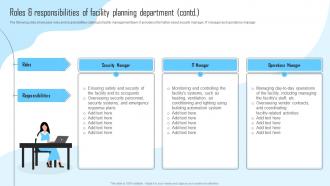
The following slide showcases roles and responsibilities catering to facility management team. It provides information about facility manager, maintenance manager, engineering manager and environmental health and safety EHS manager.
People who downloaded this PowerPoint presentation also viewed the following :
Roles And Responsibilities Of Facility Planning Department Facility Management And Maintenance with all 7 slides:
Use our Roles And Responsibilities Of Facility Planning Department Facility Management And Maintenance to effectively help you save your valuable time. They are readymade to fit into any presentation structure.






FAQs for Roles And Responsibilities Of Facility Planning Department Facility
Effective facility management encompasses space planning and optimization, preventive maintenance systems, energy management, safety and compliance protocols, and technology integration for monitoring and automation. These components work together to streamline operations, reduce operational costs, and enhance employee productivity, with many organizations finding that strategic facility management delivers improved workplace experiences and significant competitive advantage.
Technology enhances facility management efficiency by automating routine tasks, enabling predictive maintenance through IoT sensors, and streamlining work order management systems. Through integrated platforms, facilities managers can monitor energy consumption, track asset performance, and optimize space utilization in real-time, with many organizations finding that these solutions reduce operational costs while delivering faster response times and improved building performance.
Essential facility management skills include technical expertise in building systems, project management capabilities, budgeting and financial planning, vendor relationship management, and strong communication abilities. These competencies enable facility managers to streamline operations, reduce maintenance costs, and enhance workplace productivity, with many organizations finding that skilled managers deliver significant cost savings while creating safer, more efficient work environments.
Sustainability practices transform facility management strategies by integrating energy-efficient systems, waste reduction protocols, green building certifications, and resource optimization technologies. These approaches enable organizations to significantly reduce operational costs, enhance regulatory compliance, and improve occupant health, with many institutions finding that sustainable facilities deliver competitive advantages while meeting increasingly stringent environmental standards.
Data analytics optimizes facility operations by enabling predictive maintenance, space utilization analysis, energy consumption monitoring, and resource allocation planning. Through IoT sensors and building management systems, facilities managers can reduce operational costs by 15-30%, minimize equipment downtime, and enhance occupant comfort, with many organizations finding that data-driven insights ultimately deliver significant competitive advantages.
Facility management enhances employee well-being and productivity by optimizing workspace design, maintaining air quality and lighting, implementing ergonomic solutions, and ensuring efficient temperature control. Through strategic space planning and wellness-focused amenities, organizations create environments that reduce stress, minimize health issues, and boost engagement, with many companies finding that thoughtful facility management directly correlates with improved performance and retention rates.
Best practices for maintaining safety and compliance include regular safety audits, comprehensive staff training programs, automated monitoring systems, standardized documentation processes, and proactive maintenance scheduling. These approaches streamline compliance management by reducing human error, enhancing incident response times, and ensuring regulatory adherence, with many organizations finding that integrated facility management platforms ultimately deliver improved safety outcomes and operational efficiency.
Facility managers can utilize space optimization techniques through space utilization analysis, flexible workspace design, hot-desking implementation, strategic furniture placement, and technology integration for occupancy tracking. These approaches streamline operations by reducing real estate costs, enhancing employee productivity, and maximizing resource allocation, with many organizations finding that optimized spaces ultimately deliver improved workflow efficiency and significant operational savings.
Facility managers in multi-site operations face challenges including inconsistent maintenance standards, communication gaps between locations, resource allocation complexities, technology integration issues, and compliance variations across jurisdictions. These operational hurdles can significantly impact efficiency and cost control, with many organizations finding that standardized processes, centralized management systems, and strategic vendor partnerships ultimately streamline operations while reducing overhead expenses.
Budget constraints significantly influence facility management decisions by prioritizing essential maintenance over upgrades, implementing energy-efficient solutions to reduce operational costs, and adopting preventive maintenance strategies to avoid expensive repairs. These financial limitations drive facilities managers to seek cost-effective technologies and vendor partnerships, ultimately delivering enhanced resource allocation and operational efficiency while maintaining service quality standards.
Emerging trends shaping facility management include IoT sensors for predictive maintenance, AI-powered space optimization, sustainability initiatives, and mobile-first service platforms. These technologies streamline operations by reducing downtime, maximizing space utilization, and enhancing occupant experiences, with many organizations finding that integrated facility management ultimately delivers significant cost savings and competitive advantage.
Facility management enhances brand image by maintaining pristine environments, ensuring seamless operations, and creating positive visitor experiences that reflect organizational professionalism. Well-managed facilities demonstrate attention to detail and operational excellence, with corporate offices, retail spaces, and healthcare facilities finding that strategic facility management drives customer confidence, employee pride, and competitive differentiation.
Effective vendor management strategies include establishing clear performance metrics, implementing regular communication protocols, conducting thorough vendor assessments, creating standardized contracts, and developing strategic partnerships. These approaches streamline facility operations by reducing costs, improving service quality, and ensuring compliance standards, with many organizations finding that proactive vendor relationships ultimately deliver enhanced operational efficiency and competitive advantage.
Risk management integrates into facility management frameworks through comprehensive risk assessments, preventive maintenance protocols, emergency response planning, and continuous monitoring systems. These frameworks enable organizations to identify potential hazards, minimize operational disruptions, and ensure regulatory compliance, with many hospitals and manufacturing facilities finding that proactive risk integration ultimately delivers enhanced safety, reduced liability costs, and improved operational continuity.
A preventative maintenance program offers facility managers reduced equipment downtime, lower long-term repair costs, extended asset lifespans, improved energy efficiency, and enhanced safety compliance. Through scheduled inspections and proactive servicing, organizations streamline operations while minimizing unexpected breakdowns, with many facilities finding that strategic maintenance delivers significant cost savings and operational reliability.
-
“One of the best experiences with SlideTeam for my presentation.Everything on time, communication is efficient and price is reasonable. All good in one place.”
-
The quality of the templates is as fine as it could get. It was a purchase well made!