

Root cause analysis showing select team and collect data




Try Before you Buy Download Free Sample Product
 Impress Your
 Audience
 100%
100% Editable
 Save Hours
 of Time


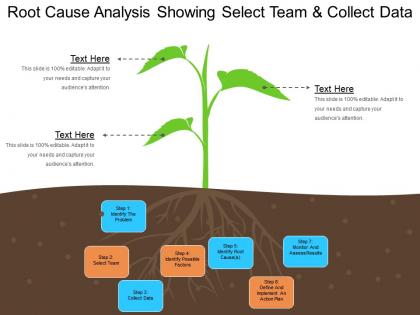
Analyze the causes and effects of the problem by employing Root Cause Analysis Showing Select Team And Collect Data slideshow. Discuss the five whys of root cause analysis that determine the root cause of a defect by repeating the question “why. Showcase the method of doing root cause analysis by utilizing our content-ready problem-solving PPT visual. Also, explain root cause analysis tools which are fishbone diagram, Pareto chart, scatter plot diagram, failure mode, and effect analysis. Describe a wide range of approaches, tools, and techniques used to uncover the causes of problems. Discuss some applications of root cause analysis such as manufacturing and industrial process control, IT and telecommunications, health and safety, system analysis, etc. By using this Ishikawa diagram PPT slide, you can determine quality control issues in product development and manufacturing. Track down the reasons for imperfections, variations, defects, or failures with the help of this fishbone diagram PowerPoint theme. Thus, determine the root cause of the problem or challenge by downloading the Ishikawa analysis PPT presentation.
People who downloaded this PowerPoint presentation also viewed the following :
Root cause analysis showing select team and collect data with all 5 slides:
Inspire the demoralised with our Root Cause Analysis Showing Select Team And Collect Data. Boost the inherent confidence they have,




FAQs for Root cause analysis showing select team
The primary purpose of conducting root cause analysis is identifying underlying systemic issues rather than addressing surface-level symptoms, enabling organizations to implement targeted solutions that prevent problem recurrence. Through systematic investigation methods, companies across manufacturing, healthcare, and financial services streamline operations, reduce costly recurring failures, and ultimately deliver sustained operational improvements and competitive advantage.
Industries adapt root cause analysis by customizing methodologies like fishbone diagrams, 5 Whys, and fault tree analysis to align with their operational contexts, regulatory requirements, and risk profiles. Manufacturing sectors focus on equipment failures and process variations, while healthcare organizations emphasize patient safety protocols, and financial services target compliance gaps, ultimately delivering industry-specific insights that enhance operational efficiency and minimize sector-relevant risks.
Common root cause analysis techniques include the Five Whys, fishbone diagrams, fault tree analysis, Pareto analysis, and failure mode analysis. These methods differ in complexity and application, with Five Whys offering simplicity for straightforward issues, while fault tree analysis provides systematic approaches for complex problems, ultimately enabling organizations to prevent recurring issues and improve operational efficiency.
The "5 Whys" technique effectively uncovers underlying issues by systematically drilling down through surface symptoms to reveal fundamental problems, asking "why" at each layer until reaching the true root cause. This methodical approach enables organizations to move beyond quick fixes, identify systemic weaknesses in manufacturing, healthcare, and service processes, ultimately delivering sustainable solutions and preventing recurring issues.
Data collection serves as the foundation of effective root cause analysis, providing the factual evidence, quantitative metrics, performance indicators, and contextual information needed to identify true underlying issues rather than symptoms. Through systematic data gathering from multiple sources, organizations can eliminate guesswork, validate hypotheses, and uncover patterns that reveal genuine root causes, ultimately delivering more accurate solutions and preventing recurring problems across operations.
**INPUT**: Which tools can be utilized to visualize findings during a root cause analysis? **OUTPUT**: Visualization tools for root cause analysis include fishbone diagrams, fault trees, process flow charts, timeline maps, and scatter plot matrices. These tools streamline complex problem identification by organizing data systematically, highlighting relationship patterns, and enabling cross-functional teams to collaborate more effectively, ultimately delivering faster resolution times and sustainable solutions. [Word count: 50 words]
Teams ensure they identify true root causes by asking "why" multiple times to dig deeper, validating findings with data and evidence, and involving diverse perspectives from different departments or expertise areas. This systematic approach prevents teams from stopping at surface-level symptoms, with many organizations finding that cross-functional collaboration and structured methodologies like fishbone diagrams ultimately deliver more accurate problem resolution and prevent recurring issues.
Common pitfalls include stopping at symptoms rather than underlying causes, rushing the analysis process, failing to gather diverse perspectives, and implementing solutions without proper validation. These mistakes can lead organizations to address surface-level issues while deeper problems persist, with many companies finding that thorough investigation and cross-functional collaboration ultimately delivers more sustainable solutions and prevents recurring incidents.
Cross-functional collaboration enhances root cause analysis by bringing diverse perspectives, specialized expertise, and comprehensive data from different departments, eliminating blind spots that single teams might miss. This collaborative approach enables organizations to identify systemic issues more accurately, develop holistic solutions, and implement sustainable corrective actions, with many companies finding that multi-departmental insights significantly reduce recurring problems.
Effective communication significantly enhances root cause analysis outcomes by facilitating transparent information sharing, encouraging diverse perspectives, and ensuring stakeholder alignment throughout the investigation process. Clear communication channels enable teams to gather comprehensive data, validate findings across departments, and implement solutions more effectively, with many organizations finding that structured communication protocols reduce analysis time and improve solution adoption rates.
A successful root cause analysis involves defining the problem clearly, gathering comprehensive data, identifying potential causes through techniques like fishbone diagrams or 5 Whys, and systematically testing hypotheses. Organizations across manufacturing, healthcare, and financial services streamline this process by assembling cross-functional teams, documenting findings thoroughly, and implementing corrective actions with monitoring systems, ultimately delivering sustainable solutions and preventing recurring issues.
Organizations measure root cause analysis effectiveness through metrics like problem recurrence rates, time-to-resolution improvements, cost savings from prevented issues, and implementation success rates of corrective actions. Through tracking these indicators, companies in manufacturing, healthcare, and financial services can quantify reduced downtime, fewer customer complaints, and enhanced operational efficiency, ultimately delivering measurable ROI and competitive advantage.
Long-term benefits include reduced recurring problems, improved operational efficiency, enhanced product quality, stronger risk management, and increased customer satisfaction. These corrective actions enable organizations to minimize costly firefighting, streamline processes, and build more resilient systems, with many companies finding that systematic implementation ultimately delivers competitive advantage and sustainable growth.
Cultural factors significantly influence root cause analysis through communication patterns, blame attribution tendencies, hierarchical reporting structures, and openness to challenging established processes. Organizations with transparent, learning-focused cultures typically uncover deeper systemic issues more effectively, while blame-oriented environments may surface only superficial causes, ultimately impacting the thoroughness and accuracy of problem-solving efforts.
Technology and software improve root cause analysis efficiency through automated data collection, pattern recognition algorithms, predictive analytics, real-time monitoring systems, and collaborative digital platforms. These tools streamline investigation processes by rapidly analyzing vast datasets, identifying correlations across multiple variables, and enabling cross-functional teams to share insights seamlessly, ultimately delivering faster problem resolution and more accurate preventive measures.
-
Excellent products for quick understanding.
-
Excellent products for quick understanding.