

Run Penetration Testing To Review Risk Implementing Strategies To Mitigate Cyber Security Threats




Try Before you Buy Download Free Sample Product
 Impress Your
Audience
 100%
Editable
 Save Hours
of Time


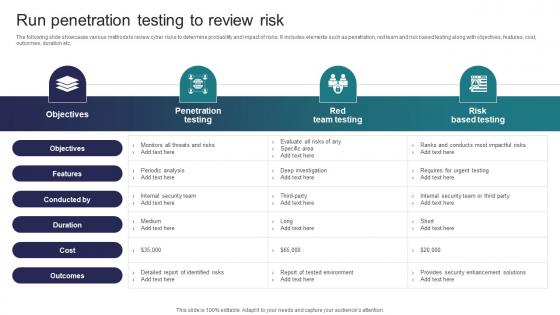
The following slide showcases various methods to review cyber risks to determine probability and impact of risks. It includes elements such as penetration, red team and risk based testing along with objectives, features, cost, outcomes, duration etc.
People who downloaded this PowerPoint presentation also viewed the following :
Run Penetration Testing To Review Risk Implementing Strategies To Mitigate Cyber Security Threats with all 9 slides:
Use our Run Penetration Testing To Review Risk Implementing Strategies To Mitigate Cyber Security Threats to effectively help you save your valuable time. They are readymade to fit into any presentation structure.









FAQs for Run Penetration Testing To Review Risk Implementing Strategies To Mitigate
Penetration testing is an authorized simulated cyberattack that actively exploits system vulnerabilities to assess security defenses, while vulnerability assessment identifies and catalogs potential weaknesses without exploitation. Through comprehensive testing methodologies, organizations in banking, healthcare, and retail can distinguish between theoretical risks and actual exploitable threats, ultimately delivering stronger security postures and regulatory compliance.
Penetration testing methodologies include black-box testing, white-box testing, gray-box testing, network penetration testing, and web application testing. These approaches enhance cybersecurity by systematically identifying vulnerabilities, simulating real-world attacks, and evaluating security controls, with many organizations finding that comprehensive testing ultimately delivers stronger defenses and regulatory compliance.
Organizations benefit from regular penetration testing by identifying vulnerabilities before attackers exploit them, ensuring compliance with security regulations, and validating their defense mechanisms. Through systematic security assessments, companies across sectors like banking, healthcare, and retail can minimize breach risks, reduce potential financial losses, and maintain customer trust, ultimately delivering stronger security postures and competitive advantage.
**INPUT**: What are the key phases of a penetration testing engagement? **OUTPUT**: Penetration testing engagements include reconnaissance, scanning, vulnerability assessment, exploitation, and reporting phases. These structured phases enable organizations to systematically identify security gaps, validate defenses, and prioritize remediation efforts, with many financial institutions and healthcare providers finding that comprehensive testing ultimately delivers stronger security postures and regulatory compliance.
Penetration testers commonly use vulnerability scanners like Nessus and OpenVAS, network mapping tools such as Nmap, exploitation frameworks including Metasploit, web application testers like Burp Suite, and social engineering techniques. These tools enable comprehensive security assessments by identifying system weaknesses, simulating real-world attacks, and testing human vulnerabilities, ultimately helping organizations strengthen their defenses and minimize breach risks.
Social engineering can be integrated into penetration testing through phishing campaigns, pretexting calls, physical security assessments, and tailgating attempts to evaluate human vulnerabilities alongside technical weaknesses. These methods help organizations identify gaps in security awareness training and policy enforcement, with many companies finding that combining technical and social engineering tests provides comprehensive security assessments, ultimately strengthening both technological defenses and employee resilience against manipulation tactics.
Legal considerations for penetration testing include obtaining written authorization, defining scope boundaries, ensuring compliance with data protection regulations, securing proper contracts, and maintaining confidentiality agreements. Organizations must navigate privacy laws, industry regulations, and jurisdictional requirements, with many financial institutions and healthcare providers finding that comprehensive legal frameworks ultimately deliver regulatory compliance and risk mitigation.
Penetration testing scope is determined by identifying critical assets, defining testing boundaries, establishing permitted testing methods, and setting clear objectives with stakeholders. Organizations typically focus on high-value systems like customer databases, payment processors, and network infrastructure, while balancing comprehensive security assessment with operational continuity, ultimately ensuring thorough vulnerability identification without disrupting essential business functions.
Common vulnerabilities penetration tests uncover include SQL injection, cross-site scripting, weak authentication protocols, unpatched software systems, and misconfigured network settings. These security assessments enable organizations to identify critical weaknesses before malicious actors exploit them, with many financial institutions and healthcare providers finding that regular testing significantly reduces breach risks and enhances overall cybersecurity posture.
Penetration test findings are effectively communicated through executive summaries for leadership, detailed technical reports for IT teams, risk matrices prioritizing vulnerabilities by severity, and remediation roadmaps with clear timelines. These multi-layered reports enable organizations to align security investments with business priorities, facilitate informed decision-making across departments, and ensure both technical teams and executives understand critical vulnerabilities requiring immediate attention.
Penetration testing serves as crucial validation for regulatory compliance frameworks like SOX, HIPAA, and PCI-DSS by demonstrating proactive security measures, identifying vulnerabilities before audits, and providing documented evidence of security controls. Organizations across healthcare, finance, and retail leverage these assessments to meet mandatory requirements while strengthening their overall security posture, ultimately reducing compliance costs and regulatory risks.
Penetration testing contributes to risk management by identifying vulnerabilities before malicious actors exploit them, quantifying potential security impacts, and providing actionable remediation priorities. These assessments enable organizations to allocate security resources strategically, demonstrate compliance with regulatory requirements, and reduce overall cyber risk exposure, ultimately delivering measurable improvements in security posture and business continuity planning.
Best practices for choosing a penetration testing service provider include verifying certifications like CISSP or CEH, evaluating industry experience, confirming comprehensive methodology coverage, and ensuring detailed reporting capabilities. Organizations should prioritize providers with proven expertise in their specific sector, whether healthcare, financial services, or retail, while confirming they offer both automated and manual testing approaches that deliver actionable insights for strengthening security posture.
Organizations prepare for penetration testing by defining clear scope and objectives, updating system documentation, implementing baseline security measures, and establishing communication protocols with testing teams. Through comprehensive employee briefings, backup procedures, and incident response planning, companies ensure minimal disruption while maximizing testing value, ultimately strengthening their security posture and regulatory compliance across all operational areas.
Organizations should measure penetration test success through vulnerability discovery rates, risk severity classifications, remediation timelines, coverage scope across systems, and retest validation results. These metrics enable financial institutions, healthcare providers, and retail companies to quantify security improvements, track remediation progress, and demonstrate compliance effectiveness, ultimately delivering measurable risk reduction and enhanced cybersecurity posture.
-
“One of the best experiences with SlideTeam for my presentation.Everything on time, communication is efficient and price is reasonable. All good in one place.”
-
Their professional templates are very impressive, even my manager was curious about the source. I am very grateful.