

SaaS Company Profile Powerpoint Presentation Slides CP CD V




Try Before you Buy Download Free Sample Product
 Impress Your
 Audience
 100%
100% Editable
 Save Hours
 of Time


Introducing our SaaS Company Profile PowerPoint presentation, a professionally designed resource that provides a comprehensive overview of your organizations critical points for investors and stakeholders to evaluate your business value and performance. This Cloud based Software profile starts with an executive summary and company overview, highlighting your core values, company history, and global presence. It showcases the impressive facts and figures about your salesforce, including your products, CRM software solutions, and other innovative offerings such as the CRM Customer 360 software with Slack, MuleSoft platform, Heroku platform, Tableau tool, and Salesforce coding based systems. The Sales and Service Cloud presentation emphasizes the importance and benefits of CRM management systems and delves into the pricing of sales and service cloud CRM, MandA deals, global clients, customer reviews, awards, new product innovation, revenue, cash flow, and financial performance comparison. Additionally, it provides insights into the worldwide CRM applications market share, a comprehensive SWOT analysis, and highlights your organizations ESG leadership. This 100 percentage editable and customizable template allows you to tailor the content to accurately represent your SaaS companys profile. Impress your audience and showcase your strengths with our SaaS Company Profile PowerPoint presentation. Download now to effectively communicate your business value and achievements.
People who downloaded this PowerPoint presentation also viewed the following :
Content of this Powerpoint Presentation
Slide 1: This slide introduces SaaS Company Profile. State your company name and begin.
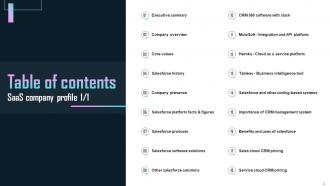
Slide 2: This slide shows Table of Content for the presentation.
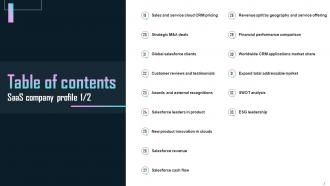
Slide 3: This is another slide continuing Table of Content for the presentation.
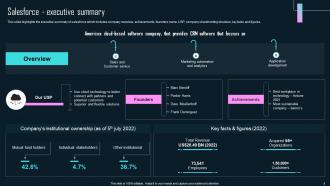
Slide 4: This slide highlights the executive summary of salesforce.
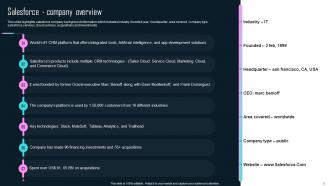
Slide 5: This slide highlights salesforce company background information.
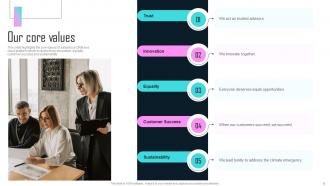
Slide 6: This slide highlights the core values of salesforce CRM and cloud platform.
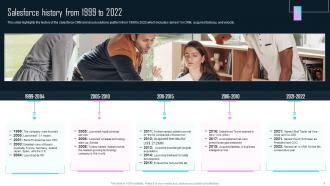
Slide 7: This slide highlights the history of the salesforce CRM and cloud solutions platform from 1999 to 2022.
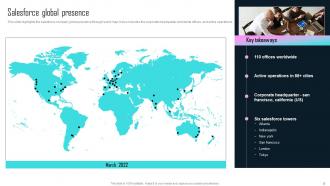
Slide 8: This slide highlights the salesforce company global presence through world map.
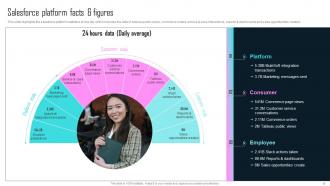
Slide 9: This slide highlights the salesforce platform statistics.
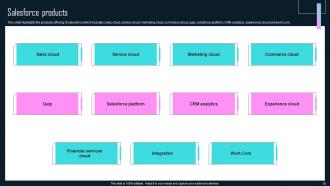
Slide 10: This slide highlights the products offering of salesforce which includes sales cloud, service cloud, marketing cloud, commerce cloud etc.
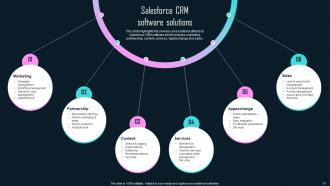
Slide 11: This slide highlights the services and solutions offered by salesforce CRM software.
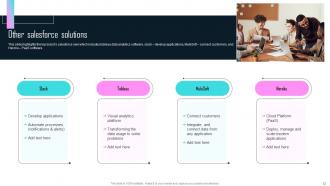
Slide 12: This slide highlights the top brand’s salesforce own which includes tableau data analytics software, slack – develop applications etc.
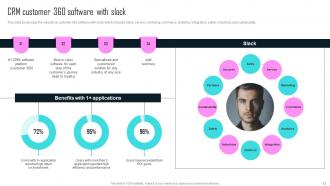
Slide 13: This slide showcases the salesforce customer 360 software with slack.
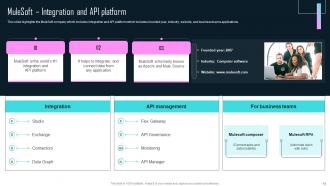
Slide 14: This slide highlights the MuleSoft company which includes integration and API platform.
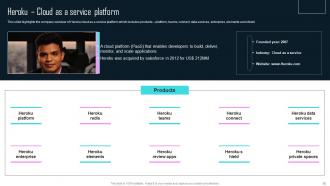
Slide 15: This slide highlights the company overview of Heroku cloud as a service platform.
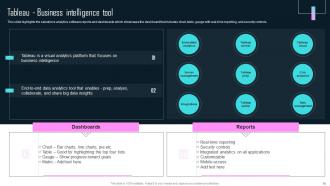
Slide 16: This slide highlights the salesforce analytics software reports and dashboards which showcases the dashboard.
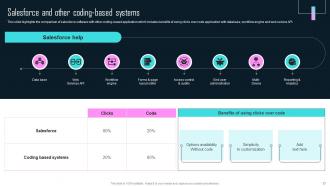
Slide 17: This slide highlights the comparison of salesforce software with other coding-based application.
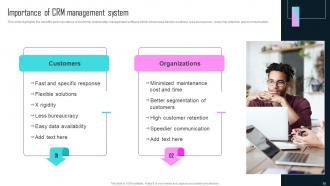
Slide 18: This slide highlights the benefits and importance of customer relationship management software.
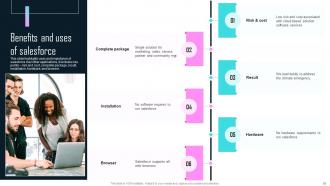
Slide 19: This slide highlights uses and importance of salesforce over other applications.
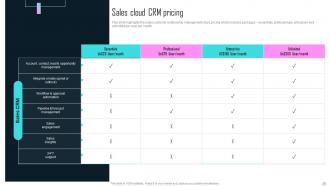
Slide 20: This slide highlights the sales customer relationship management cloud pricing.
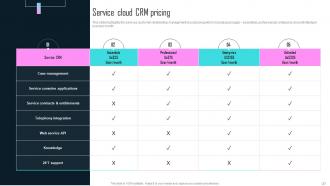
Slide 21: This slide highlights the services customer relationship management cloud pricing which includes packages – essentials, professionals, enterprise etc.
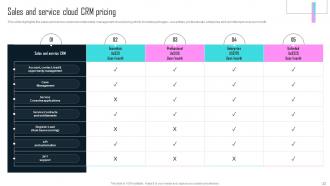
Slide 22: This slide highlights the sales and service customer relationship management cloud pricing.
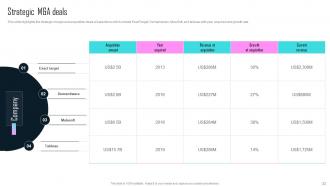
Slide 23: This slide highlights the strategic merger and acquisition deals of salesforce.
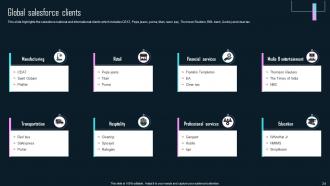
Slide 24: This slide highlights the salesforce national and international clients which includes CEAT, Pepe jeans, puma, titan etc.
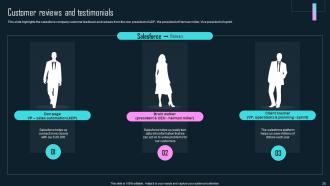
Slide 25: This slide highlights the salesforce company customer feedback and reviews from the vice president of ADP, the president of Herman miller, Vice president of sprint.
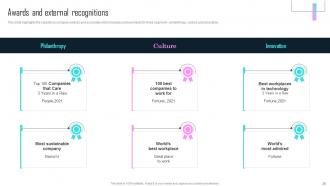
Slide 26: This slide highlights the salesforce company awards and accolades which includes achievements for three segment – philanthropy, culture and innovation.
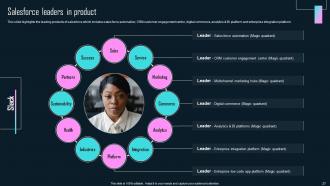
Slide 27: This slide highlights the leading products of salesforce which includes sales force automation, CRM customer engagement center etc.
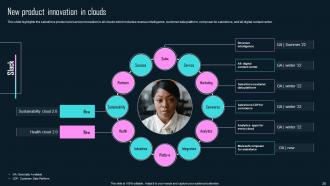
Slide 28: This slide highlights the salesforce product and service innovation in all clouds which includes revenue intelligence, customer data platform etc.
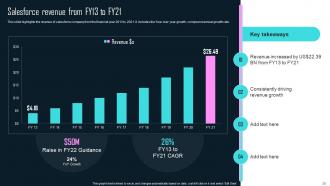
Slide 29: This slide highlights the revenue of salesforce company from the financial year 2013 to 2021.
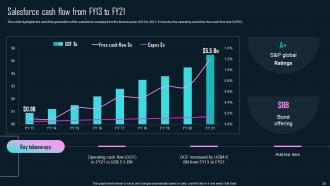
Slide 30: This slide highlights the cash flow generation of the salesforce company from the financial year 2013 to 2021.
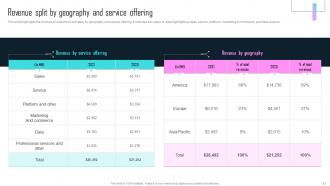
Slide 31: This slide highlights the revenue of salesforce company by geography and service offering.
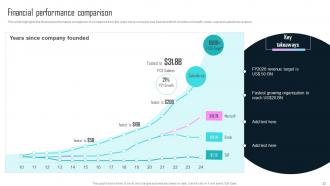
Slide 32: This slide highlights the financial performance comparison of companies from the years since company was founded.
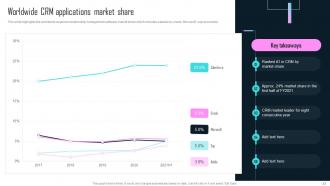
Slide 33: This slide highlights the worldwide customer relationship management software market share which includes salesforce, oracle, Microsoft, sap and adobe.
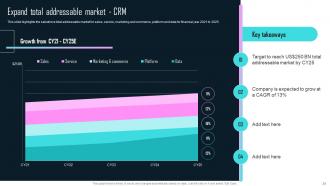
Slide 34: This slide highlights the salesforce total addressable market for sales, service, marketing and commerce, platform and data for financial year 2021 to 2025.
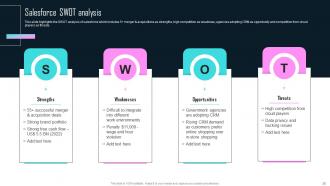
Slide 35: This slide highlights the SWOT analysis of salesforce.
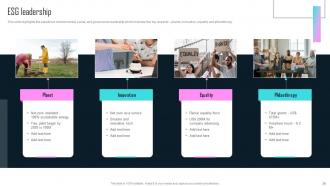
Slide 36: This slide highlights the salesforce environmental, social, and governance leadership.
Slide 37: This slide contains all the icons used in this presentation.
Slide 38: This slide is titled as Additional Slides for moving forward.
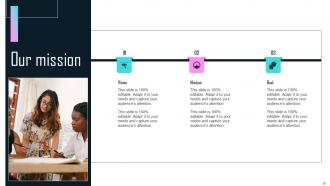
Slide 39: This is Our Mission slide with related imagery and text.
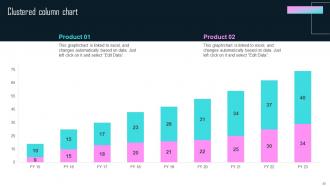
Slide 40: This slide provides Clustered Column chart with two products comparison.
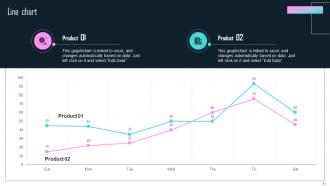
Slide 41: This slide describes Line chart with two products comparison.
Slide 42: This slide provides 30 60 90 Days Plan with text boxes.
Slide 43: This is Our Target slide. State your targets here.
Slide 44: This is a Timeline slide. Show data related to time intervals here.
Slide 45: This slide shows Post It Notes. Post your important notes here.
Slide 46: This is a Financial slide. Show your finance related stuff here.
Slide 47: This slide depicts Venn diagram with text boxes.
Slide 48: This is a Thank You slide with address, contact numbers and email address.
SaaS Company Profile Powerpoint Presentation Slides CP CD V with all 53 slides:
Use our SaaS Company Profile Powerpoint Presentation Slides CP CD V to effectively help you save your valuable time. They are readymade to fit into any presentation structure.






FAQs for SaaS Company Profile Powerpoint Presentation Slides
Start with the obvious stuff - what problem you're solving, who's buying it, and how much you charge. Investors will definitely ask about MRR, churn, and customer acquisition costs, so get those ready. The team section matters more than you'd think - I swear people make snap judgments about SaaS founders. Throw in your tech stack and any big-name customers if you've got them. Security certs are clutch for enterprise deals. Oh, and make sure your value prop hits hard in those first couple sentences or you'll lose people fast.
Look, your mission statement is basically what separates you from every other random SaaS tool out there. It shows you actually solve real problems instead of just existing to make money. People remember companies with clear purpose - customers trust you more, investors pay attention, and honestly, who wants to work somewhere that doesn't matter? Connect your product to the bigger outcomes your customers actually care about. Be specific to your industry though. Skip the generic "revolutionizing business through innovation" nonsense that makes my eyes roll. Here's a quick test: if someone can't remember it after hearing it once, you've probably overcomplicated things.
Honestly, just track the big three first: ARR, churn rate, and customer acquisition cost. Those are what investors actually look at when they're deciding if you're worth their time. Monthly recurring revenue growth is solid too, plus customer lifetime value - actually, the LTV/CAC ratio might be your most important number. Shows whether you're making smart bets on customers or just burning cash. Oh, and gross + net revenue retention tell you if existing customers are sticking around and spending more. But seriously, start with ARR and churn. Get those right and you've got most of your story sorted.
Dude, testimonials are absolutely clutch for SaaS companies. They're like instant credibility boosters when prospects are still deciding. Real customers sharing specific results? Way more convincing than your typical marketing BS. I mean, literally anyone can say their software is "game-changing" - but testimonials actually prove it works. SaaS buyers usually involve multiple decision-makers too, so that social proof really helps seal the deal. Oh, and make sure you get ones with actual numbers or outcomes, not just "loved it!" fluff. Those generic ones don't move the needle at all.
Look, your UVP is basically what stops people from scrolling past your SaaS profile in 2 seconds. Without it, you're just another "we make business better" company that sounds like everyone else. You need to spell out exactly what problem you fix and why you're different - think elevator pitch but written down. I see so many companies mess this up and wonder why nobody remembers them. Put yours right at the top, make it super specific, and focus on what people actually get from using your stuff. Don't be vague or you'll get lost in the noise.
Dude, visual design can make or break your SaaS profile. I've literally watched investors scroll past amazing companies because their decks looked outdated. First impressions matter so much in tech - clean, modern visuals instantly show you're legit and know what you're doing. Honestly? If your presentation looks like garbage, people assume your software does too. Stick with consistent branding and simple layouts. Don't try to get fancy with weird fonts or whatever. Grab a decent template if you need to - it's worth spending a bit on design help since this stuff directly impacts how serious people think you are.
Dude, start with data privacy stuff - spell out how you handle customer info and which rules you follow (GDPR, CCPA, whatever applies). Make your terms of service and privacy policy super easy to find. The legal side is honestly such a pain but you gotta nail it early. Cover liability limits too, plus service disclaimers and who owns what IP-wise. Oh, and pick which state/country handles any legal drama. Seriously though, get a lawyer to check your wording before you launch. Way cheaper than dealing with lawsuits later - trust me on this one.
Create a section showing all your integrations - logos, API stuff, partnerships with tools they probably already use. Break it into categories like CRM, marketing, analytics so it's easy to scan. Trust me, people spend forever on this page trying to figure out if you'll mess up their current setup. Don't forget marketplace listings if you're on Salesforce AppExchange or HubSpot. Got a public API? Mention it. Webhooks too. The whole point is making it obvious you won't be a pain to implement with whatever they're already running.
Honestly, just pick 2-3 trends that actually match your roadmap instead of rattling off everything. AI features are huge right now, obviously. Vertical solutions are hot too - way better than trying to be everything to everyone. Remote work stuff is still messy so that's fair game. Customer success metrics over pure acquisition numbers shows you get it. Usage-based pricing models are everywhere now. API-first architecture if that's your thing. Oh, and data privacy compliance - can't ignore that anymore. Don't just name-drop though. Have real examples from your platform ready because they'll definitely ask for specifics.
Just pick your main 3-5 competitors - honestly more than that gets messy and nobody reads it anyway. Make a simple table comparing pricing, features, who you're targeting, stuff like that. Here's the thing though: don't trash talk them even if they suck. Instead, just be real about where you're better and where market gaps exist. Oh and make sure you're comparing similar companies - like don't put yourself against Google if you're a 10-person startup, you know? The whole point is showing why someone should pick you over the alternatives. End it with your biggest competitive advantage spelled out clearly.
Don't just say you scale - prove it with real numbers. Uptime percentages, load test results, how fast you onboard users. That generic "we scale easily" line? Everyone says that. Case studies hit different though, especially showing how you handled a client's massive growth without any hiccups. Your team needs to scale too, not just the tech stack. Lead with the technical stuff but throw in operational capabilities since investors want to know you won't crumble under success. Performance metrics under pressure tell the whole story better than vague promises.
Definitely do an org chart, but make it visual and focus on departments like engineering, sales, marketing. Skip listing everyone's names though - that stuff gets stale quick and honestly no one really cares about random team members. What matters is showing you've got solid experience in each area. Add short bios for your leadership team and maybe a few key senior people. The whole point is proving you have the right talent to actually build your product and keep customers happy. Keep it clean so people can scan it fast, and don't forget to update it when things change.
Focus on stuff that actually fixes real problems in ways your competitors can't. AI automation that works, integrations that don't suck, or making complicated things ridiculously easy for users. Don't bother with generic "cloud-based" nonsense - everyone says that. Predictive analytics, one-click workflows, mobile-first design... but only if they genuinely make you different. Show how these features create real business results. Honestly, most companies list way too many features. Pick 3-4 killer ones and lead with what customers get, not the boring technical details.
Look, case studies are basically proof you're not just talking BS - they show real results from actual customers. Get specific about the problems you solved and throw in solid numbers like "cut costs by 40%" or whatever. That stuff matters way more than fancy marketing speak. Mix up different industries and company sizes so people see you work for everyone, not just tech startups in Silicon Valley. Keep the format clean with clear before/after stats and genuine customer quotes. Nobody wants to read something that sounds like a robot wrote it. When prospects see "this saved us $50K," that's when they actually start caring about what you're selling.
Yeah, totally do a roadmap section! Show the next 12-18 months but don't get crazy specific with dates - we all know those never work out anyway. Focus on the big stuff your customers actually want: API updates, mobile apps, better analytics, whatever keeps showing up in your support inbox. I'd tie each feature back to real customer problems you're solving. Makes it way more compelling than just listing random tech improvements. Keep it realistic but exciting enough that investors see you're actually moving forward, not just treading water. People want to know you're building toward something bigger.
-
Extensive range of templates! Highly impressed with the quality of the designs.
-
I joined SlideTeam last month and there’s no doubt that I tend to find our bond only strengthening over time. Best place to find world-class themes, templates, and icons.