

Safety Controls For Real Estate Project Powerpoint Presentation Slides






Try Before you Buy Download Free Sample Product
 Impress Your
Audience
 100%
Editable
 Save Hours
of Time


Safety Controls for Real Estate Project helps real estate companies prevent and minimize the risks that can cause loss of workers lives, property damage, and loss of reputation. This PPT deck can assist managers in civil engineering firms in drafting and deploying a health and safety plan for workers to make the building sites safer. The PowerPoint module includes a business portfolio of the construction company and a performance snapshot for recent civil engineering projects on the schedule performance index SPI, cost performance index CPI, and injuries incurred. Then it highlights the significant issues faced by the real estate firm due to poor safety at the construction site, such as legal ramifications and claims for compensation. Additionally, the PPT deck covers in detail the multiple goals of the construction site safety program, such as setting up a safety department, conducting hazard impact analysis, implementing control measures for working at heights, electrocution prevention, excavation and trenching injuries avoidance, and impart safety training. Moreover, it shows a budget plan for the construction site safety program, potential barriers to its implementation, and its impact on building construction site safety in terms of fewer accidents, lesser legal repercussions, and enhanced brand reputation. At last, it includes dashboards to monitor construction site injuries and safety program performance. Download our 100 parcent editable and customizable deck to know more in detail.
People who downloaded this PowerPoint presentation also viewed the following :
Content of this Powerpoint Presentation
Slide 1: This slide introduces the Safety Controls for Real Estate Project. Commence by stating Your Company Name.
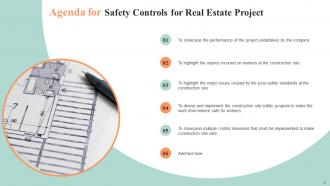
Slide 2: This slide reveals the Agenda of the presentation.
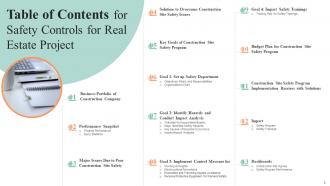
Slide 3: This slide incorporates the Table of Contents.
Slide 4: This slide depicts the Title for the Topics to be covered in the next template.
Slide 5: This slide indicates the business portfolio of the construction company covering various details.
Slide 6: This slide highlights the Heading for the Topics to be discussed in the upcoming template.
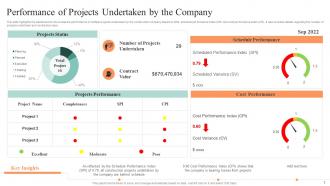
Slide 7: This slide displays the dashboard to showcase the performance of multiple projects undertaken by the construction company.
Slide 8: This slide presents the dashboard to showcase the workers injuries incurred at construction site.
Slide 9: This slide contains the Title for the Ideas to be discussed further.
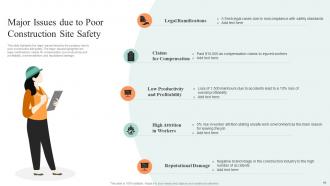
Slide 10: This slide highlights the major issues faced by the company due to poor construction site safety.
Slide 11: This slide includes the Heading for the Topics to be covered further.
Slide 12: This slide showcases the Solution to Overcome Construction Site Poor Safety Impact.
Slide 13: This slide elucidates the Title for the Topics to be covered next.
Slide 14: This slide indicates the major focus areas for the construction site safety program.
Slide 15: This slide incorporates the Heading for the Contents to be discussed further.
Slide 16: This slide provides information regarding the key objectives of the construction site safety department and details of major responsibilities.
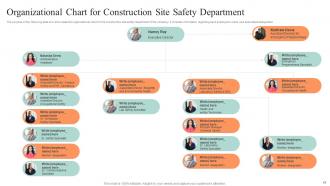
Slide 17: This slide represents the organizational chart for the construction site safety department of the company.
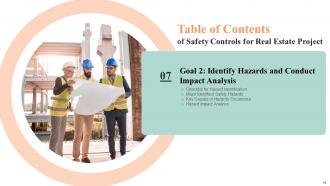
Slide 18: This slide includes the Title for the Topics to be covered next.
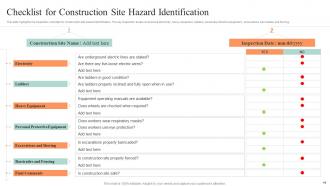
Slide 19: This slide highlights the inspection checklist for construction site hazard identification.
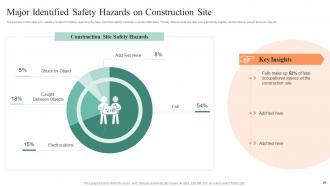
Slide 20: The slide visually provides information regarding the major identified safety hazards on construction sites.
Slide 21: This slide provides information regarding the major causes of hazards occurrence on worksites.
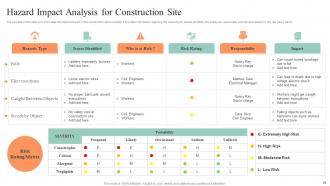
Slide 22: This slide showcases the impact analysis of the construction site’s hazards.
Slide 23: This slide depicts the Heading for the Components to be discussed further.
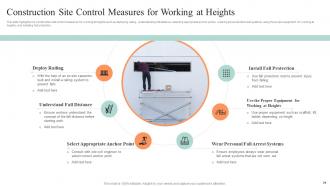
Slide 24: This slide highlights the different construction site control measures for working at heights.
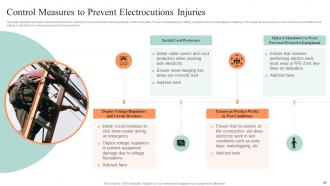
Slide 25: This slide elucidats the safety measures that must be deployed to prevent electrocutions injuries at construction sites.
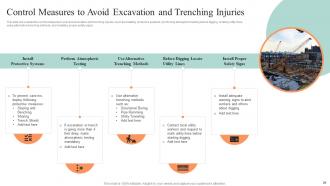
Slide 26: This slide showcases the control measures to prevent excavation and trenching injuries.
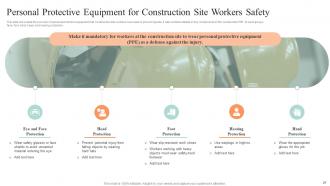
Slide 27: This slide showcase the overview of personal protective equipment that construction site workers must wear to prevent injuries.
Slide 28: This slide includes the Title for the Topics to be covered in the next template.
Slide 29: This slide showcases the training plan for the construction site safety program.
Slide 30: This slide exhibits information about the Heading for the Ideas to be discussed further.
Slide 31: This slide presents the Budget Plan for Construction Site Safety Program.
Slide 32: This slide elucidates the Title for the Ideas to be discussed next.
Slide 33: This slide showcases the major barriers to successfully implement of construction site safety program.
Slide 34: This slide incorporates the Title for the Contents to be covered further.
Slide 35: This slide highlights the impact of the construction site safety program.
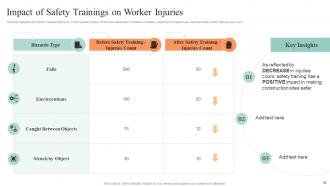
Slide 36: This slide presents the impact of safety training on worker injuries to make construction sites safer.
Slide 37: This slide includes the Heading for the Contents to be discussed further.
Slide 38: This slide showcasesthe dashboard to monitor workers injuries at the construction site.
Slide 39: This slide reflects the key performance indicator dashboard to track the performance of the safety program.
Slide 40: This is the Icons slide depicting various Icons used in the plan.
Slide 41: This slide is used for showcasing some additional information.
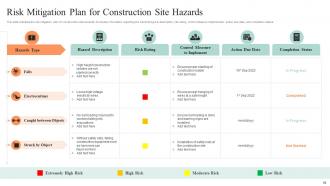
Slide 42: This slide indicates the risk mitigation plan for construction site hazards.
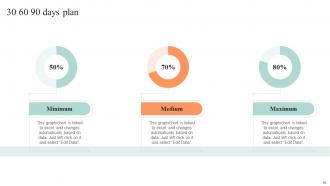
Slide 43: This is the 30 60 90 days plan slide for efficient planning.
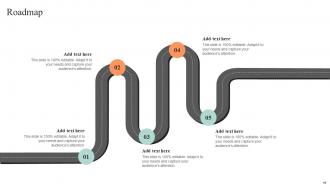
Slide 44: This is the Roadmap slide revealing the Company's journey.
Slide 45: This slide presents information using a Column chart.
Slide 46: This is the Venn Diagram slide for showcasing some relevant information.
Slide 47: This is the Timeline slide of the organization.
Slide 48: This is Out target slide. List your organization's targets here.
Slide 49: This slide represents a magnifying glass for minute details.
Slide 50: This is the Puzzle slide with related imagery.
Slide 51: This is the Thank You slide for acknowledgement.
Safety Controls For Real Estate Project Powerpoint Presentation Slides with all 56 slides:
Use our Safety Controls For Real Estate Project Powerpoint Presentation Slides to effectively help you save your valuable time. They are readymade to fit into any presentation structure.
























FAQs for Safety Controls For Real Estate Project
Primary safety regulations in real estate projects include OSHA standards, local building codes, fire safety requirements, environmental protection laws, and accessibility compliance under ADA guidelines. These regulations work together by ensuring structural integrity, worker protection, and occupant safety, with many developers finding that proactive compliance streamlines project approvals, reduces liability risks, and ultimately delivers safer properties while maintaining competitive construction timelines.
Real estate developers can integrate safety controls during planning by conducting comprehensive risk assessments, incorporating safety regulations into design specifications, establishing emergency response protocols, and implementing quality assurance frameworks. Through strategic planning integration, developers streamline construction workflows, minimize liability exposure, and ensure regulatory compliance, with many finding that proactive safety measures ultimately reduce project costs and accelerate delivery timelines.
Building codes establish mandatory safety standards for structural integrity, fire protection, electrical systems, plumbing, and accessibility compliance in real estate developments. These regulations ensure that projects meet minimum safety requirements through rigorous inspections and approvals, with developers in residential, commercial, and mixed-use sectors finding that adherence ultimately delivers reduced liability, enhanced marketability, and long-term asset protection.
Safety inspections should be conducted daily for high-risk activities, weekly for general site conditions, and monthly for comprehensive reviews, with specialized inspections required after weather events or incidents. Construction companies increasingly implement digital inspection systems and third-party audits to ensure compliance, ultimately reducing accidents, minimizing project delays, and delivering safer developments while maintaining competitive construction timelines.
Common safety hazards on real estate construction sites include falls from heights, electrical hazards, heavy machinery accidents, structural collapses, and exposure to hazardous materials like asbestos or chemicals. These risks significantly impact project timelines and costs, with many developers finding that proactive safety protocols streamline operations, reduce insurance premiums, and ultimately deliver faster project completion while enhancing worker productivity and regulatory compliance.
Technology like BIM enhances safety controls by enabling 3D visualization of hazards, automated clash detection, real-time progress monitoring, and integrated safety planning throughout project lifecycles. Construction companies increasingly use BIM alongside IoT sensors and mobile platforms to identify potential risks before they occur, streamline safety inspections, and ensure compliance documentation, ultimately reducing workplace incidents while accelerating project timelines.
Essential training programs include hazard identification, equipment operation, emergency response, fall protection, and regulatory compliance training. These programs enhance worker safety by establishing proper procedures, reducing accident rates, and ensuring OSHA adherence, with many construction companies finding that comprehensive training ultimately delivers lower insurance costs, improved project timelines, and enhanced competitive positioning.
Local laws and regulations establish mandatory safety standards for real estate development, including building codes, fire safety requirements, environmental compliance measures, and occupational health protocols. These regulations vary significantly by jurisdiction, with developers in urban markets like New York or California facing stricter requirements than rural areas, ultimately ensuring project safety while influencing construction timelines and costs.
Best practices for mitigating hazardous materials risks include comprehensive site assessments, proper material identification and labeling, specialized storage protocols, worker safety training, and emergency response procedures. These approaches streamline compliance by establishing clear handling protocols, implementing regular monitoring systems, and ensuring proper disposal methods, with construction companies and property developers finding that proactive hazardous materials management ultimately delivers reduced liability and enhanced project safety.
Project managers can effectively communicate safety protocols through regular toolbox talks, visual safety displays, multilingual training materials, digital safety apps, and mandatory safety briefings before each project phase. In construction and development projects, managers who combine face-to-face meetings with digital dashboards and clear visual signage find that workers better retain safety information, ultimately reducing workplace incidents and ensuring regulatory compliance across large-scale developments.
Safety culture serves as the foundation for project success by fostering accountability, reducing incidents, minimizing delays, and enhancing reputation across all stakeholders. Organizations with strong safety cultures experience fewer costly accidents, faster project completion, and improved relationships with contractors, investors, and regulatory bodies, ultimately delivering competitive advantage and long-term profitability in today's risk-conscious market.
Post-project safety assessments contribute to future planning by identifying recurring hazards, evaluating control effectiveness, documenting lessons learned, and establishing improved safety protocols for similar projects. These comprehensive reviews enable construction companies and developers to refine risk management strategies, reduce insurance costs, and enhance worker protection, with many organizations finding that systematic post-project analysis significantly streamlines safety planning and execution.
Effective safety compliance tools include BIM software like Autodesk Construction Cloud, safety management platforms such as Procore and SafetyCulture, IoT sensors for real-time monitoring, mobile inspection apps, and automated reporting systems. These technologies streamline compliance tracking, hazard identification, and documentation processes, with many construction firms finding that integrated platforms reduce safety incidents by 30-40% while accelerating project timelines.
Emergency response plans serve as critical components within real estate safety frameworks by establishing clear protocols, communication channels, evacuation procedures, and coordination with local authorities during incidents. These comprehensive plans integrate seamlessly with existing safety measures across construction and operational phases, enabling developers to minimize risks, ensure regulatory compliance, and protect both workers and future occupants, ultimately delivering safer projects and enhanced stakeholder confidence.
Non-compliance with safety regulations creates significant legal, financial, and operational risks including hefty fines, project delays, lawsuits, and potential criminal liability for developers. These violations ultimately result in increased insurance costs, damaged reputation, and reduced property values, with many real estate firms finding that proactive compliance delivers competitive advantage and long-term profitability.
-
The designs are very attractive and easy to edit. Looking forward to downloading more of your PowerPoint Presentations.
-
Based on my personal experience, I would recommend other people to subscribe to SlideTeam. No one can be disappointed here!