

Safety Essentials For Biomass Energy Power Plants




Try Before you Buy Download Free Sample Product
 Impress Your
 Audience
 100%
100% Editable
 Save Hours
 of Time


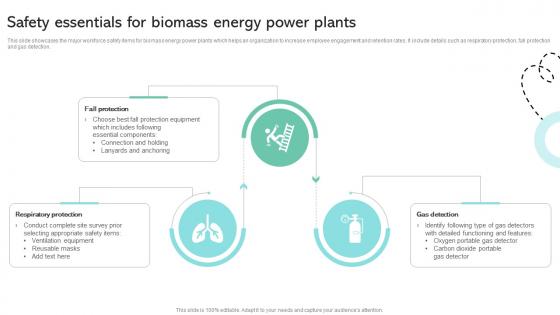
This slide showcases the major workforce safety items for biomass energy power plants which helps an organization to increase employee engagement and retention rates. It include details such as respiratory protection, fall protection and gas detection.
People who downloaded this PowerPoint presentation also viewed the following :
Safety Essentials For Biomass Energy Power Plants with all 9 slides:
Use our Safety Essentials For Biomass Energy Power Plants to effectively help you save your valuable time. They are readymade to fit into any presentation structure.









FAQs for Safety Essentials For Biomass
Biomass energy power plants must adhere to OSHA workplace safety standards, EPA emissions regulations, NFPA fire protection codes, DOT transportation guidelines for fuel handling, and local environmental compliance requirements. These regulations work together by ensuring worker protection, minimizing environmental impact, and maintaining operational safety, with many facilities finding that comprehensive compliance ultimately delivers reduced insurance costs and enhanced community relations.
Biomass energy power plants manage fire hazards through comprehensive safety protocols including automated sprinkler systems, dust suppression technologies, temperature monitoring sensors, proper material storage procedures, and regular equipment maintenance schedules. These integrated safety measures work by minimizing combustible dust accumulation, detecting early warning signs of overheating, and ensuring rapid response capabilities, with many facilities finding that proactive fire prevention ultimately delivers enhanced operational reliability and regulatory compliance.
Best practices for ensuring worker safety in biomass facilities include comprehensive hazard identification, rigorous equipment maintenance protocols, mandatory personal protective equipment usage, regular safety training programs, and robust emergency response procedures. These safety measures streamline operations by minimizing workplace incidents, reducing insurance costs, and maintaining regulatory compliance, with many energy companies finding that proactive safety investments ultimately deliver enhanced productivity and competitive advantage.
Regular maintenance in biomass energy power plants enhances safety by preventing equipment failures, ensuring proper ventilation systems, monitoring temperature controls, and maintaining fire suppression mechanisms. Through systematic inspections and preventive care, operators can identify potential hazards before they escalate, ultimately reducing operational risks and ensuring consistent, safe energy production while minimizing costly downtime.
Essential PPE for biomass plant personnel includes respiratory protection against dust and particulates, heat-resistant clothing for high-temperature operations, safety helmets, cut-resistant gloves, and steel-toed boots with slip resistance. These safety measures enable workers to operate efficiently in challenging environments involving wood processing, ash handling, and boiler maintenance, while organizations increasingly find that comprehensive PPE programs reduce workplace incidents and enhance operational continuity.
Air quality standards significantly impact biomass operational safety by requiring comprehensive emission monitoring, advanced filtration systems, regular equipment maintenance, and strict particulate control measures. These regulatory requirements enhance worker protection through improved ventilation protocols, reduce respiratory health risks, and ensure safer working environments, while many power plants find that compliance ultimately delivers operational efficiency, environmental responsibility, and competitive advantage in increasingly regulated energy markets.
Critical emergency response plans for biomass energy facilities include fire suppression protocols, dust explosion prevention, equipment failure procedures, hazardous material handling, and personnel evacuation strategies. These comprehensive safety frameworks enable power plants to minimize operational risks, ensure worker protection, and maintain regulatory compliance, with many biomass facilities finding that integrated emergency planning ultimately delivers enhanced safety performance and reduced insurance costs.
Risk assessment in biomass energy power plants involves systematic evaluation of fire hazards, dust explosion potential, equipment failure risks, fuel supply variability, and environmental compliance requirements. Through comprehensive hazard identification protocols, quantitative risk modeling, and regular safety audits, operators can minimize operational disruptions while ensuring worker safety, with many facilities finding that proactive risk management ultimately delivers enhanced operational efficiency and regulatory compliance.
Employee training plays a crucial role in biomass power plant safety by ensuring proper equipment operation, hazard recognition, emergency response protocols, and maintenance procedures. Through comprehensive safety programs, plant operators develop expertise in handling combustible materials, managing high-temperature systems, and preventing accidents, with many facilities finding that well-trained teams significantly reduce incidents while enhancing operational efficiency.
Proper biomass feedstock storage and handling procedures significantly impact plant safety by controlling dust accumulation, preventing spontaneous combustion, and minimizing fire hazards through moisture monitoring, temperature control, and ventilation systems. These protocols enable power plants to reduce explosion risks, maintain air quality standards, and ensure worker safety, while streamlined handling processes ultimately deliver operational efficiency and regulatory compliance across energy facilities.
Common incidents in biomass power plants include fires from combustible fuel handling, explosions from dust accumulation, equipment failures in boilers and turbines, respiratory hazards from particulate exposure, and chemical burns from ash handling. These risks can be prevented through comprehensive dust control systems, regular equipment maintenance, proper ventilation protocols, automated fire suppression technologies, and mandatory personal protective equipment, with many facilities finding that integrated safety management systems significantly reduce incident rates while maintaining operational efficiency.
Technology and automation enhance biomass energy power plant safety through real-time monitoring systems, automated fuel handling equipment, predictive maintenance sensors, and emergency shutdown protocols. These systems streamline operations by detecting potential hazards early, minimizing human exposure to dangerous conditions, and enabling rapid response to equipment malfunctions, with many power facilities finding that automated safety controls ultimately deliver reduced accident rates and improved operational efficiency.
Safety audits in biomass energy facilities are crucial for identifying potential hazards, ensuring regulatory compliance, preventing equipment failures, and protecting worker health in high-risk environments. These comprehensive assessments enable operators to minimize fire risks, optimize operational efficiency, and maintain insurance coverage, with many facilities finding that regular audits ultimately deliver reduced downtime, lower liability costs, and enhanced competitive positioning in the renewable energy sector.
Environmental factors significantly influence biomass power plant safety protocols through dust control measures, emission monitoring systems, weather-related operational adjustments, and waste management procedures. These protocols adapt to seasonal variations, air quality conditions, and local environmental regulations, with facilities in agricultural regions finding that pollen seasons and harvest periods require enhanced filtration and fire prevention measures, ultimately delivering safer operations and regulatory compliance.
Collaboration with local fire departments enhances biomass plant safety by providing specialized emergency response training, conducting joint fire prevention assessments, and establishing rapid response protocols for biomass-specific incidents. These partnerships enable power facilities to develop comprehensive evacuation procedures, improve incident response times, and leverage firefighters' expertise in handling complex industrial fires, ultimately delivering enhanced worker protection and operational continuity.
-
This design is not only aesthetically pleasing but it has many uses making the cost worthwhile. The graphics look stunning, and you can edit them as per your needs.
-
Nice and innovative design.