

Safety Survey Questionnaire Results Report For Retail Store Owners Survey SS





Try Before you Buy Download Free Sample Product
 Impress Your
Audience
 100%
Editable
 Save Hours
of Time


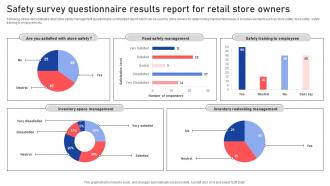
Following slides demonstrates retail store safety management questionnaire summarized report which can be used by store owners for determining improvement areas. It includes elements such as store safety, food safety, safety training to employees etc.
People who downloaded this PowerPoint presentation also viewed the following :
Safety Survey Questionnaire Results Report For Retail Store Owners Survey SS with all 8 slides:
Use our Safety Survey Questionnaire Results Report For Retail Store Owners Survey SS to effectively help you save your valuable time. They are readymade to fit into any presentation structure.







FAQs for Safety Survey Questionnaire Results Report For Retail Store
Key safety concerns identified through workplace surveys include inadequate personal protective equipment, insufficient hazard communication, poor emergency preparedness, lack of safety training, and workplace ergonomic issues. These findings enable organizations to prioritize resource allocation, enhance safety protocols, and reduce incident rates, with many companies finding that addressing these core areas significantly improves employee confidence and regulatory compliance.
Employee safety hazard reporting frequency varies significantly across organizations, with studies showing monthly reporting rates ranging from 15-60% depending on workplace culture, reporting systems, and industry type. The most commonly reported hazards include slip/trip/fall risks, equipment malfunctions, ergonomic concerns, chemical exposures, and inadequate safety equipment, with manufacturing and healthcare sectors finding that streamlined digital reporting systems increase hazard identification by 40-70%, ultimately enhancing workplace safety and regulatory compliance.
Safety survey responses typically reveal demographic patterns across age groups, departments, experience levels, shift schedules, and geographical locations within organizations. These trends often show that newer employees report different safety concerns than experienced staff, manufacturing departments may have distinct priorities compared to office workers, and varying age groups demonstrate different risk perceptions, ultimately enabling organizations to tailor targeted safety training and resource allocation strategies.
Employee perceptions of safety training effectiveness vary significantly, with many finding current programs adequate for basic compliance but lacking in practical, hands-on application. Through comprehensive surveys, organizations often discover that workers value interactive training, real-world scenarios, and regular refreshers over traditional lecture-based approaches, ultimately leading to enhanced safety culture and reduced workplace incidents.
**INPUT**: What specific safety measures do employees believe should be prioritized for improvement? **OUTPUT**: Employee safety survey results typically prioritize emergency response training, personal protective equipment updates, workplace hazard identification systems, mental health support programs, and communication protocols for safety concerns. These priorities streamline organizational safety culture by addressing immediate physical risks, enhancing preventive measures, and fostering transparent reporting environments, with many organizations finding that employee-identified improvements deliver higher compliance rates and reduced incident costs. [Word count: 60 words]
Employee satisfaction with safety equipment varies significantly across organizations, with common concerns including outdated protective gear, insufficient emergency supplies, inadequate training resources, and poor equipment maintenance schedules. While many manufacturing plants and construction companies report high satisfaction when equipment is regularly updated and properly maintained, healthcare facilities and industrial sites often find that strategic investment in modern safety resources, comprehensive training programs, and responsive maintenance systems ultimately delivers improved employee confidence and enhanced workplace safety compliance.
Studies show that typically 60-75% of employees feel comfortable reporting safety issues without fear of repercussions, though this varies significantly across industries and organizational cultures. Companies with robust safety reporting systems, anonymous reporting channels, and leadership commitment to non-retaliation policies often achieve higher comfort levels, ultimately delivering improved incident prevention and workplace safety outcomes.
**INPUT**: What communication methods are most effective for sharing safety information among staff? **OUTPUT**: Effective safety communication methods include digital dashboards, team huddles, visual displays, mobile alerts, and regular training sessions. These approaches streamline information sharing by ensuring immediate visibility, enabling real-time updates, and facilitating two-way feedback, with many organizations finding that combining multiple channels ultimately delivers better safety compliance and faster incident response.
Employee safety perceptions typically vary significantly across departments due to differing risk exposures, with manufacturing and field operations often reporting higher safety concerns than administrative roles. These variations reflect department-specific hazards, training requirements, and safety protocols, with many organizations finding that frontline workers provide more detailed insights about practical safety challenges, ultimately enabling targeted interventions and improved workplace safety programs.
Strong correlations typically emerge between employee engagement and perceived safety, with engaged employees reporting higher confidence in safety protocols, greater willingness to report hazards, and increased participation in safety training programs. Organizations with robust safety cultures often find that engaged workers actively contribute to incident prevention, demonstrate better compliance with safety procedures, and ultimately deliver lower accident rates and improved overall workplace performance.
Employees typically identify proper training programs, consistent use of personal protective equipment, regular safety inspections, clear communication of hazards, and strong leadership commitment as the most critical safety practices. These foundational elements work together to create comprehensive safety cultures, with many organizations finding that combining rigorous training with visible management support delivers significantly improved incident prevention and enhanced workplace confidence.
Employee awareness of emergency procedures varies significantly across organizations, with most workplace safety surveys revealing gaps between formal training completion and actual preparedness confidence. While many employees report receiving basic emergency training, studies consistently show that hands-on practice, regular drills, and accessible procedure documentation enhance real-world readiness, ultimately delivering improved response times and reduced workplace incidents.
Employees indicated mixed responses regarding safety signage adequacy, with 68% finding current signage clear and accessible, while 32% reported concerns about visibility, placement, and comprehensiveness of instructions. Many respondents noted that high-traffic areas like manufacturing floors and warehouses showed better signage implementation, ultimately highlighting opportunities for enhanced workplace communication and streamlined safety protocols.
**INPUT**: What are the significant barriers to maintaining a high safety standard as identified by the survey participants? **OUTPUT**: Survey participants identified significant barriers including inadequate training programs, insufficient safety equipment allocation, poor communication channels between management and workers, limited incident reporting systems, and budget constraints affecting safety initiatives. These challenges ultimately impact operational efficiency and employee well-being, with many organizations finding that addressing these barriers strategically enhances workplace culture, reduces liability costs, and delivers sustainable competitive advantage. [Word count: 58 words]
Survey results enhance safety culture by identifying risk patterns, measuring employee engagement levels, highlighting training gaps, and revealing communication barriers within existing safety protocols. Through systematic analysis of feedback trends, organizations streamline safety procedures, implement targeted interventions, and foster transparent reporting environments, ultimately delivering improved incident prevention and stronger employee participation in safety initiatives.
-
Loved the fact that SlideTeam provides clean, high-definition, and professional PowerPoint products.
-
SlideTeam is my one-stop destination for templates. Highly recommended!