

Sales and logistics process




Try Before you Buy Download Free Sample Product
 Impress Your
 Audience
 100%
100% Editable
 Save Hours
 of Time


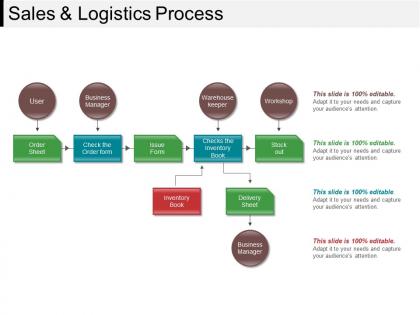
Check the order form and delivery sheet after the execution of your product by using the Sales And Logistics Process. You can design, plan, execute, control, and monitor the activities of supply chain management with the help of this professionally designed service chain optimization presentation template. Use the global supply chain management PowerPoint graphic to reduce the cost of the product and increase the cash flow entities. In the inventory control management PPT slideshow, you can achieve efficient fulfillment of demand, drive consumer value, enhance organizational responsiveness, facilitate finance success, and build network resiliency that helps to grow your business efficiently. Take the assistance of the demand chain management PowerPoint layout to illustrate the numerous components of the supply chain like planning, information, source, inventory, production, location, transportation, and return of goods. Therefore, download our ready-to-use supply chain management PPT visual to understand financial statements and maintain business ethics.
People who downloaded this PowerPoint presentation also viewed the following :
Sales and logistics process with all 5 slides:
Have the flexibility you desire with our Sales And Logistics Process. Alter your approach as per the demand.



FAQs for Sales
Key components of an effective sales logistics strategy include demand forecasting, inventory optimization, order management systems, distribution network design, and performance analytics. These elements work together by streamlining order fulfillment, reducing delivery times, and minimizing costs, with many organizations finding that strategic integration of these components delivers enhanced customer satisfaction and significant competitive advantage.
Technology streamlines sales logistics through automated inventory management, real-time order tracking, predictive analytics, and integrated CRM systems that synchronize customer data across all touchpoints. These solutions enable faster order processing, reduce manual errors, and optimize delivery routes, with companies in retail and manufacturing finding significantly improved operational efficiency and enhanced customer satisfaction through seamless end-to-end visibility.
Inventory management serves as the backbone of sales logistics, ensuring optimal stock levels, minimizing carrying costs, preventing stockouts, and synchronizing supply with customer demand patterns. Through automated tracking systems and demand forecasting, companies streamline order fulfillment, reduce warehousing expenses, and enhance customer satisfaction, while maintaining competitive advantage in increasingly dynamic markets.
Understanding customer demand improves sales logistics efficiency by enabling accurate inventory forecasting, optimizing distribution routes, and reducing stockouts or overstock situations. Through demand analytics, retailers and manufacturers streamline warehouse operations, minimize transportation costs, and enhance delivery timing, with many supply chain organizations finding that predictive demand insights ultimately deliver faster customer fulfillment and significant operational cost reductions.
Common bottlenecks in sales logistics include inventory mismanagement, poor demand forecasting, inefficient order processing, inadequate warehouse operations, and delayed shipment tracking. These challenges can be mitigated through automated inventory systems, real-time analytics, streamlined workflows, and integrated communication platforms, with many organizations finding that strategic technology investments ultimately deliver faster order fulfillment and enhanced customer satisfaction.
Shipping options significantly impact customer satisfaction by offering flexibility, speed, and cost control that align with diverse customer preferences and urgency levels. When businesses provide multiple delivery choices, from standard to express shipping, customers experience greater convenience and value perception, ultimately leading to increased loyalty, repeat purchases, and positive reviews that drive competitive advantage.
Best practices for selecting reliable logistics partners include evaluating their track record, technology capabilities, geographic coverage, financial stability, and customer service standards. These criteria help businesses streamline operations by ensuring consistent delivery performance, transparent communication, and scalable solutions, with many companies finding that strategic partnerships ultimately enhance customer satisfaction and operational efficiency.
Aligning sales logistics with marketing strategies enhances customer experience by synchronizing inventory management, delivery timelines, and promotional campaigns to ensure product availability matches demand forecasting. This strategic coordination enables retailers and e-commerce companies to minimize stockouts during marketing pushes, optimize fulfillment costs, and deliver consistent brand promises, ultimately strengthening customer trust and competitive advantage.
Reverse logistics significantly enhances customer satisfaction and retention by streamlining returns, exchanges, and warranty processes, ultimately building trust and encouraging repeat purchases. Through efficient reverse logistics systems, retailers and manufacturers reduce operational costs, recover valuable materials, and create competitive advantages, with many companies finding that seamless return experiences directly correlate with increased customer loyalty and sales growth.
Geographical factors influence sales logistics planning by determining distribution routes, warehouse locations, transportation costs, and delivery timeframes across different regions. Companies operating in mountainous areas, remote locations, or international markets must strategically adapt their supply chains, inventory positioning, and shipping methods to overcome distance barriers, ultimately ensuring cost-effective delivery while maintaining competitive service levels.
Key sales logistics metrics include order fulfillment time, inventory turnover rates, shipping accuracy, cost per shipment, and customer satisfaction scores. These indicators enable businesses to streamline operations, reduce costs, and enhance customer experiences, with many retail and manufacturing organizations finding that comprehensive tracking ultimately delivers competitive advantage and improved profitability.
Predictive analytics enhances sales logistics by forecasting demand patterns, optimizing inventory levels, improving route planning, and anticipating customer needs before they arise. Through machine learning algorithms, companies streamline warehouse operations, reduce stockouts, and accelerate delivery times, with retail and manufacturing organizations finding that predictive insights ultimately deliver cost reductions and superior customer experiences.
Sustainable practices integrate into sales logistics through eco-friendly packaging, optimized route planning, carbon-neutral shipping options, local supplier partnerships, and digital documentation systems. These approaches streamline operations while reducing environmental impact, with many retail and manufacturing companies finding that sustainable logistics ultimately delivers cost savings, enhanced brand reputation, and competitive advantage in increasingly environmentally-conscious markets.
Globalization significantly impacts sales logistics by expanding market reach, increasing supply chain complexity, and requiring multi-regional coordination capabilities. Companies now manage cross-border inventory flows, navigate diverse regulatory environments, and synchronize distribution networks across continents, with many organizations finding that strategic technology investments and local partnerships ultimately deliver faster global delivery times and enhanced competitive positioning.
Payment terms significantly influence sales logistics by affecting cash flow timing, inventory planning, credit risk assessment, and customer relationship management throughout the order-to-delivery cycle. Extended payment terms can strain working capital and require more sophisticated inventory forecasting, while shorter terms improve cash flow but may reduce customer satisfaction, with many organizations finding that strategic payment term optimization ultimately enhances both operational efficiency and competitive positioning.
-
Easy to edit slides with easy to understand instructions.
-
Presentation Design is very nice, good work with the content as well.