

Sales Close Plan Timeline For Company Top Sales Closing Techniques SA SS




Try Before you Buy Download Free Sample Product
 Impress Your
 Audience
 100%
100% Editable
 Save Hours
 of Time


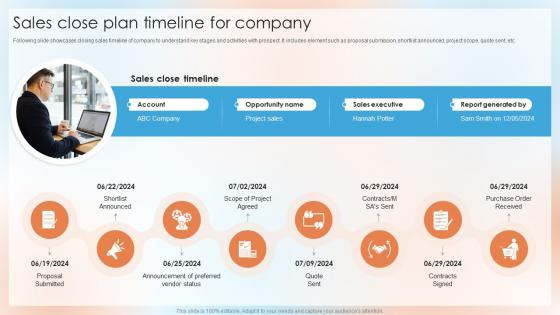
Following slide showcases closing sales timeline of company to understand key stages and activities with prospect. It includes element such as proposal submission, shortlist announced, project scope, quote sent, etc.
People who downloaded this PowerPoint presentation also viewed the following :
Sales Close Plan Timeline For Company Top Sales Closing Techniques SA SS with all 9 slides:
Use our Sales Close Plan Timeline For Company Top Sales Closing Techniques SA SS to effectively help you save your valuable time. They are readymade to fit into any presentation structure.









FAQs for Sales Close Plan Timeline For Company Top Sales Closing
Soft closing techniques use subtle suggestions and trial questions to gauge readiness, while hard closing techniques employ direct, assertive approaches that push for immediate decisions. Soft closes work best with relationship-focused clients, early in sales cycles, or in consultative environments, whereas hard closes prove effective with decisive buyers, urgent situations, or transactional sales, ultimately enabling sales professionals to match their approach to customer preferences and maximize conversion rates.
Storytelling enhances sales closing by creating emotional connections, building trust through relatable scenarios, and making abstract benefits tangible through real customer experiences. When sales professionals share compelling narratives about similar clients overcoming challenges, prospects can envision themselves achieving comparable outcomes, ultimately reducing resistance and accelerating decision-making while establishing stronger rapport.
Emotional intelligence enables salespeople to read customer emotions, adapt communication styles, and build genuine rapport throughout the sales process. By recognizing buying signals, addressing unspoken concerns, and responding empathetically to client needs, sales professionals create trust-based relationships that naturally lead to successful closes, ultimately delivering higher conversion rates and stronger customer loyalty.
Sales professionals can effectively handle objections by actively listening to concerns, acknowledging their validity, and providing specific evidence-based responses that address underlying needs. Through strategic questioning techniques, professionals uncover root concerns, present tailored solutions, and guide conversations toward mutual benefit, with many finding that reframing objections as opportunities ultimately builds stronger relationships and increases closing rates.
Effective urgency techniques include limited-time offers, scarcity messaging, deadline-driven incentives, social proof of high demand, and exclusive access opportunities. These approaches work by focusing on genuine value and customer benefits rather than aggressive pressure, with many sales professionals finding that transparency about timing constraints, coupled with consultative guidance, ultimately delivers authentic urgency while maintaining trust and long-term relationships.
Social proof influences closing decisions by showcasing testimonials, case studies, customer reviews, and success stories that demonstrate proven value and reduce perceived risk. When prospects see similar companies achieving measurable results—like increased revenue or operational efficiency—they gain confidence in their purchase decision, with many sales professionals finding that peer validation and industry-specific examples accelerate final approvals significantly.
Body language significantly impacts sales closing through nonverbal cues like maintaining confident posture, using open gestures, making appropriate eye contact, and mirroring client behavior to build rapport. These techniques help salespeople convey trustworthiness, read buyer hesitation or interest, and create psychological comfort during decision moments, with many retail and B2B professionals finding that aligned body language ultimately accelerates deal closure and enhances customer confidence.
Trial closes provide valuable feedback on prospect readiness, identify objections early, maintain conversation momentum, reduce final presentation pressure, and help salespeople adjust their approach strategically. These techniques enable sales professionals to gauge interest levels, address concerns proactively, and build confidence throughout interactions, with many finding that consistent trial closing ultimately increases conversion rates and shortens sales cycles.
Active listening enhances closing techniques by demonstrating genuine interest, identifying unspoken objections, and building trust through attentive engagement with prospects. Sales professionals incorporate this by paraphrasing customer concerns, asking clarifying questions, and responding directly to specific needs mentioned, with many finding that prospects feel more valued and are ultimately more receptive to closing attempts.
Common sales closing techniques include the assumptive close, urgency close, summary close, question close, and benefit close. These methods work particularly well in retail, real estate, insurance, and B2B software sales, with many organizations finding that combining multiple techniques based on customer behavior and industry context delivers higher conversion rates and stronger client relationships.
Technology and CRM tools streamline sales closing by automating follow-ups, tracking customer interactions, and providing real-time analytics on prospect behavior and engagement patterns. These systems enable sales teams to identify optimal closing moments, personalize outreach strategies, and minimize administrative tasks, with many organizations finding that automated workflows and data-driven insights significantly accelerate deal closure rates.
Follow-up communication significantly enhances sales closings by maintaining prospect engagement, addressing lingering concerns, and demonstrating consistent value proposition throughout the decision-making process. Strategic follow-up sequences enable sales professionals to nurture relationships, provide additional insights, and create multiple touchpoints that build trust, with many organizations finding that systematic follow-up approaches increase conversion rates substantially.
Sales professionals can tailor closing techniques by identifying personality types through communication styles, decision-making patterns, and behavioral cues during conversations. Analytical buyers respond well to data-driven summaries and trial closes, while relationship-oriented clients prefer consultative approaches that emphasize trust and partnership, ultimately enabling faster deal progression and higher conversion rates across diverse customer segments.
Effective sales closing strategies in competitive markets include value-based selling, consultative approaches, creating urgency through limited-time offers, leveraging social proof, and building strong relationships throughout the sales cycle. These techniques enable sales teams to differentiate from competitors by addressing specific customer pain points, demonstrating clear ROI, and establishing trust, ultimately delivering higher conversion rates and stronger customer loyalty.
Aggressive closing can damage customer relationships, create buyer's remorse, and harm long-term trust, often resulting in lost deals or cancellations. These pitfalls can be avoided by reading customer signals carefully, building genuine rapport first, and focusing on consultative selling approaches that prioritize customer needs over immediate sales pressure, ultimately delivering stronger relationships and sustainable revenue growth.
-
The quality of PowerPoint templates I found here is unique and unbeatable. Keep up the good work and continue providing us with the best slides!
-
SlideTeam offers so many variations of designs and topics. It’s unbelievable! Easy to create such stunning presentations now.