

Sales Growth Strategies Future Potential For Ecommerce Sales Growth





Try Before you Buy Download Free Sample Product
 Impress Your
 Audience
 100%
100% Editable
 Save Hours
 of Time


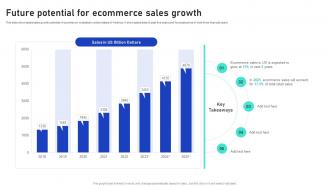
This slide showcases sales growth potential of ecommerce websites in united states of America. It showcases data of past five years and forecast period of next three financial years.
People who downloaded this PowerPoint presentation also viewed the following :
Sales Growth Strategies Future Potential For Ecommerce Sales Growth with all 10 slides:
Use our Sales Growth Strategies Future Potential For Ecommerce Sales Growth to effectively help you save your valuable time. They are readymade to fit into any presentation structure.









FAQs for Sales Growth Strategies Future Potential For
Key factors driving eCommerce sales growth in 2023 include mobile-first optimization, personalized customer experiences, social commerce integration, omnichannel fulfillment strategies, and AI-powered recommendation engines. These technologies enhance conversion rates by streamlining checkout processes, delivering targeted product suggestions, and enabling seamless shopping across platforms, with many retailers finding that strategic combinations ultimately deliver increased average order values and customer retention.
Personalized marketing enhances customer engagement by delivering tailored content, product recommendations, and targeted offers based on individual behavior, preferences, and purchase history. Through AI-driven analytics and segmentation tools, ecommerce businesses streamline customer experiences, increase conversion rates, and build stronger brand loyalty, with many retailers finding that personalized campaigns deliver significantly higher ROI and repeat purchases.
Mobile optimization significantly enhances eCommerce conversions by streamlining checkout processes, improving page load speeds, and creating responsive user interfaces that adapt seamlessly across devices. With mobile commerce accounting for over half of online sales, retailers implementing mobile-first designs, simplified navigation, and optimized payment systems see conversion rate increases of 20-30%, ultimately delivering competitive advantage in an increasingly mobile-driven marketplace.
Social media platforms drive traffic and sales through targeted advertising, influencer partnerships, shoppable posts, customer engagement, and user-generated content campaigns. These strategies enable ecommerce businesses to reach broader audiences, build brand loyalty, and convert social interactions into purchases, with many online retailers finding that integrated social commerce approaches deliver significantly higher conversion rates and customer lifetime value.
Effective online inventory management strategies include automated reorder systems, demand forecasting analytics, real-time stock tracking, ABC classification methods, and integrated supplier management platforms. These approaches streamline operations by reducing stockouts, minimizing carrying costs, and enhancing customer satisfaction, with many ecommerce businesses finding that strategic inventory optimization ultimately delivers faster fulfillment and improved profit margins.
Customer feedback and reviews significantly enhance eCommerce sales by building trust, improving search rankings, and providing social proof that influences purchasing decisions. These user-generated insights help retailers identify product improvements, optimize inventory management, and address customer concerns proactively, with many online businesses finding that products with positive reviews convert 270% higher than those without feedback.
Targeted email marketing influences buyer behavior by delivering personalized product recommendations, abandoned cart reminders, and exclusive offers based on purchase history and browsing patterns. Through strategic segmentation and automation, retailers create tailored customer journeys that increase conversion rates, encourage repeat purchases, and build long-term loyalty, ultimately driving higher lifetime customer value.
SEO best practices for eCommerce include optimizing product descriptions with targeted keywords, creating category-specific landing pages, implementing technical SEO for site speed, building quality backlinks, and leveraging user-generated content like reviews. These strategies enhance search visibility by improving page rankings, increasing click-through rates, and building domain authority, with many online retailers finding that comprehensive SEO approaches ultimately deliver sustained organic growth and reduced customer acquisition costs.
A robust fulfillment strategy enhances customer experience through faster delivery times, accurate order processing, real-time tracking capabilities, and seamless returns management. These operational improvements drive sales growth by increasing customer retention, reducing cart abandonment rates, and enabling competitive advantages, with many ecommerce businesses finding that streamlined fulfillment ultimately delivers higher conversion rates and customer lifetime value.
Data analytics enables eCommerce businesses to identify growth opportunities by analyzing customer behavior patterns, purchase histories, market trends, seasonal fluctuations, and competitive positioning. Through predictive modeling and customer segmentation, retailers can optimize pricing strategies, personalize product recommendations, and target high-value customer segments, ultimately delivering increased conversion rates and revenue growth.
Businesses can effectively use upselling and cross-selling in eCommerce by implementing personalized product recommendations, strategic bundle offers, automated email sequences, and smart checkout suggestions based on customer behavior and purchase history. These techniques enhance average order value by 15-30%, with many retail platforms finding that AI-powered recommendation engines and targeted post-purchase campaigns ultimately deliver increased revenue and improved customer lifetime value.
A seamless checkout experience is crucial for reducing cart abandonment rates, as complicated processes, unexpected fees, mandatory account creation, and limited payment options drive customers away before completing purchases. Through streamlined checkout flows, retailers can increase conversion rates by 35-40%, reduce abandonment from the industry average of 70%, and boost revenue, with many ecommerce businesses finding that simplified, mobile-optimized checkouts deliver significant competitive advantages.
eCommerce businesses can build brand loyalty through personalized customer experiences, consistent cross-channel messaging, loyalty reward programs, exceptional customer service, and community engagement initiatives. These strategies enhance customer retention by delivering tailored product recommendations, seamless shopping experiences, and meaningful interactions, with many retailers finding that personalized approaches significantly increase repeat purchases and long-term customer value.
Influencer partnerships drive ecommerce sales by leveraging authentic audience connections, targeted demographic reach, and social proof validation to convert followers into customers. Through strategic collaborations, online retailers access niche markets, enhance brand credibility, and generate measurable ROI, with many fashion and lifestyle brands finding that micro-influencer partnerships deliver higher engagement rates and sustained sales growth.
Emerging eCommerce trends include AI-powered personalization, voice commerce, social shopping integration, augmented reality experiences, and sustainable packaging solutions. These technologies streamline customer interactions by delivering targeted recommendations, enabling hands-free purchasing, and creating immersive product demonstrations, with many retailers finding that early adoption of these trends significantly enhances customer engagement and competitive positioning.
-
Appreciate the research and its presentable format.
-
“I've always gotten excellent slides from them and the customer service is up to the mark.”