

Sales highlights ppt sample file





Try Before you Buy Download Free Sample Product
 Impress Your
Audience
 100%
Editable
 Save Hours
of Time


Heighten your chances of achieving your goal with our Sales Highlights Ppt Sample File. It helps arrive at accurate estimates.
People who downloaded this PowerPoint presentation also viewed the following :
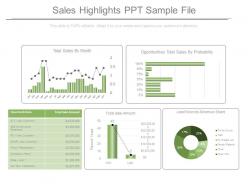
Sales highlights ppt sample file with all 4 slides:
Get over the impasse with our Sales Highlights Ppt Sample File. Arrive at generally acceptable conclusions.


FAQs for Sales highlights
Key elements include compelling opening hooks, clear value propositions, customer pain point identification, solution demonstrations, social proof through testimonials, competitive differentiators, and strong calls-to-action. These components work together by establishing credibility, addressing prospect concerns, and guiding decision-making, with many sales teams finding that structured templates increase conversion rates while reducing presentation preparation time, ultimately delivering consistent messaging and enhanced closing success.
Data visualization transforms sales highlights by incorporating interactive charts, infographics, trend graphs, heat maps, and dashboard summaries that make complex performance data immediately accessible. These visual elements streamline information processing, enhance audience retention, and enable faster decision-making, with many sales teams finding that visual presentations deliver significantly higher engagement rates and more compelling storytelling than traditional text-heavy reports.
Charts showing revenue growth, competitive comparisons, customer success metrics, product feature visualizations, and ROI projections are most impactful in sales presentations. These graphics streamline complex data into digestible formats, enhance credibility through visual proof points, and accelerate decision-making processes, with many sales teams finding that strategic visual storytelling ultimately delivers higher conversion rates and stronger client engagement.
Tailoring sales presentation templates involves customizing messaging, case studies, value propositions, visual elements, and industry-specific pain points to resonate with each audience's unique needs. This strategic approach enables sales teams to deliver more compelling presentations by incorporating relevant examples from healthcare, finance, or manufacturing sectors, while emphasizing outcomes that matter most to each industry, ultimately improving conversion rates and client engagement.
Common mistakes include overwhelming slides with excessive data, failing to prioritize key achievements, using generic templates without customization, neglecting visual hierarchy, and omitting compelling storytelling elements. These pitfalls undermine presentation effectiveness by confusing audiences, diluting impact, and missing opportunities to showcase strategic wins, with many sales teams finding that streamlined, visually compelling highlights drive better stakeholder engagement and decision-making.
Storytelling integration involves weaving customer success stories, problem-solution narratives, and outcome-focused case studies throughout presentations, rather than relying solely on feature lists. This approach enables sales teams to connect emotionally with prospects, demonstrate real-world applications across industries like healthcare and manufacturing, and ultimately transform abstract value propositions into tangible, relatable experiences that drive decision-making.
Color psychology significantly influences audience perception, emotional response, and decision-making in sales presentations through strategic use of trust-building blues, confidence-inspiring reds, and growth-associated greens. These color choices enhance message retention, create subconscious buying triggers, and establish brand credibility, with many sales teams finding that psychologically-informed color schemes increase engagement rates and ultimately drive higher conversion outcomes.
User feedback significantly influences sales template design by identifying pain points, highlighting effectiveness gaps, and revealing client preferences through usage analytics and direct input. This strategic combination enables organizations to refine messaging approaches, optimize visual layouts, and enhance conversion elements, with many sales teams finding that feedback-driven iterations deliver improved engagement rates and ultimately stronger closing ratios across diverse market segments.
Sales presentations should highlight revenue growth, conversion rates, customer acquisition costs, deal velocity, and market share expansion. These metrics communicate success by demonstrating financial performance, operational efficiency, and competitive positioning, with many organizations finding that combining quantitative achievements with customer retention data ultimately delivers compelling proof of sustainable growth and strategic market advantage.
Multimedia elements enhance sales presentations by increasing engagement, simplifying complex concepts, and creating memorable experiences that resonate with diverse learning styles. Through strategic video demonstrations and audio testimonials, sales teams can showcase product capabilities, build emotional connections, and deliver compelling proof points more effectively than static slides alone, ultimately accelerating decision-making and improving conversion rates.
Current sales presentation design trends include bold typography with strategic white space, data-driven storytelling through interactive charts, minimalist color palettes with accent highlights, mobile-responsive layouts, and immersive visual narratives. These design approaches enhance audience engagement by improving readability, accelerating comprehension, and delivering memorable brand experiences, with many sales teams finding that modern aesthetics significantly boost conversion rates and client retention.
Sales templates remain versatile through modular design incorporating customizable sections, flexible formatting options, standardized core elements, and adaptable content blocks that accommodate different industries and deal types. This strategic combination enables sales teams to maintain consistency while personalizing presentations for specific clients, ultimately delivering faster proposal development and higher conversion rates across diverse market segments.
User-friendly sales presentation templates include intuitive drag-and-drop functionality, pre-designed slide layouts, customizable data visualization tools, brand-consistent formatting options, and seamless integration capabilities. These features streamline presentation creation by reducing design time, ensuring visual consistency, and enabling quick customization, with many sales teams finding that standardized templates ultimately accelerate deal cycles while maintaining professional quality across all client interactions.
Sales presentation templates should be updated quarterly to reflect market changes, competitive developments, and evolving customer needs, while incorporating fresh performance data and industry insights. Many organizations find that regular updates, combined with seasonal adjustments and immediate responses to major market shifts, keep presentations compelling and relevant, ultimately delivering stronger engagement and improved conversion rates across sales teams.
Templates can be optimized through flexible design elements, modular content blocks, interactive features, and scalable visual components that adapt seamlessly across presentation formats. Sales teams in industries like software, financial services, and consulting find that incorporating clickable navigation, video integration, and responsive layouts enables consistent messaging delivery while maximizing engagement, ultimately driving higher conversion rates regardless of presentation medium.
-
Attractive design and informative presentation.
-
Much better than the original! Thanks for the quick turnaround.
-
Excellent products for quick understanding.
-
Editable templates with innovative design and color combination.