

Sales Process Quality Improvement Plan Powerpoint Presentation Slides




Try Before you Buy Download Free Sample Product
 Impress Your
 Audience
 100%
100% Editable
 Save Hours
 of Time


We meticulously designed the Sales Process Quality Improvement Plan template to actively enable organizations to enhance their process quality and drive sales growth. The professionally crafted Continuous Improvement PPT takes a proactive approach by evaluating the current scenario, identifying business problems, and analyzing performance gaps. Moreover, Total Quality Management Powerpoint then focuses on the current sales process, including prospecting, lead qualification, sales presentation, objection handling, and closure techniques. Also, the Sales Development plan deck provides actionable ways to enhance the sales process by optimizing advanced tools, technology solutions, and employee training. Lastly, the Operations Workflow Powerpoint analyzes the impact of these enhancements and presents multiple KPI dashboards to track sales, social media, and website performance, ensuring continuous improvement. Embrace this opportunity to drive sales development and improve operations workflow with our comprehensive plan. Get access now.
People who downloaded this PowerPoint presentation also viewed the following :
Content of this Powerpoint Presentation
Slide 1: This slide displays the title Sales Process Quality Improvement Plan.
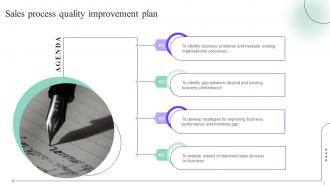
Slide 2: This slide displays the title Agenda for process improvement plan to enhance sales performance.
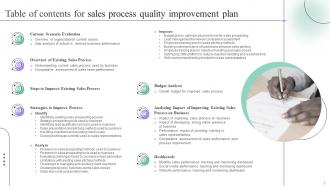
Slide 3: This slide exhibit table of content.
Slide 4: This slide exhibit table of content- Current scenario evaluation.
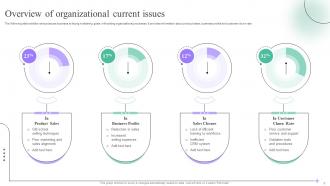
Slide 5: The following slide exhibits various issues business is facing in attaining goals with exiting organizational processes.
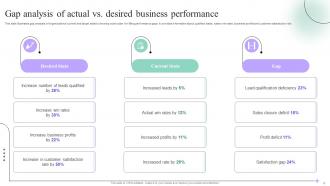
Slide 6: This slide illustrates gap analysis of the organizational current and target state to develop action plan for filling performance gaps.
Slide 7: This slide exhibit table of content- Overview of Existing Sales Process.
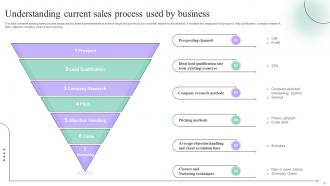
Slide 8: This slide presents existing sales process steps used by sales representatives to achieve target.
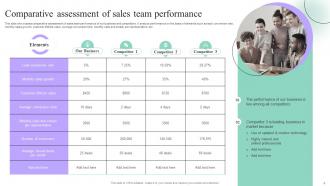
Slide 9: This slide showcases comparative assessment of sales team performance of our business and competitors.
Slide 10: This slide exhibit table of content- Steps to Improve Existing Sales Process.
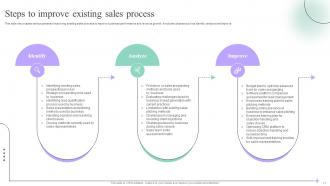
Slide 11: This slide showcases various phases in improving existing sales process to improve business performance and revenue growth.
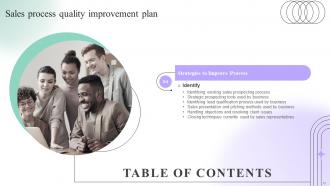
Slide 12: This slide exhibit table of content- Strategies to Improve Process: Identify
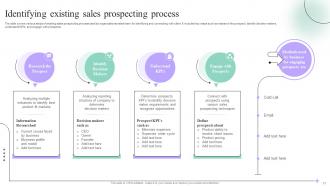
Slide 13: The slide covers various steps of existing sales prospecting process used by organizational sales team for identifying and connecting with client.
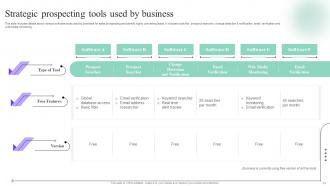
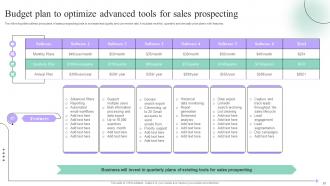
Slide 14: This slide includes details about various software tools used by business for sales prospecting and identify highly converting leads.
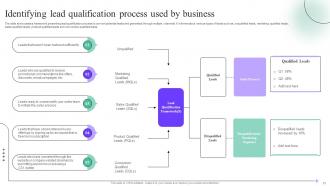
Slide 15: The slide showcases a framework presenting lead qualification process to convert potential leads and generated through multiple channels.
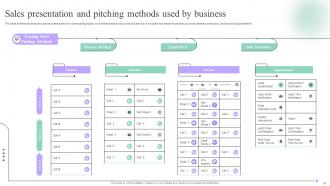
Slide 16: The slide exhibits techniques used by sales person for persuading highly convertible leads to buy product/ service.
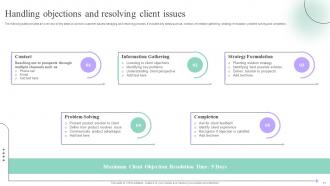
Slide 17: The following slide provides an overview of key steps involved in customer issues managing and resolving process.
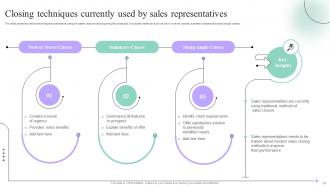
Slide 18: The slide presents various techniques business is using for sales closure and acquiring the prospect.
Slide 19: This slide exhibit table of content- Strategies to Improve Process: Analyze
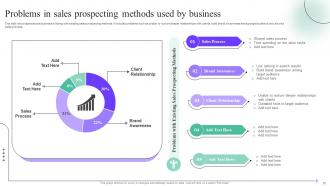
Slide 20: This slide showcases issues business is facing with existing sales prospecting methods.
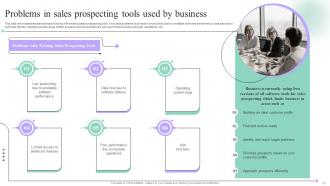
Slide 21: This slide showcases issues business is facing with existing sales prospecting tools.
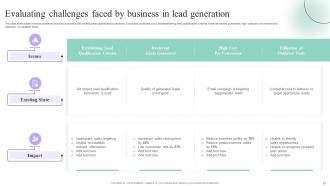
Slide 22: The slide showcases various problems faced by business with existing lead qualification practices.
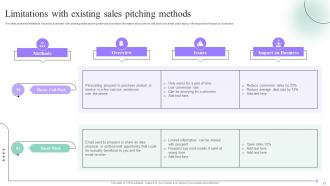
Slide 23: The slide presents limitations faced by business with existing sales pitching methods.
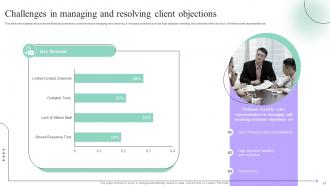
Slide 24: This slide showcases various issues faced by business in customer issue managing and resolving.
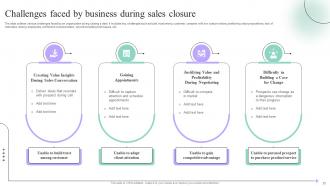
Slide 25: The slide outlines various challenges faced by an organization during closing a deal.
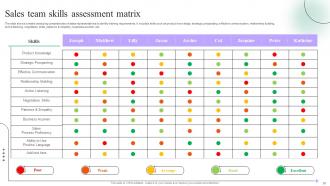
Slide 26: The slide shows a matrix analyzing competencies of sales representatives to identify training requirements.
Slide 27: This slide exhibit table of content- Strategies to Improve Process: Improve
Slide 28: The following slide outlines price plans of sales prospecting tools to increase lead quality and conversion rate.
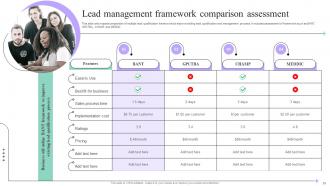
Slide 29: This slide showcases comparison of multiple lead qualification frameworks to improve exiting lead qualification and management process.
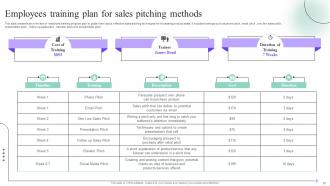
Slide 30: This slide presents an overview of employee training program plan to guide them about effective sales pitching techniques for increasing product sales.
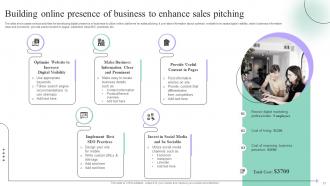
Slide 31: The slide showcases various activities for developing digital presence of business to utilize online platforms for sales pitching.
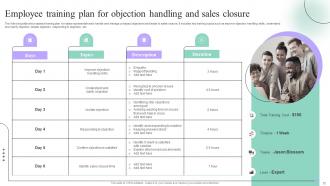
Slide 32: The following slide showcases a training plan for sales representatives to handle and manage prospect objections and leads to sales closure.
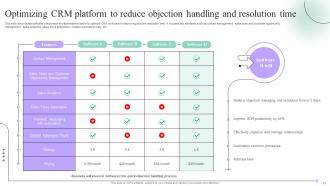
Slide 33: This slide showcases software comparison and assessment matrix to optimize CRM software for improving problem resolution time.
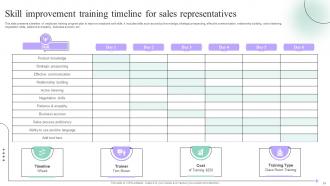
Slide 34: This slide presents a timeline of employee training program plan to improve employee soft skills.
Slide 35: This slide exhibit table of content- Budget Analysis.
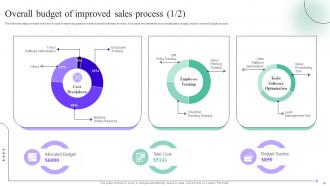
Slide 36: The following slide provides overview of cost of improving sales process to boost business revenue.
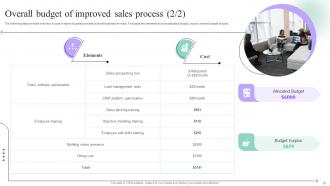
Slide 37: The following slide provides overview of cost of improving sales process to boost business revenue.
Slide 38: This slide exhibit table of content- Analyzing Impact of Improving Existing Sales Process on Business.
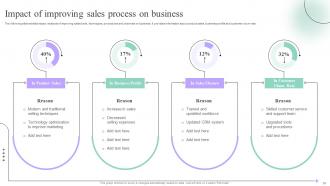
Slide 39: The following slide exhibits impact analysis of improving sales tools, techniques, procedures and channels on business.
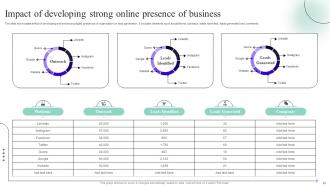
Slide 40: The slide showcases effect of developing and enhancing digital presence of organization on lead generation.
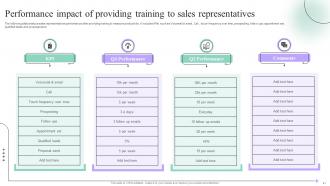
Slide 41: The following slide analyze sales representatives performance after providing training to measure productivity.
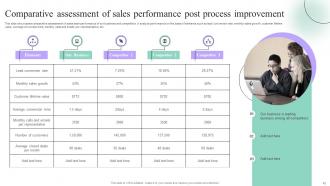
Slide 42: This slide showcases comparative assessment of sales team performance of our business and competitors.
Slide 43: This slide exhibit table of content- Dashboards
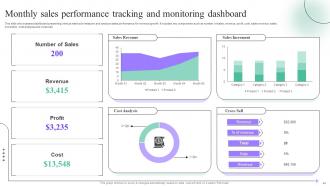
Slide 44: This slide showcases a dashboard presenting various metrics to measure and analyze sales performance for revenue growth.
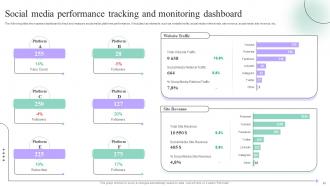
Slide 45: The following slide showcases a dashboard to track and measure social media platforms performance.
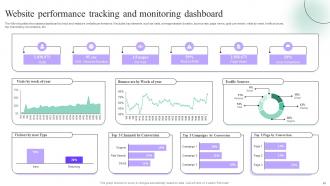
Slide 46: The following slide showcases a dashboard to track and measure website performance.
Slide 47: This is the icons slide.
Slide 48: This slide presents title for additional slides.
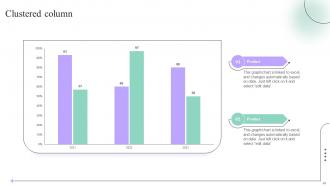
Slide 49: This slide display Clustered column for two products.
Slide 50: This slide display title About us
Slide 51: This slide shows details of team members like name, designation, etc.
Slide 52: This slide presents your company's vision, mission and goals.
Slide 53: This slide display 30 60 90 Days plan.
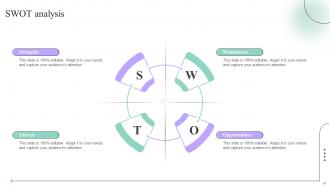
Slide 54: This slide display SWOT analysis.
Slide 55: This slide display Comparison.
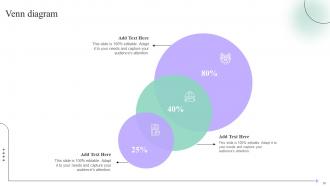
Slide 56: This slide display Venn diagram.
Slide 57: This slide exhibit Idea Generation.
Slide 58: This is thank you slide & contains contact details of company like office address, phone no., etc.
Sales Process Quality Improvement Plan Powerpoint Presentation Slides with all 63 slides:
Use our Sales Process Quality Improvement Plan Powerpoint Presentation Slides to effectively help you save your valuable time. They are readymade to fit into any presentation structure.









FAQs for Sales Process Quality Improvement Plan
So you've got six main stages: lead gen, qualification, needs discovery, proposal/demo, negotiation, and closing. For each one, pick specific metrics to track - like how many leads actually get qualified, how long your discovery calls run (longer usually means better), proposal win rates, deal cycle times. Honestly, the biggest red flag is deals that just... sit there. That's where your process is probably broken. Your CRM setup matters more than people think - if it's a pain to input data, nobody will do it consistently. Start small though. Pick maybe 2-3 metrics per stage that won't drive your team crazy to track, then expand once it's actually a habit.
Honestly, just map out your whole sales process first - every single step. Then dig into your CRM and see where deals are dying or taking forever. I'm always surprised how different the actual process looks compared to what's on paper, so maybe shadow your team for a day or two. Check conversion rates between each stage too. The spots where you're bleeding prospects or where your timeline estimates are constantly wrong? That's where the real problems are. Your CRM data will tell you everything if you actually look at it right.
Honestly, tech just handles all the boring grunt work for you. Your CRM keeps customer info organized so you're not scrambling through sticky notes (been there lol). Email automation and lead scoring help you focus on prospects who actually want to buy instead of chasing dead ends. The cool part? You can see exactly where deals stall out - like, actual data instead of just wondering why nothing's closing. Analytics show which tactics work and which ones suck. Having everything in one dashboard means you'll spot patterns you'd never notice otherwise. Way better than going with your gut all the time.
Honestly, skip the generic sales stuff and drill down on what's actually breaking in your process. Customer satisfaction tanking? Deal details getting messy? Poor follow-up? Pick your top 3 pain points and build training around those exact scenarios. I swear, most companies waste time on random objection handling when they should be looking at retention rates instead. Role-play the situations where things go wrong. Then track how it affects your quality metrics afterward - not just the revenue stuff everyone obsesses over. Way more useful than another "sales techniques 101" session.
Honestly, start with the basics - conversion rates at each funnel stage, average deal size, and how long your sales cycle takes. Response time is where most people screw up though. Like, if you're not hitting back within minutes, you're basically dead in the water. Win rate and pipeline velocity matter too, obviously. Here's the thing - get your baseline numbers first before changing anything, otherwise you're just guessing. Don't go crazy tracking 20 different things right away. Pick maybe 3-4 metrics and actually nail those down. You can always add more fancy stuff later once you've got the fundamentals figured out.
Honestly, don't wait until deals are dead to ask for feedback - that's pointless. Build in quick check-ins throughout your sales process instead. After demos or big presentations, send brief surveys while you can still fix things. Your existing customers are goldmines for this stuff too since they'll actually tell you the truth about what sucked during their buying experience. Oh, and make giving feedback stupid easy for people. The whole thing falls apart if you don't act on what they're telling you though.
Dude, team chemistry is everything for your sales process. Good communication means cleaner handoffs and fewer deals slip away. Trust me on this one - I've watched ridiculously talented teams bomb because they couldn't work together. Bad dynamics create these awful silos where marketing won't talk to sales, reps start hoarding leads, nobody shares wins. It's brutal. Regular check-ins help tons. So does getting different departments to actually collaborate instead of just existing near each other. Honestly beats buying another fancy tool that'll just collect digital dust.
Record your best sales calls first - figure out what's actually working. Then build loose frameworks, not rigid scripts. Nobody wants to sound like a telemarketer, you know? Focus on the money phrases: smooth transitions, solid objection handling, qualifying questions that don't feel like an interrogation. Have your team test different versions and see what sticks. Honestly, the whole point is giving people proven words they can make their own. They hit the key points but still sound like themselves, not some corporate robot reading from a manual.
Honestly, most companies mess this up because their lead qualification criteria is either nonexistent or marketing and sales have completely different ideas about what counts. Get both teams in a room and hash out shared scoring that actually makes sense. Your CRM needs to track the whole journey - none of this "here's a name and email, good luck" nonsense. Regular handoff meetings help too, where marketing explains the lead's specific pain points instead of just dumping contacts. Oh, and don't let marketing disappear after the handoff - they should stick around for those first few touchpoints. I'd start by looking at your current process and finding the biggest disaster area first.
Check your CRM data first - pull conversion rates, deal sizes, and close times for each funnel stage. Honestly, pipeline velocity is where you'll catch most issues. Maybe prospects always drop off during proposals, or Sarah from sales is crushing it while everyone else struggles (definitely pick her brain). Short sentences work. Look at win/loss patterns too since they reveal gaps you might miss otherwise. Dashboard everything by rep and timeframe so you're not just guessing. Oh, and don't forget customer feedback - they'll tell you exactly where your process sucks if you ask.
Honestly, the biggest mistake is trying to tackle everything at once - you'll just overwhelm yourself. Pick one specific problem area first. Your sales team will hate you if they feel like changes are being forced on them, so get them on board early by showing how it helps them close more deals. Most people track useless vanity metrics instead of what actually impacts revenue (guilty of this myself). Oh, and definitely check what your current tech can actually handle before making big plans. Start small and focus on bottlenecks that matter most.
Dude, lead quality is everything. Your conversion rates go through the roof when you're not chasing random people who'll never buy anything. Bad leads? Your sales team just burns out calling prospects with zero budget or interest - been there, it sucks. Quality leads already want what you're selling, so reps can actually close deals instead of endless qualifying calls. I'd definitely start tracking which sources give you the best lead-to-close ratios. You'll be shocked how much time you've been wasting on the wrong channels. Focus there and watch your numbers improve.
First thing - map out your whole sales process from start to finish. Document every step, tool, handoff, whatever. Then check your conversion rates at each stage to see where people bail out. Here's what most people skip: actually talk to your sales team about what sucks. They know exactly what's broken but nobody ever asks them (honestly drives me crazy). Pull some sample calls and emails to see if the quality's there. Oh, and dig into your CRM data for patterns. Don't just randomly fix stuff - make a plan based on what'll move the revenue needle most.
Honestly, benchmarking is like holding up a mirror to your sales team - sometimes the reflection isn't pretty, but it's super useful. You'll spot gaps you didn't even know existed, like why your conversion rates suck compared to competitors or why deals take forever to close. Pick 3-4 metrics that actually move the needle (not just vanity stuff). Research what top performers hit in your space. Then figure out how to close those gaps. I'd probably start with conversion rates since that's usually the biggest money leak most teams have.
You definitely need regular coaching - it stops your sales process from falling apart over time. Reps will start cutting corners and making up their own shortcuts if you don't stay on top of it. Trust me, I've watched this happen way too many times! Weekly one-on-ones work way better than those awful quarterly reviews everyone hates. Focus on whether they're actually following the process and give feedback on real deals as they happen. Bad habits creep in fast without consistent check-ins. Keep reinforcing the standards and jump on skill gaps right when you spot them.
-
“I required a slide for a board meeting and was so satisfied with the final result !! So much went into designing the slide and the communication was amazing! Can’t wait to have my next slide!”
-
What an exhaustive collection of templates you guys have there in slideteam. Impressive!!!