

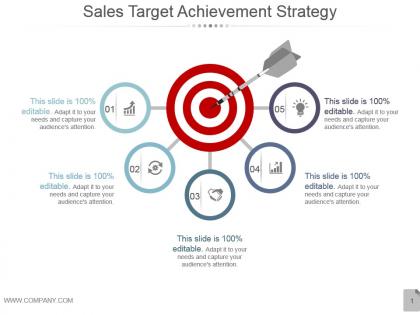
Sales target achievement strategy powerpoint themes




Try Before you Buy Download Free Sample Product
 Impress Your
 Audience
 100%
100% Editable
 Save Hours
 of Time


Aid the digestion of your ideas. Flavour it with our Sales Target Achievement Strategy Powerpoint Themes.
People who downloaded this PowerPoint presentation also viewed the following :
Sales target achievement strategy powerpoint themes with all 5 slides:
Bash on bravely with our Sales Target Achievement Strategy Powerpoint Themes. They assist you to conquer your fears.


FAQs for Sales target achievement
Key components of an effective sales strategy include target market identification, value proposition development, sales process optimization, competitive positioning, and performance measurement systems. These elements work together by aligning sales teams with customer needs, streamlining lead qualification and conversion processes, and enabling data-driven decisions, with many organizations finding that this strategic combination delivers higher conversion rates, shorter sales cycles, and sustainable revenue growth.
Market segmentation improves sales performance by enabling targeted messaging, optimized resource allocation, and personalized customer approaches that resonate with specific buyer groups. Through strategic segmentation, organizations streamline their sales processes, enhance conversion rates, and deliver more relevant solutions, with many companies finding that focused targeting ultimately reduces acquisition costs while significantly increasing customer lifetime value and competitive positioning.
CRM serves as the foundational backbone of modern sales strategy, centralizing customer data, tracking interactions, managing pipeline opportunities, and automating follow-up processes. Through integrated CRM systems, sales teams streamline lead nurturing, enhance customer segmentation, and deliver personalized experiences, with many organizations finding that strategic CRM implementation ultimately drives higher conversion rates and long-term customer retention.
Sales teams leverage data analytics by analyzing customer behavior patterns, identifying high-value prospects, tracking conversion rates, and optimizing sales funnel performance through predictive modeling. Through advanced analytics platforms, organizations can personalize outreach strategies, forecast revenue more accurately, and allocate resources strategically, with many sales departments finding that data-driven approaches increase close rates significantly.
**INPUT**: What are the best practices for setting achievable sales targets? **OUTPUT**: Best practices for setting achievable sales targets include analyzing historical performance data, conducting thorough market research, aligning targets with business capacity, incorporating seasonal trends, and establishing realistic timelines. These approaches streamline goal-setting by balancing ambition with practicality, enhancing team motivation, and ensuring resource allocation matches expectations, with many organizations finding that data-driven targets ultimately deliver higher performance and sustained growth. **Word count**: 60 words
The competitive landscape shapes sales strategy by determining pricing approaches, differentiation messaging, market positioning, and customer acquisition tactics. Organizations analyze competitor strengths, weaknesses, and market gaps to identify strategic opportunities, with many finding that adaptive positioning and unique value propositions ultimately deliver sustainable competitive advantage and accelerated growth.
Effective lead generation strategies include content marketing through valuable resources, social media engagement across targeted platforms, search engine optimization for visibility, email marketing campaigns, and strategic partnerships with complementary businesses. These approaches work by attracting qualified prospects, nurturing relationships through multiple touchpoints, and building trust, with many organizations finding that combining digital and relationship-based methods delivers higher conversion rates and sustainable growth.
Storytelling enhances sales presentations by creating emotional connections, simplifying complex concepts, and making messages more memorable and relatable to prospects. Through compelling narratives, sales professionals can demonstrate value propositions more effectively, address customer pain points with real scenarios, and build trust, ultimately delivering higher engagement rates and improved conversion outcomes.
Key sales strategy metrics include revenue growth, conversion rates, customer acquisition cost, sales cycle length, and customer lifetime value. These metrics enhance performance visibility by tracking pipeline efficiency, forecasting accuracy, and territory effectiveness, with many organizations finding that combining leading and lagging indicators ultimately delivers comprehensive insights and competitive advantage in increasingly data-driven markets.
Sales and marketing collaboration enhances lead quality, accelerates pipeline velocity, and improves conversion rates by aligning messaging, sharing customer insights, and coordinating campaign timing. Through integrated CRM systems and regular strategy sessions, organizations streamline prospect nurturing, reduce sales cycle length, and increase revenue predictability, with many companies finding that unified teams deliver significantly higher quota attainment.
Sales team training techniques include role-playing exercises, product knowledge workshops, objection handling practice, CRM system training, and performance analytics review. These methods enhance effectiveness by building confidence, improving customer interactions, and tracking results, with many organizations finding that combining skill development with incentive programs, recognition systems, and clear goal-setting ultimately delivers higher conversion rates and team retention.
Emerging technologies revolutionize modern sales strategies by enabling predictive analytics, automating lead qualification, personalizing customer interactions, and streamlining pipeline management. Through AI-powered CRM systems and data analytics, sales teams can identify high-value prospects faster, deliver targeted messaging, and optimize conversion rates, ultimately enhancing revenue generation and competitive positioning.
Implementing a global sales strategy presents challenges including cultural differences, varying regulatory requirements, diverse market conditions, currency fluctuations, and coordinating across time zones. These complexities require strategic adaptation by localizing messaging, establishing regional partnerships, and implementing unified CRM systems, with many multinational organizations finding that phased rollouts and local market expertise ultimately deliver consistent growth and competitive advantage.
Customer feedback shapes sales techniques by revealing customer pain points, preferred communication styles, objection patterns, and decision-making processes that sales teams can leverage to refine their approaches. Through systematic feedback analysis, organizations enhance their sales conversations, customize presentations more effectively, and address concerns proactively, with many companies finding that feedback-driven sales strategies ultimately deliver higher conversion rates and stronger customer relationships.
Ethical sales considerations include transparent pricing, honest product representation, respecting customer privacy, avoiding manipulative tactics, and ensuring fair treatment across all demographics. These practices build long-term customer trust, reduce legal risks, and enhance brand reputation, with many organizations finding that ethical approaches ultimately deliver higher customer retention and sustainable competitive advantage.
-
Best Representation of topics, really appreciable.
-
Understandable and informative presentation.