

Sandboxing As A Type Of Network Security Training Ppt





Try Before you Buy Download Free Sample Product
 Impress Your
Audience
 100%
Editable
 Save Hours
of Time


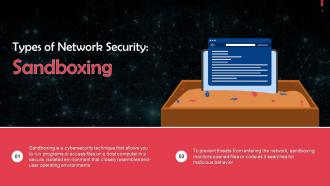
This slide discusses sandboxing as a type of network security. Sandboxing is a cybersecurity technique that allows you to run programs or access files on a host computer in a secure, isolated environment that closely resembles end-user operating environments.
People who downloaded this PowerPoint presentation also viewed the following :
Sandboxing As A Type Of Network Security Training Ppt with all 20 slides:
Use our Sandboxing As A Type Of Network Security Training Ppt to effectively help you save your valuable time. They are readymade to fit into any presentation structure.










FAQs for Sandboxing As A Type Of Network
Sandboxing in software development serves to isolate applications or code segments in controlled environments, preventing them from accessing unauthorized system resources, data, or other applications. This security mechanism enables developers to test potentially harmful code, analyze malware behavior, and validate software functionality while protecting production systems, ultimately delivering enhanced security and risk mitigation across development workflows.
Sandboxing enhances web application security by creating isolated execution environments that contain potentially malicious code, preventing unauthorized access to system resources, and limiting the scope of security breaches. Through containerization and virtual environments, organizations can test suspicious files, execute untrusted scripts, and validate user inputs safely, ultimately delivering robust protection while maintaining seamless user experiences.
Sandboxing significantly prevents malware from affecting host systems by creating isolated environments that contain threats, monitor suspicious activities, and block unauthorized access to system resources. Through virtualized containers and restricted permissions, organizations in banking, healthcare, and enterprise IT successfully neutralize malicious code while maintaining operational efficiency, ultimately delivering enhanced security without compromising system performance.
Common sandboxing use cases in cloud computing include application testing, malware analysis, secure code development, compliance validation, and multi-tenant isolation. These approaches enhance security by containing potential threats, enabling safe experimentation with new applications, and streamlining development workflows, with many cloud providers finding that sandbox environments ultimately deliver faster deployment cycles and reduced operational risks.
Sandboxing creates isolated environments within existing systems to test suspicious code or applications safely, while virtualization creates complete separate operating system instances on shared hardware. Sandboxing focuses on security containment and malware analysis, whereas virtualization emphasizes resource optimization and system consolidation, with many organizations finding that combining both approaches delivers comprehensive security and operational efficiency.
Sandboxing limitations include resource overhead, performance impacts, sophisticated evasion techniques, incomplete isolation, and potential false security confidence. While sandboxes effectively contain many threats, advanced malware increasingly uses anti-sandbox detection, time-delayed execution, and environment-aware behaviors, with many organizations finding that sandboxing works best as part of layered security strategies rather than standalone protection.
Programming languages with memory management vulnerabilities like C, C++, and Rust benefit significantly from sandboxing, alongside interpreted languages such as JavaScript, Python, and Java used in web applications. These languages leverage sandboxing through containerization, virtual machines, and browser isolation to minimize security risks, streamline code testing, and enhance system stability, with many organizations finding improved development workflows and reduced deployment vulnerabilities.
Sandboxing improves software testing by creating isolated environments where developers can safely test new applications without affecting production systems, enabling thorough vulnerability assessments, performance monitoring, and compatibility checks. Through controlled testing environments, organizations streamline quality assurance processes, reduce deployment risks, and accelerate release cycles, with many software companies finding that sandboxed testing ultimately delivers more reliable products and faster time-to-market.
Recommended sandboxing tools include Docker for containerization, VMware for virtualization, Cuckoo Sandbox for malware analysis, Firejail for application isolation, and cloud-based solutions like AWS Lambda. These frameworks enhance security by isolating potentially harmful code, streamlining threat detection, and enabling safe testing environments, with many organizations finding that strategic sandbox implementation significantly reduces security incidents while accelerating development cycles.
Sandboxing supports regulatory compliance by creating isolated testing environments where developers can validate code against regulatory requirements, conduct security assessments, and document compliance processes without affecting production systems. Through controlled sandbox environments, organizations streamline audit preparations, ensure data protection standards, and demonstrate regulatory adherence to authorities, while minimizing compliance risks and accelerating certified software releases.
Developers face challenges including performance overhead from security layers, compatibility issues with legacy systems, complex configuration requirements, debugging difficulties within isolated environments, and resource allocation constraints. These integration hurdles often require significant architectural changes and specialized expertise, though many organizations find that strategic implementation ultimately delivers enhanced security, regulatory compliance, and user trust while minimizing operational risks.
Sandboxing can impact application performance through increased resource overhead, slower execution speeds, and additional latency from security monitoring processes. However, modern sandboxing technologies minimize these effects through optimized isolation techniques and hardware acceleration, with many organizations finding that enhanced security and reduced breach risks outweigh minor performance trade-offs.
Developers can use sandboxing to isolate user permissions by creating restricted execution environments, implementing role-based access controls, containerizing applications, and establishing secure API boundaries. Through these isolation techniques, financial services and healthcare organizations minimize security risks, prevent unauthorized data access, and maintain regulatory compliance, while enabling controlled functionality that enhances user experiences without compromising system integrity.
Containerization enhances sandboxing by creating isolated, lightweight environments that package applications with their dependencies, runtime libraries, and configuration files. These containerized sandboxes enable organizations to test software safely, deploy applications consistently across different environments, and minimize security risks, with many financial services and healthcare institutions finding that containerized sandboxes significantly streamline development workflows while maintaining strict isolation protocols.
AI enhances sandboxing strategies by enabling automated threat detection, predictive analysis, and real-time behavioral monitoring within isolated environments. Machine learning algorithms can identify sophisticated malware patterns, zero-day exploits, and advanced persistent threats more effectively than traditional methods, with financial institutions and healthcare organizations finding that AI-powered sandboxes deliver faster threat assessment and enhanced security resilience.
-
Perfect template with attractive color combination.
-
I really liked their customized design services. I got my desired template made by their expert team. Thank You!