


Sap Analytics Cloud Implementation Process For Sap Analytics Cloud Suite




Try Before you Buy Download Free Sample Product
 Impress Your
 Audience
 100%
100% Editable
 Save Hours
 of Time


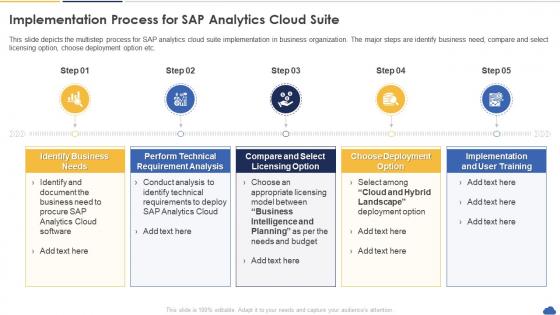
This slide depicts the multistep process for SAP analytics cloud suite implementation in business organization. The major steps are identify business need, compare and select licensing option, choose deployment option etc.
People who downloaded this PowerPoint presentation also viewed the following :
Sap Analytics Cloud Implementation Process For Sap Analytics Cloud Suite with all 6 slides:
Use our Sap Analytics Cloud Implementation Process For Sap Analytics Cloud Suite to effectively help you save your valuable time. They are readymade to fit into any presentation structure.





FAQs for Sap Analytics Cloud Implementation Process For Sap
Key SAP Analytics Cloud implementation components include data integration and connectivity, user provisioning and security setup, dashboard and report development, model configuration, and training programs. These elements work together by establishing secure data flows, creating intuitive analytical interfaces, and building user competency, with many organizations finding that structured implementation phases ultimately deliver faster decision-making capabilities and enhanced operational visibility.
Organizations can assess their SAP Analytics Cloud readiness by evaluating current data infrastructure, existing SAP systems integration capabilities, user skill levels, and governance frameworks. Through comprehensive data quality audits, technical architecture reviews, and stakeholder readiness surveys, companies identify implementation gaps, resource requirements, and training needs, ultimately ensuring smoother deployment and faster user adoption across departments.
Common SAP Analytics Cloud implementation challenges include data integration complexities, user adoption resistance, inadequate change management, insufficient technical expertise, and unclear governance frameworks. These obstacles often stem from legacy system dependencies and organizational silos, with many enterprises finding that strategic planning, comprehensive training programs, and phased rollout approaches significantly streamline deployment while ensuring sustainable user engagement and operational efficiency.
Data connectivity in SAP Analytics Cloud works through native connectors, APIs, and direct database connections that enable real-time and scheduled data imports from various sources. These integration capabilities streamline data flows from ERP systems, cloud platforms, and third-party applications, with many organizations finding that unified data access enhances reporting accuracy and accelerates decision-making processes.
**INPUT**: What best practices should be followed during the preparation phase of the implementation? **OUTPUT**: Best practices include conducting comprehensive data audits, defining clear business objectives, establishing governance frameworks, training key stakeholders, and creating detailed project timelines. These preparation strategies streamline implementation by minimizing data inconsistencies, aligning cross-functional teams, and establishing robust security protocols, with many organizations finding that thorough preparation phases reduce deployment time and ultimately deliver more successful SAP Analytics Cloud adoptions. [Word count: 58 words]
Organizations ensure data quality and governance within SAP Analytics Cloud through comprehensive data validation rules, automated quality checks, role-based access controls, and standardized data modeling practices. These governance frameworks enable consistent reporting across departments, maintain regulatory compliance, and streamline decision-making processes, with many enterprises finding that structured governance ultimately delivers enhanced operational efficiency and competitive advantage.
Stakeholders drive SAP Analytics Cloud implementation by defining requirements, providing domain expertise, validating data models, and ensuring user adoption across departments. Business leaders, IT teams, and end-users collaborate throughout planning, configuration, and testing phases, with many organizations finding that early stakeholder engagement streamlines deployment timelines and enhances system acceptance.
User training during SAP Analytics Cloud deployment is structured through role-based modules, hands-on workshops, progressive skill-building sessions, and ongoing support frameworks. These comprehensive programs enhance user adoption by delivering targeted content for analysts, executives, and IT teams, while providing practical experience with real business scenarios, ultimately ensuring organizations maximize their analytics investment and accelerate time-to-value.
**INPUT**: What methods can be employed to customize SAP Analytics Cloud to meet specific business needs? **OUTPUT**: SAP Analytics Cloud customization methods include custom dashboards, personalized analytics models, tailored data connections, configurable planning workflows, and branded user interfaces. These approaches streamline reporting by integrating specific data sources, automating business processes, and delivering role-based insights, with many organizations finding enhanced decision-making capabilities and operational efficiency.
Organizations can measure SAP Analytics Cloud implementation success through key performance indicators like report generation time reduction, user adoption rates, data accuracy improvements, and decision-making speed enhancements. These metrics enable businesses to track operational efficiency gains, cost savings from streamlined analytics processes, and improved strategic planning capabilities, with many enterprises finding that faster insights delivery ultimately drives competitive advantage and enhanced business outcomes.
SAP Analytics Cloud is exclusively cloud-based, offering rapid deployment, automatic updates, and scalable infrastructure without hardware investments, while on-premise solutions require physical servers, manual maintenance, and significant IT resources. This cloud-first approach enables organizations to streamline analytics operations, reduce total cost of ownership, and accelerate time-to-insight, with many enterprises finding that cloud implementation delivers enhanced flexibility and seamless integration across global operations.
Change management strategies enhance SAP Analytics Cloud implementation by establishing clear communication protocols, providing comprehensive user training, and creating structured adoption frameworks that minimize resistance to new analytics processes. Through strategic stakeholder engagement and phased rollout approaches, organizations streamline user onboarding, accelerate platform adoption, and maximize ROI, with many enterprises finding that proactive change management reduces implementation timelines while delivering superior user experiences.
SAP Analytics Cloud delivers comprehensive analytics capabilities including predictive analytics, real-time reporting, interactive dashboards, data visualization, and collaborative planning tools. These integrated features enable organizations to streamline decision-making processes, automate forecasting workflows, and enhance operational transparency, with many enterprises finding that the platform ultimately delivers faster insights and competitive advantage in increasingly data-driven markets.
Organizations can ensure seamless collaboration in SAP Analytics Cloud through centralized data governance, real-time sharing capabilities, role-based access controls, and integrated commenting systems. These features enable teams to work simultaneously on dashboards and reports, streamline decision-making processes across departments, and maintain data consistency, with many enterprises finding that collaborative analytics ultimately accelerates business insights and strategic alignment.
Organizations should consider AI-driven predictive analytics, real-time streaming data integration, augmented analytics with natural language processing, embedded machine learning capabilities, and advanced data visualization technologies. These trends enable businesses to anticipate market changes, automate decision-making processes, and deliver faster insights, with many enterprises finding that early adoption creates significant competitive advantages in increasingly data-driven markets.
-
The ease of modifying templates is just superb! Also, the vast collection offers plenty of options to choose from.
-
The slides are remarkable with creative designs and interesting information. I am pleased to see how functional and adaptive the design is. Would highly recommend this purchase!