

Sase Model Secure Access Service Edge Sase Architecture




Try Before you Buy Download Free Sample Product
 Impress Your
Audience
 100%
Editable
 Save Hours
of Time


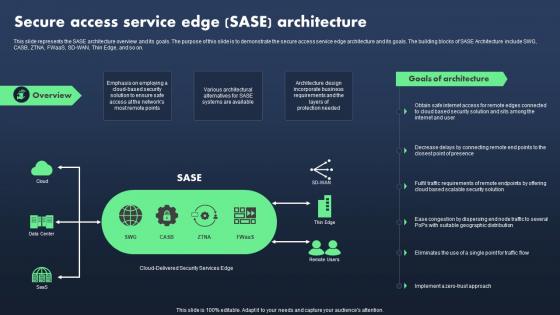
This slide represents the SASE architecture overview and its goals. The purpose of this slide is to demonstrate the secure access service edge architecture and its goals. The building blocks of SASE Architecture include SWG, CASB, ZTNA, FWaaS, SD-WAN, Thin Edge, and so on.
People who downloaded this PowerPoint presentation also viewed the following :
Sase Model Secure Access Service Edge Sase Architecture with all 9 slides:
Use our Sase Model Secure Access Service Edge Sase Architecture to effectively help you save your valuable time. They are readymade to fit into any presentation structure.









FAQs for Sase Model Secure Access Service
SASE architecture comprises SD-WAN, secure web gateways, cloud access security brokers, firewall-as-a-service, and zero-trust network access capabilities. These components streamline network security by converging connectivity and protection into unified cloud services, enabling organizations to secure remote workers, branch offices, and cloud applications while delivering enhanced performance and simplified management.
SASE differs from traditional network security models by consolidating multiple security functions into a cloud-native platform, eliminating the need for separate appliances and point solutions. Unlike legacy perimeter-based approaches, SASE delivers security and networking as a service, enabling organizations to protect distributed workforces and cloud applications more effectively while reducing infrastructure costs and complexity.
Cloud-native platforms serve as the foundational infrastructure for SASE implementation, enabling scalable security services, dynamic resource allocation, seamless integration across distributed environments, and automated policy enforcement. These platforms streamline deployment by delivering consistent security postures, reducing operational complexity, and enhancing network performance, with many organizations finding that cloud-native architectures ultimately accelerate their digital transformation initiatives.
Businesses can assess SASE readiness by evaluating their current network infrastructure, security posture, cloud adoption levels, and remote workforce requirements. Organizations should analyze bandwidth capacity, existing security tools integration capabilities, and IT team expertise, with many enterprises finding that comprehensive network audits and pilot programs help identify gaps while ensuring seamless migration to this converged architecture.
SASE addresses security challenges including unsecured home networks, device vulnerabilities, data exposure risks, inconsistent access controls, and limited visibility across distributed workforces. Through cloud-native security frameworks, organizations streamline threat detection, enforce zero-trust policies, and maintain consistent protection regardless of location, with many enterprises finding significantly enhanced security posture and operational efficiency.
SASE enhances user experience by delivering optimized network paths, reduced latency, and consistent security policies regardless of location or device. Through cloud-native architecture, distributed teams access applications faster, experience seamless connectivity across multiple locations, and benefit from streamlined authentication processes, ultimately enabling organizations to maintain productivity while ensuring secure, reliable performance in increasingly remote work environments.
Identity and access management solutions that integrate seamlessly with SASE include cloud-based IAM platforms, zero-trust identity verification systems, multi-factor authentication services, privileged access management tools, and identity governance solutions. These technologies streamline security by centralizing user authentication, automating access policies, and providing real-time threat detection, with many organizations finding that integrated IAM-SASE frameworks significantly reduce security complexities while enhancing operational efficiency.
SASE adoption typically reduces long-term costs through consolidated vendor management, simplified infrastructure, and reduced hardware requirements, while initial implementation may involve integration expenses and staff training. Organizations increasingly find that operational savings from streamlined network management, enhanced security efficiency, and reduced maintenance overhead significantly outweigh upfront investments, ultimately delivering improved cost predictability and competitive advantage.
Businesses ensure SASE compliance through integrated security policies, continuous monitoring, automated audit trails, and centralized visibility across all network traffic and user activities. These cloud-native architectures streamline regulatory adherence by consolidating security functions, enabling real-time policy enforcement, and delivering comprehensive reporting capabilities, with many financial services and healthcare organizations finding enhanced compliance efficiency.
SASE significantly reduces network latency by routing traffic through optimized cloud-based points of presence and eliminating backhauling to centralized data centers, while intelligent traffic management and caching minimize bandwidth consumption. Through strategic edge computing integration, organizations streamline data flow, enhance application performance, and deliver faster user experiences, with many enterprises finding that distributed SASE architectures ultimately improve operational efficiency and competitive advantage.
SASE convergence streamlines IT operations by eliminating network-security silos, reducing vendor management complexity, and enabling centralized policy enforcement across distributed environments. This unified approach delivers faster deployment cycles, simplified troubleshooting processes, and enhanced visibility, with many enterprises finding that consolidated management reduces operational overhead while accelerating incident response times significantly.
Organizations should evaluate network performance metrics like latency and throughput, security effectiveness through threat detection rates and incident response times, user experience scores, cost optimization measures, and compliance adherence levels. These metrics enable IT teams to assess operational efficiency, security posture, and resource allocation across distributed environments, with many enterprises finding that comprehensive monitoring ultimately delivers enhanced visibility, streamlined management, and measurable competitive advantage.
Service providers differentiate their SASE offerings through specialized security capabilities, integration approaches, global network reach, industry-specific solutions, and performance optimization features. While some focus on advanced threat detection and zero-trust architectures, others emphasize seamless cloud integration and edge computing, with many organizations finding that vendor selection ultimately depends on specific scalability requirements and existing infrastructure compatibility.
Common SASE misconceptions include believing it's just SD-WAN rebranded, that it requires complete network replacement, that it's only for large enterprises, and that implementation is overly complex or expensive. While these concerns are understandable, modern SASE solutions offer scalable deployment options and gradual migration paths, with many mid-sized organizations finding significant cost savings and operational efficiency improvements.
Organizations can effectively train their teams for SASE adoption through comprehensive security awareness programs, hands-on workshops with cloud-native tools, cross-functional collaboration sessions, and continuous learning modules covering network-as-a-service concepts. These training approaches enhance team capabilities by building cloud security expertise, streamlining policy management skills, and fostering adaptive thinking, ultimately delivering faster implementation and stronger security postures across distributed workforces.
-
It saves your time and decrease your efforts in half.
-
Editable, diversified, compatible with MS PPT and Google Slides, and on top of that finest graphics!! I mean in the words of the famous Ross Geller, “What more do you want!”