

Scrum Sprint Retrospective Inspection Matrix With Action Plan




Try Before you Buy Download Free Sample Product
 Impress Your
 Audience
 100%
100% Editable
 Save Hours
 of Time


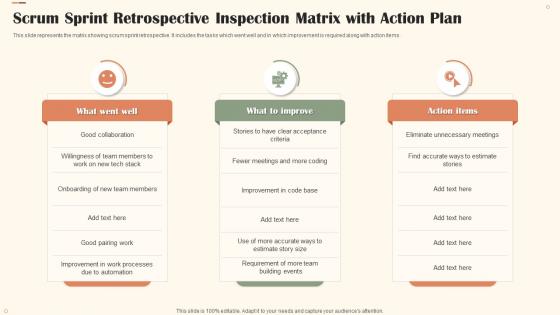
This slide represents the matrix showing scrum sprint retrospective. It includes the tasks which went well and in which improvement is required along with action items.
People who downloaded this PowerPoint presentation also viewed the following :
Scrum Sprint Retrospective Inspection Matrix With Action Plan with all 6 slides:
Use our Scrum Sprint Retrospective Inspection Matrix With Action Plan to effectively help you save your valuable time. They are readymade to fit into any presentation structure.





FAQs for Scrum Sprint Retrospective Inspection Matrix
Scrum retrospective objectives include identifying what worked well, addressing challenges and blockers, improving team collaboration processes, and planning actionable changes for future sprints. These sessions enhance team performance by fostering open communication, streamlining workflows, and building stronger working relationships, with many development teams finding that regular retrospectives ultimately deliver faster delivery cycles and higher product quality.
Teams can effectively prepare for a Scrum retrospective by gathering sprint data, reviewing completed user stories, identifying blockers encountered, and collecting feedback from stakeholders throughout the iteration. This preparation enables more focused discussions, streamlines issue identification, and ultimately delivers actionable insights, with many development teams finding that structured pre-retrospective analysis significantly enhances meeting outcomes and sprint improvements.
Common retrospective pitfalls include blame-focused discussions, surface-level analysis, dominating voices, lack of actionable outcomes, and inconsistent facilitation. Teams often struggle when retrospectives become complaint sessions rather than solution-focused dialogues, with many organizations finding that structured facilitation, time-boxed discussions, and commitment to specific improvements ultimately deliver better team dynamics and enhanced project outcomes.
Facilitators encourage honest feedback by creating psychological safety, using structured activities like Start-Stop-Continue or anonymous voting, and establishing clear ground rules that focus on processes rather than individuals. Effective facilitators actively listen, ask open-ended questions, and demonstrate vulnerability by sharing their own observations, with many teams finding that rotating facilitation roles and celebrating transparency ultimately delivers stronger team cohesion and continuous improvement.
Techniques to enhance retrospective engagement include gamification elements, visual collaboration tools, rotating facilitation, themed formats, and interactive exercises like timeline mapping. These approaches streamline team participation by encouraging diverse perspectives, breaking routine patterns, and creating psychological safety, with many agile teams finding that varied retrospective formats ultimately deliver improved team dynamics and more actionable insights.
Remote teams effectively conduct Scrum retrospectives through digital collaboration tools like Miro or Retrospective.io, structured formats such as Start-Stop-Continue, and clear facilitation protocols. These approaches enable distributed teams to maintain engagement, gather honest feedback, and identify actionable improvements, while many organizations find that virtual retrospectives actually increase participation and transparency.
The Scrum Master facilitates the retrospective by creating a safe environment, guiding structured discussions, ensuring balanced participation, and helping teams identify actionable improvements while remaining neutral and objective. They enable effective collaboration through proven facilitation techniques, conflict resolution, and follow-up accountability, with many teams finding that skilled facilitation ultimately delivers higher engagement, honest feedback, and sustainable process improvements.
Teams measure retrospective impact through sprint velocity tracking, defect reduction rates, cycle time improvements, and team satisfaction surveys. By establishing baseline metrics before implementing changes, teams can quantify progress in areas like story completion rates, bug frequency, and delivery speed, with many organizations finding that consistent measurement drives 20-30% productivity gains over subsequent sprints.
Creative retrospective formats include starfish analysis, timeline mapping, mood boards, sailboat exercises, and speed car workshops. These approaches enhance team engagement by incorporating visual elements, metaphorical thinking, and structured problem-solving techniques, with many agile teams finding that varied formats encourage deeper reflection, improve participation rates, and ultimately deliver more actionable insights for continuous improvement.
Teams ensure feedback leads to actionable outcomes by prioritizing specific, measurable improvements, assigning clear ownership with deadlines, and focusing on 2-3 changes per sprint rather than overwhelming lists. Through structured retrospective formats and follow-up tracking, organizations streamline implementation processes, enhance team accountability, and deliver continuous improvement cycles, with many finding that smaller, focused changes ultimately generate greater long-term productivity gains.
Managing dominant voices requires implementing structured facilitation techniques, rotating speaking opportunities, using silent brainstorming methods like sticky note sessions, and establishing clear time limits for individual contributions. Effective Scrum Masters often employ round-robin discussions, anonymous feedback tools, and smaller breakout groups before full team discussions, ultimately ensuring all team members contribute equally and retrospectives deliver balanced insights for continuous improvement.
Team dynamics significantly influence retrospective success by determining psychological safety, participation levels, communication openness, and willingness to embrace change within the development process. Strong team cohesion enables honest feedback, collaborative problem-solving, and actionable improvement commitments, while dysfunctional dynamics can limit transparency, reduce engagement, and ultimately hinder the team's ability to deliver enhanced performance and competitive advantage.
Action items transform retrospective discussions into tangible improvements by identifying specific, assignable tasks that address team challenges and opportunities. These commitments drive continuous improvement through accountability, measurable progress tracking, and systematic implementation of team insights, with many agile organizations finding that consistent follow-up on retrospective action items significantly enhances team performance, collaboration, and delivery outcomes.
Retrospective adaptation involves adjusting facilitation depth, question complexity, and improvement focus based on team experience and self-organization capabilities. Newer teams benefit from structured formats and concrete action items, while mature teams can handle open discussions and systemic improvements, with many organizations finding that tailored approaches accelerate team development and delivery outcomes.
Digital retrospective tools include Miro, Retrium, FunRetro, Metro Retro, and TeamRetro, which streamline feedback collection, voting, and action tracking. These platforms enhance remote collaboration through real-time editing, anonymous input options, and structured templates, with many distributed teams finding that digital tools deliver better engagement and more actionable outcomes than traditional methods.
-
Loved the collection. Editing the presentation was seamless with their templates.
-
I am not the best at presentations but using SlideTeam’s PPT template made it easier for me. Thank you SlideTeam!