
Sdr playbook powerpoint presentation slides
Try Before you Buy Download Free Sample Product
Audience
Editable
of Time
A playbook serves as a blueprint for your organization as it helps the organization by efficiently guiding them and optimizing the process. Here is a professionally designed SDR Sales Development Representative Playbook that helps you with new SDRs onboarding process. The following playbook is helpful for organizations and Sales Managers intending to help their sales development representative come on board and learn about the organizations sales process. This playbook is divided into four major parts; these parts serve as a step-by-step guide for the organization as they guide your organization by mapping out a blueprint for the organization. The first part includes the introduction, which provides an overview of the SDR playbook. The second part displays the entire process of sales, which highlights the onboarding process, ideal customer profile identification process, client journey, etc. The third part of the playbook displays the essential tools that enable the sales process, these tools are assessed on various metrics. In the end, the best practices for sales are shown along with a case study. Download our 100 percent editable and customizable template.
People who downloaded this PowerPoint presentation also viewed the following :
Content of this Powerpoint Presentation
Slide 1: This slide introduces SDR Playbook. State Your Company Name and begin.
Slide 2: This slide shows Purpose of Sales Development Representative Playbook.
Slide 3: This slide presents Table of Contents for Sales Development Representative Playbook.
Slide 4: This slide highlights title for topics that are to be covered next in the template.
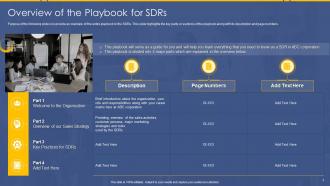
Slide 5: This slide displays overview of the entire playbook to the SDRs.
Slide 6: This slide represents key highlights of the organization such as its headquarter, its historical background etc.
Slide 7: This slide showcases Career Matrix for Employees in the Organization.
Slide 8: This slide shows Sales and Business Development Team Structure.
Slide 9: This slide highlights title for topics that are to be covered next in the template.
Slide 10: This slide presents Onboarding Process and Training Plan for SDRs.
Slide 11: This slide displays major questions that the SDR should ask the prospect in order to determine their budget, objective and requirements.
Slide 12: This slide represents Identifying the Ideal Customer in Sales and Marketing Activity.
Slide 13: This slide showcases Customer Journey a Part of Our Process.
Slide 14: This slide shows Defining the Complete Process of Outreach.
Slide 15: This slide presents key activities that a sales development representative is supposed to perform when they receive a sales request.
Slide 16: This slide displays Call Framework for Sales Development Representative.
Slide 17: This slide represents Defining Parameters with Our SDR Checklist.
Slide 18: This slide highlights title for topics that are to be covered next in the template.
Slide 19: This slide showcases Overview of Our CRM Software that enables marketing managers to track their lead cycle.
Slide 20: This slide shows Other Software that we use to Acquire Customer.
Slide 21: This slide highlights title for topics that are to be covered next in the template.
Slide 22: This slide presents case study that helps the SDRs to understand a realistic sales scenario.
Slide 23: This slide displays KPIs for Business Development Representative.
Slide 24: This slide represents Identify the buyers persona and define their needs and wants.
Slide 25: This slide showcases Icons for Sales Development Representative Playbook.
Slide 26: This slide is titled as Additional Slides for moving forward.
Slide 27: This slide shows Our Product and Services for SDR Playbooks.
Slide 28: This slide presents Our Core Business Competencies.
Slide 29: This slide displays Our Geographical Presence.
Slide 30: This slide is titled as Welcome to ABC Corporation.
Slide 31: This is Our Mission slide with related imagery and text.
Slide 32: This is Our Team slide with names and designation.
Slide 33: This slide presents Roadmap with additional textboxes.
Slide 34: This is a Financial slide. Show your finance related stuff here.
Slide 35: This slide shows Post It Notes. Post your important notes here.
Slide 36: This slide shows SWOT describing- Strength, Weakness, Opportunity, and Threat.
Slide 37: This is a Quotes slide to convey message, beliefs etc.
Slide 38: This slide contains Puzzle with related icons and text.
Slide 39: This slide provides 30 60 90 Days Plan with text boxes.
Slide 40: This is a Thank You slide with address, contact numbers and email address.
Sdr playbook powerpoint presentation slides with all 45 slides:
Use our SDR Playbook Powerpoint Presentation Slides Powerpoint Presentation Slides to effectively help you save your valuable time. They are readymade to fit into any presentation structure.
FAQs for Sdr playbook
Track the basics daily - calls, emails, LinkedIn outreach. Shows they're actually working. Then watch your conversion stuff: response rates, meetings that turn into real opps, qualified leads. Revenue metrics are obvious but take forever to show up, like pipeline and closed deals. Most teams make this way more complicated than it needs to be, honestly. Balance the activity stuff (leading indicators) with the money stuff (lagging). Just make sure everyone knows what "good" actually looks like for each number. Otherwise you're all just guessing.
So basically you gotta tailor everything for each type of buyer. CFOs only care about money and ROI, while tech people want to know how stuff actually works. I learned this the hard way lol. Write different email templates and call scripts that match how each persona thinks. It's kinda like code-switching - you wouldn't pitch your boss the same way you'd pitch a developer, right? Set up separate tracks in your CRM so the right message goes to the right person automatically. Pain points, follow-ups, the whole sequence needs to be different for each role.
Honestly, you've gotta hit them from multiple angles - email, LinkedIn, phone calls, maybe throw in a video message. Do your homework first so that initial outreach actually matters to them. Then stay consistent with follow-ups every 3-4 days for a couple weeks. Here's the thing that trips people up: most reps bail after 2-3 tries, but deals usually happen after the 5th touchpoint or later. Pretty wild, right? Don't just pitch constantly - give them something valuable each time. Build some templates you can tweak quickly while keeping it personal. That's honestly your best shot at breaking through all the noise.
Break down objections into buckets - timing, budget, authority, need. That stuff. Then build response frameworks around each one, but here's the thing: skip the scripts because buyers can smell that BS from a mile away. Train your reps on the core principles instead. Acknowledge what they're saying, dig deeper with questions to find the real problem, then give them something valuable that actually hits their situation. You want objections to spark conversations, not kill them. Oh and update this regularly based on what's working in real calls, not some theory from a sales book.
Start with call scripts and email templates - that's your bread and butter. Objection handling guides are clutch since prospects will hit your team with random stuff constantly. Product training and competitive battle cards help reps know their shit, plus ICP profiles so they're not just spraying and praying. Discovery frameworks like BANT or MEDDIC keep things structured. Role-playing scenarios work great for prepping the tough conversations. Oh, and CRM training - because nothing's worse than deals disappearing into the void. Keep everything searchable and fresh, otherwise it just collects digital dust.
Look, an SDR playbook is basically like having everyone speak the same language. Marketing and sales actually know what they're talking about when they hand stuff off to each other. Your messaging stays consistent, lead qualification makes sense, and nobody's throwing around garbage leads anymore (thank god). Marketing can see what's actually working in real conversations and focus there. Plus when SDRs know exactly what qualifies someone, those weird tension meetings disappear. The key thing though? Build it together from day one. If marketing just throws something over the wall, it'll collect dust. Both teams need to own it or you're wasting time.
Honestly, tech is what makes your SDR playbook actually scalable. Your CRM tracks prospects, email tools handle sequences, dialers manage calls efficiently. Without this stuff you're stuck with spreadsheets and sticky notes - been there, it sucks! The playbook gives you strategy and messaging, but tech handles execution and follow-ups automatically. Integration matters though - you want your data flowing between tools smoothly. I'd start by looking at what you're already using and figuring out the gaps. Oh, and don't go crazy buying every shiny tool out there.
Build out your follow-up sequences with specific timing - don't just improvise after that first email. Most SDRs give up way too early, but the real magic happens between touches 5-12. Your playbook needs templates for emails, calls, and LinkedIn that actually build on each other instead of saying the same thing over and over. Map out 2-3 weeks minimum. Oh, and make sure you know when to switch up your messaging or try different channels. There's gotta be a clear endpoint too - you can't chase dead leads forever when there are better prospects waiting.
Honestly? The worst thing you can do is make it too scripted. Nobody wants to sound like they're reading from a telemarketer handbook. Give your SDRs frameworks instead - stuff they can actually work with. Oh, and don't write it alone in your office. Get your best reps involved because they're the ones who know what actually converts prospects. I've seen too many playbooks created by managers who haven't made a cold call in years. Keep it short too. If it's a 50-page novel, nobody's gonna use it. Break it into sections they can flip to mid-call. And update the damn thing regularly - outdated competitor info makes everyone look stupid.
Honestly, monthly is what I'd go with - quarterly feels too slow these days. Messaging gets stale super quick, and buyers are constantly changing what they respond to. The teams that crush it are always tweaking their approach. Here's what works: set up a monthly check-in to look at your numbers and get feedback from the reps. They'll tell you what's actually working in the field vs what looks good on paper. Small tweaks beat massive rewrites every time - nobody has bandwidth to learn a completely new playbook anyway. If you're testing different approaches, fold those results in right away. Don't sit on good data.
Track both activity and outcome stuff - email open rates, call connections, meetings booked, pipeline generated per rep. Volume metrics matter too (calls made, emails sent). But honestly, don't get caught up in vanity numbers that look impressive but don't actually move deals forward. Focus on what shows real progression through your sales funnel. I'd do weekly check-ins with the team for quick adjustments. Monthly reviews work better for spotting bigger trends and figuring out what's broken vs. what's crushing it.
Honestly, monthly sit-downs with your AEs are a game changer - they'll tell you what messaging actually lands and which objections keep coming up. Track which SDR leads convert best too, that's pure gold. I'd set up a Slack channel where sales can dump real-time insights about weird prospect reactions or whatever shifts they're seeing. Don't just hope feedback happens naturally, make it systematic. Oh, and those quarterly playbook updates based on their input? Worth their weight in gold. The field team knows what's really happening out there better than anyone.
So when your SDR playbook actually matches what the company's trying to accomplish, everything just clicks better. Your reps aren't just randomly hitting numbers - they're doing work that matters. Better leads come in, deals close faster, conversion rates go up. Honestly, the motivation piece is probably the biggest win though. SDRs actually get why their job exists when they see how it connects to bigger goals. You've gotta review your playbook every quarter and tweak the scripts, territories, success metrics - whatever needs updating based on what the business is prioritizing. It's kind of annoying but totally worth it.
Think of a playbook as your new hire's GPS. You're giving them the exact route instead of making them figure it out themselves - which honestly saves everyone's sanity. Document how your best reps handle objections and their go-to scripts. New people cut their learning time in half because they're not stumbling around blind. Your seasoned team stops getting interrupted every five minutes with "wait, what do I do if they say this?" Plus you'll actually know if someone's following process or just winging it. Start simple - just write down what your top performers do differently.
Hit the basics first - prospecting, objection handling, your company's specific talk tracks for different buyer types. Product positioning is huge too. Walk them through the tech stack early because that always confuses people at first. Role-play scenarios work way better than just lecturing at them. I'd add competitive battlecards and spell out exactly what metrics matter. Oh, and grab examples from your best reps - that stuff's gold. Build in actual practice time before they touch real prospects. Nobody learns this just from reading slides.
-
Colors used are bright and distinctive.
-
Very unique and reliable designs.