

Seamless Data Transition Through Cloud Migration CRP CD





Try Before you Buy Download Free Sample Product
 Impress Your
Audience
 100%
Editable
 Save Hours
of Time


Cloud migration is transferring digital assets from on-premises to cloud servers. Check out our professionally designed PPT on Seamless Data Transition Through Cloud Migration. This PPT provides a comprehensive overview of the significance faced by companies while using on-premises data storage. Such as poor data security, high costs, and limited accessibility, with cloud testing as a solution to ensure data scalability and security. It includes an overview of the cloud data migration process, its importance, strategies, market overview, and associated statistics. It also defines the implementation process, including steps such as cloud readiness checks for applications, choosing a cloud environment, and deploying a model. It also includes selecting a cloud service provider, prioritizing applications and migration, cloud testing, monitoring, and reporting. Further, it also provides strategies for application modernization once the post-migration process is completed. Furthermore, it also showcases the impact of transferring data migration from on-premises to cloud platforms and its benefits on company operations. Download it now.
People who downloaded this PowerPoint presentation also viewed the following :
Content of this Powerpoint Presentation
Slide 1: This slide showcase title Seamless Data Transition Through Cloud Migration. State Your Company Name.
Slide 2: This slide showcase title Agenda.
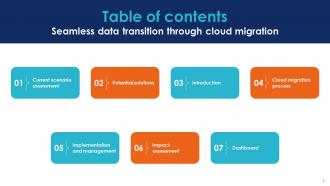
Slide 3: This slide exhibit Table of Content.
Slide 4: This slide exhibit Table of Content: Current scenario assessment
Slide 5: This slide showcases various pain points faced by business with on-premises data storage such as high costs, data security and limited accessibility.
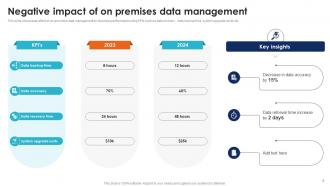
Slide 6: This slide showcases effect of on-premises data management on business performance using KPIs such as data recovery , data backup time, system upgrade costs etc.
Slide 7: This slide exhibit Table of Content: Data storage solutions
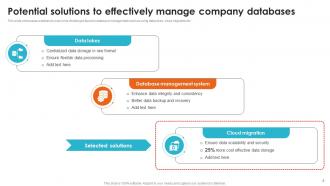
Slide 8: This slide showcases solutions to overcome challenges faced in database management such as using data lakes, cloud migration etc.
Slide 9: This slide showcases comparative assessment between on premises and cloud storage based on cost, resources, data security, flexibility etc.,
Slide 10: This slide exhibit Table of Content: Introduction
Slide 11: This slide provides introduction to cloud migration which also includes elements such as data security, data recovery, applications, IT resources etc.
Slide 12: This slide showcases key benefits of using cloud services for data migration such as cost saving, improved performance and digital experience.
Slide 13: This slide showcases types of cloud migration strategies used by business such as retire, retain, rehost, re platform, repurchase and refactor.
Slide 14: This slide showcases overview of. Global cloud migration services market which includes growth drivers and market market players.
Slide 15: This slide showcases stats related to cloud data migration which includes cloud services, IT businesses, hybrid cloud, cloud based infrastructure etc.
Slide 16: This slide showcases trends shaping cloud migration services market such as hybrid cloud adoption, cloud native technologies, AI and automation.
Slide 17: This slide exhibit Table of Content: Cloud migration process
Slide 18: This slide showcases cloud migration process execution roadmap which includes planning, infrastructure and implementation phases.
Slide 19: This slide showcases cloud migration process which includes cloud readiness check, choose cloud environment, deployment model and service provider.
Slide 20: This slide showcases cloud migration process which includes prioritize applications, migration, cloud testing, monitoring and reporting.
Slide 21: This slide exhibit Table of Content: Cloud readiness assessment
Slide 22: This slide showcases business objectives for cloud migration such as scalability, cost saving, disaster recovery and data security.
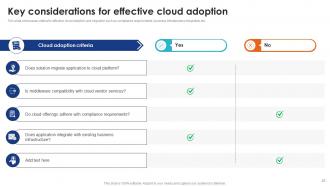
Slide 23: This slide showcases criteria for effective cloud adoption and migration such as compliance requirements, business infrastructure integration etc.
Slide 24: This slide showcases evaluation of in house resources, expertise to check business readiness for cloud migration based on technical, networking skills etc.
Slide 25: This slide showcases assessment of existing IT infrastructure which includes hardware, software, network and storage hubs, web servers, routers, database servers etc.
Slide 26: This slide showcases estimation of cost incurred during cloud migration process based on infrastructure cost, data transfer fees, training expenses etc.
Slide 27: This slide exhibit Table of Content: Choose cloud environment
Slide 28: This slide showcases various types of cloud environments adopted by business for cloud migration such as public, private and hybrid clouds.
Slide 29: This slide showcases selection of profitable cloud environment based on criteria such as ease of set up, data security control and cost effectiveness.
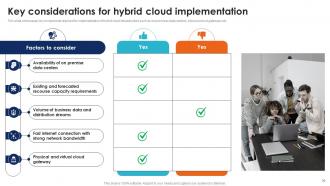
Slide 30: This slide showcases key components required for implementation of hybrid cloud infrastructure such as on premises data centers, physical cloud gateways etc.
Slide 31: This slide exhibit Table of Content: Determine cloud deployment model
Slide 32: This slide showcases cloud deployment models such as infrastructure, software, platform as a service with various service offered, advantage and disadvantages.
Slide 33: This slide showcases selection of most profitable cloud platform based on criteria service model, access control, users, cloud providers etc.
Slide 34: This slide showcases key features of SaaS cloud deployment platform such as multi tenant architecture, application security and single sign-on.
Slide 35: This slide exhibit Table of Content: Choose cloud service provider
Slide 36: This slide showcases major cloud service providers worldwide such as amazon, Microsoft azure, google cloud platform and oracle cloud.
Slide 37: This slide showcases checklist for evaluating and selecting suitable cloud service provider based on business health, costing, security requirements etc.
Slide 38: This slide showcases various computing services offered of Microsoft azure, Amazon web services, google cloud platform with key benefits.
Slide 39: This slide shows comparison between various cloud service providers based on availability, services, operating system, pricing and computing engine used.
Slide 40: This slide exhibit Table of Content: Prioritize and migrate applications
Slide 41: This slide showcases factors to consider while prioritizing application for cloud migration which includes complexities, critically and compliance.
Slide 42: This slide showcases priority matrix for application and database migration based on critically, readiness factors.
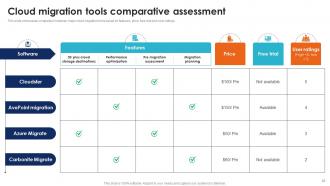
Slide 43: This slide showcases comparison between major cloud migration tools based on features, price, free trial and user ratings.
Slide 44: This slide showcases database and application migration status which includes original source, target source, migration strategy used and status.
Slide 45: This slide exhibit Table of Content: Cloud migration testing.
Slide 46: This slide showcases various cloud migration testing models used to analyze application performance such as system, security, recovery testing.
Slide 47: This slide showcases application quality assurance testing checklist which includes functional, integration, performance and security testing strategies.
Slide 48: This slide showcases tips which can used by business for application testing such as monitoring, automated testing and backup planning.
Slide 49: This slide exhibit Table of Content: Monitoring and reporting.
Slide 50: This slide showcases application performance monitoring post migrating to cloud platform based on KPIs such as response time, latency, error rate etc.
Slide 51: This slide showcases progress status report for cloud migration process based on testing, data security, incident management, application readiness etc.
Slide 52: This slide exhibit Table of Content: Application optimization.
Slide 53: This slide showcases various migration methods used for successful application upgradation such as rehost, refactor, rearchitecture and rebuild.
Slide 54: This slide showcases key phases for application modernization in cloud which includes elements such as database, process modernization, DevOps, PaaS etc.
Slide 55: This slide exhibit Table of Content: Cloud migration challenges.
Slide 56: This slide showcases challenges faced in cloud migration process such as skill gap, uncertain cost data security with solutions to overcome these barriers.
Slide 57: This slide showcases various tips which can be used for cloud migration success such as prioritize application, dependency mapping and create security measures.
Slide 58: This slide exhibit Table of Content: Impact assessment
Slide 59: This slide showcases key benefits of cloud migration such as reduced data backup, recovery time, system upgrade cost and increased data accuracy.
Slide 60: This slide showcases benefits of adopting cloud infrastructure in business such as increase in scalability, business revenue, workflow efficiency etc.
Slide 61: This slide exhibit Table of Content: Dashboards
Slide 62: This slide showcases dashboard to track application migration process to cloud platform using KPIs such as scheduled migrations, sources, project duration etc.
Slide 63: This slide showcases dashboards for monitoring cloud network performance based on KPI.
Slide 64: This slide shows all the icons included in the presentation.
Slide 65: This slide is titled as Additional Slides for moving forward.
Slide 66: This slide provides 30 60 90 Days Plan with text boxes.
Slide 67: This slide shows SWOT analysis describing- Strength, Weakness, Opportunity, and Threat.
Slide 68: This slide depicts Venn diagram with text boxes.
Slide 69: This is a Timeline slide. Show data related to time intervals here.
Slide 70: This is a Thank You slide with address, contact numbers and email address.
Seamless Data Transition Through Cloud Migration CRP CD with all 78 slides:
Use our Seamless Data Transition Through Cloud Migration CRP CD to effectively help you save your valuable time. They are readymade to fit into any presentation structure.
























FAQs for Seamless Data Transition Through Cloud
Key factors driving cloud migration include cost reduction, scalability demands, operational efficiency needs, enhanced security requirements, and competitive advantage pursuits. Organizations across industries find that migrating enables faster deployment cycles, reduces infrastructure overhead, and delivers improved disaster recovery capabilities, while ultimately positioning them for digital transformation in an increasingly cloud-first business environment.
Businesses can determine the right cloud model by evaluating their technical expertise, control requirements, development needs, and operational preferences alongside budget constraints. Organizations with strong IT teams often choose IaaS for flexibility, while those seeking streamlined development prefer PaaS, and companies wanting ready-to-use solutions select SaaS, ultimately delivering operational efficiency and strategic resource allocation.
Companies face challenges including legacy system compatibility issues, data security concerns, staff training requirements, cost management complexities, and minimizing downtime during transitions. While these obstacles can seem daunting, many organizations find that strategic planning and phased approaches ultimately deliver enhanced operational efficiency, improved scalability, and significant competitive advantages in today's increasingly digital landscape.
Organizations ensure data security and compliance during cloud migration through encryption protocols, access controls, compliance audits, data classification systems, and secure transfer methods. Financial institutions and healthcare providers increasingly implement multi-layered security frameworks, automated compliance monitoring, and phased migration approaches, ultimately delivering enhanced data protection while meeting regulatory requirements across industries.
Cloud migration assessment tools evaluate existing infrastructure, applications, and workloads to determine cloud readiness, migration complexity, and potential cost savings. These tools streamline the migration process by identifying dependencies, security requirements, and performance benchmarks, while providing detailed migration roadmaps and risk assessments, ultimately enabling organizations to minimize downtime and optimize cloud investments strategically.
Businesses calculate cloud migration ROI by comparing total migration costs against long-term savings from reduced infrastructure expenses, operational efficiency gains, and enhanced scalability benefits. Through detailed cost-benefit analysis, organizations measure factors like decreased hardware spending, lower maintenance costs, and improved productivity metrics, with many enterprises finding ROI realization within 12-18 months of migration completion.
Cloud migration best practices to minimize downtime include thorough pre-migration planning, phased rollout strategies, comprehensive testing environments, real-time monitoring systems, and robust rollback procedures. These approaches enable organizations to maintain operational continuity by reducing risks, identifying issues early, and ensuring seamless transitions, with many enterprises finding that strategic planning ultimately delivers faster deployments and enhanced customer experiences.
Companies address legacy system compatibility through phased migration strategies, API integration layers, hybrid cloud architectures, containerization technologies, and middleware solutions. These approaches enable organizations to gradually modernize systems while maintaining operational continuity, with many enterprises finding that strategic combinations of lift-and-shift and refactoring deliver enhanced scalability and reduced infrastructure costs.
Cloud cost optimization strategies include rightsizing resources, implementing automated scaling, leveraging reserved instances, monitoring usage patterns, and establishing governance policies. These approaches streamline expenses by eliminating waste, matching capacity to demand, and securing volume discounts, with many organizations finding that strategic cost management delivers 20-30% savings while maintaining performance and scalability.
Lift-and-shift migration involves moving existing applications directly to the cloud with minimal changes, while cloud-native transformation redesigns applications using microservices, containers, and serverless architectures. While lift-and-shift delivers faster migration timelines and immediate cost savings, cloud-native approaches unlock greater scalability, resilience, and operational efficiency for long-term competitive advantage.
Organizations leverage cloud-native technologies by decomposing monolithic applications into microservices, implementing containerization through Docker and Kubernetes, and adopting DevOps practices for continuous integration. These approaches enable independent scaling, faster deployment cycles, and improved fault tolerance, with companies like Netflix and Amazon finding enhanced agility and operational efficiency.
Businesses should evaluate contract flexibility, data portability standards, API compatibility, multi-cloud integration capabilities, and exit clause terms when selecting cloud providers. While established providers like AWS and Azure offer comprehensive services, organizations increasingly adopt hybrid or multi-cloud strategies to maintain negotiating power and operational flexibility, ultimately reducing dependency risks while preserving competitive advantages.
Training and change management facilitate smoother cloud adoption by addressing skill gaps, reducing resistance, and establishing clear communication channels throughout the transition process. These strategic approaches enable organizations to accelerate user adoption, minimize operational disruptions, and maximize ROI on cloud investments, with many enterprises finding that comprehensive change management reduces migration timelines significantly.
Organizations should monitor performance metrics like application response times and system uptime, cost metrics including operational expenses and resource utilization, security indicators such as compliance scores and incident rates, and user satisfaction measurements. These comprehensive metrics enable businesses to assess operational efficiency, cost optimization, and service quality improvements, with many enterprises finding that regular monitoring across these areas ensures successful migration outcomes and maximizes their competitive advantage in cloud environments.
Businesses can ensure effective collaboration during cloud migration by establishing cross-functional teams, implementing unified communication platforms, creating shared documentation repositories, and conducting regular progress meetings. Through project management tools and standardized workflows, organizations streamline coordination between IT, security, and business teams, while maintaining clear timelines and responsibilities, ultimately delivering smoother transitions and faster implementation outcomes.
-
SlideTeam is my one-stop solution for all the presentation needs. Their templates have beautiful designs that are worth every penny!
-
Unique design & color.