

Secondary Activities Of Zara Value Chain Analysis Human Resource Management




Try Before you Buy Download Free Sample Product
 Impress Your
 Audience
 100%
100% Editable
 Save Hours
 of Time


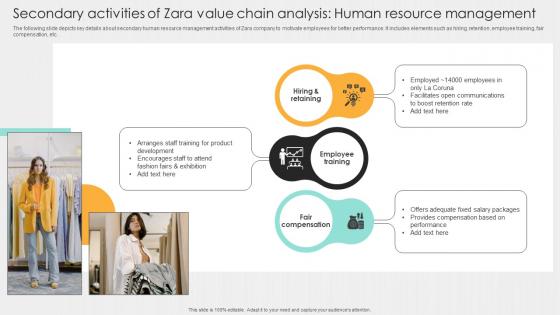
The following slide depicts key details about secondary human resource management activities of Zara company to motivate employees for better performance. It includes elements such as hiring, retention, employee training, fair compensation, etc.
People who downloaded this PowerPoint presentation also viewed the following :
Secondary Activities Of Zara Value Chain Analysis Human Resource Management with all 9 slides:
Use our Secondary Activities Of Zara Value Chain Analysis Human Resource Management to effectively help you save your valuable time. They are readymade to fit into any presentation structure.








FAQs for Secondary Activities Of Zara Value Chain Analysis
Human resource management drives organizational success through talent acquisition, employee development, performance management, compensation planning, and workplace culture enhancement. These strategic functions streamline operations by aligning workforce capabilities with business objectives, reducing turnover costs, and fostering innovation, with many organizations finding that effective HR practices ultimately deliver competitive advantage and sustainable growth.
HR practices drive employee engagement and retention through comprehensive onboarding, continuous professional development, transparent communication channels, competitive compensation packages, and flexible work arrangements. These strategic approaches enhance workplace satisfaction by fostering growth opportunities, recognizing achievements, and creating inclusive environments, with many organizations finding that engaged employees deliver higher productivity, reduced turnover costs, and stronger competitive advantage.
Essential components include targeted job descriptions, diverse sourcing channels, structured interview processes, candidate experience optimization, and data-driven selection criteria. These elements work together by attracting qualified talent, streamlining evaluation processes, and enhancing employer branding, with many organizations finding that strategic recruitment ultimately delivers faster hiring cycles, improved retention rates, and stronger competitive advantage in talent acquisition.
Performance management systems significantly enhance workplace productivity by establishing clear expectations, providing regular feedback, identifying skill gaps, and aligning individual goals with organizational objectives. Through structured evaluations and development planning, organizations streamline employee performance, reduce inefficiencies, and accelerate professional growth, with many companies finding that systematic performance tracking ultimately delivers higher engagement levels and measurable productivity improvements.
Technology revolutionizes modern HR management through AI-powered recruiting, cloud-based HRIS systems, automated payroll processing, digital performance management platforms, and employee self-service portals. These solutions streamline administrative tasks, enhance data-driven decision making, and improve employee experiences, with many organizations finding that strategic HR technology adoption delivers operational efficiency, reduced costs, and competitive talent advantages.
HR professionals foster diversity and inclusion through comprehensive recruitment strategies, bias training programs, inclusive policy development, employee resource groups, and equitable advancement opportunities. These approaches streamline organizational culture by eliminating systemic barriers, enhancing cross-cultural collaboration, and creating psychological safety, with many organizations finding that inclusive environments ultimately deliver higher employee engagement, improved innovation, and stronger competitive advantage.
HR managers in remote work settings face challenges including maintaining employee engagement, ensuring effective communication across distributed teams, managing performance without direct supervision, preserving company culture, and addressing technology gaps. These obstacles require strategic solutions like virtual team-building initiatives, digital collaboration platforms, and outcome-based performance metrics, with many organizations finding that proactive communication and flexible policies ultimately enhance employee satisfaction and retention.
Employee training and development contributes to organizational growth by enhancing workforce skills, improving productivity, and reducing turnover costs. Through strategic learning programs, companies streamline operations, accelerate innovation, and build competitive advantages, with many organizations finding that well-trained employees deliver superior customer experiences and drive revenue growth.
HR can implement talent succession planning through comprehensive talent mapping, cross-functional mentoring programs, leadership development initiatives, strategic skills gap analysis, and succession matrix creation. These approaches enable organizations to identify high-potential employees, accelerate career development pathways, and ensure seamless leadership transitions, with many companies finding that proactive succession planning reduces recruitment costs while maintaining operational continuity.
HR metrics and analytics enhance decision-making by providing data-driven insights into workforce performance, employee engagement, turnover patterns, and recruitment effectiveness. These tools enable organizations to identify talent gaps, predict retention risks, and optimize compensation strategies, with many companies finding that analytics-driven HR decisions reduce costs by 25% while improving employee satisfaction and strategic workforce planning.
Workplace culture significantly influences employee engagement, retention, and productivity by shaping organizational values, communication patterns, and behavioral expectations. A strong culture enables HR to attract top talent, reduce turnover costs, and enhance performance management, with companies like Google and Zappos finding that cultural alignment delivers competitive advantage and sustainable business growth.
HR can address workplace conflicts effectively through early intervention protocols, structured mediation processes, clear communication frameworks, and comprehensive conflict resolution training. These approaches enable organizations to transform workplace tensions into collaborative solutions, with many companies finding that proactive conflict management enhances team productivity, reduces employee turnover, and ultimately delivers stronger organizational culture and improved business outcomes.
Key trends shaping HR's future include AI-powered recruitment, remote work optimization, employee experience platforms, data-driven performance analytics, and personalized learning systems. These innovations streamline talent acquisition, enhance workforce flexibility, and deliver strategic insights, with many organizations finding that integrated HR technologies ultimately reduce costs while improving employee satisfaction and competitive advantage.
Labor laws and regulations significantly shape HR practices by establishing frameworks for hiring, compensation, workplace safety, employee rights, and termination procedures. These regulations require HR departments to maintain compliance documentation, implement standardized policies, and adapt recruitment strategies, while ensuring fair treatment across all employee interactions, ultimately protecting both organizations from legal risks and employees from workplace discrimination or unsafe conditions.
Best practices for conducting employee performance reviews include setting clear expectations, providing regular feedback, using objective metrics, preparing thoroughly, and creating a two-way dialogue. These approaches enhance performance management by fostering transparency, improving communication, and identifying development opportunities, with many organizations finding that structured reviews ultimately deliver better employee engagement and strategic talent development.
-
“Excellent information with easy access.”
-
Content of slide is easy to understand and edit.